


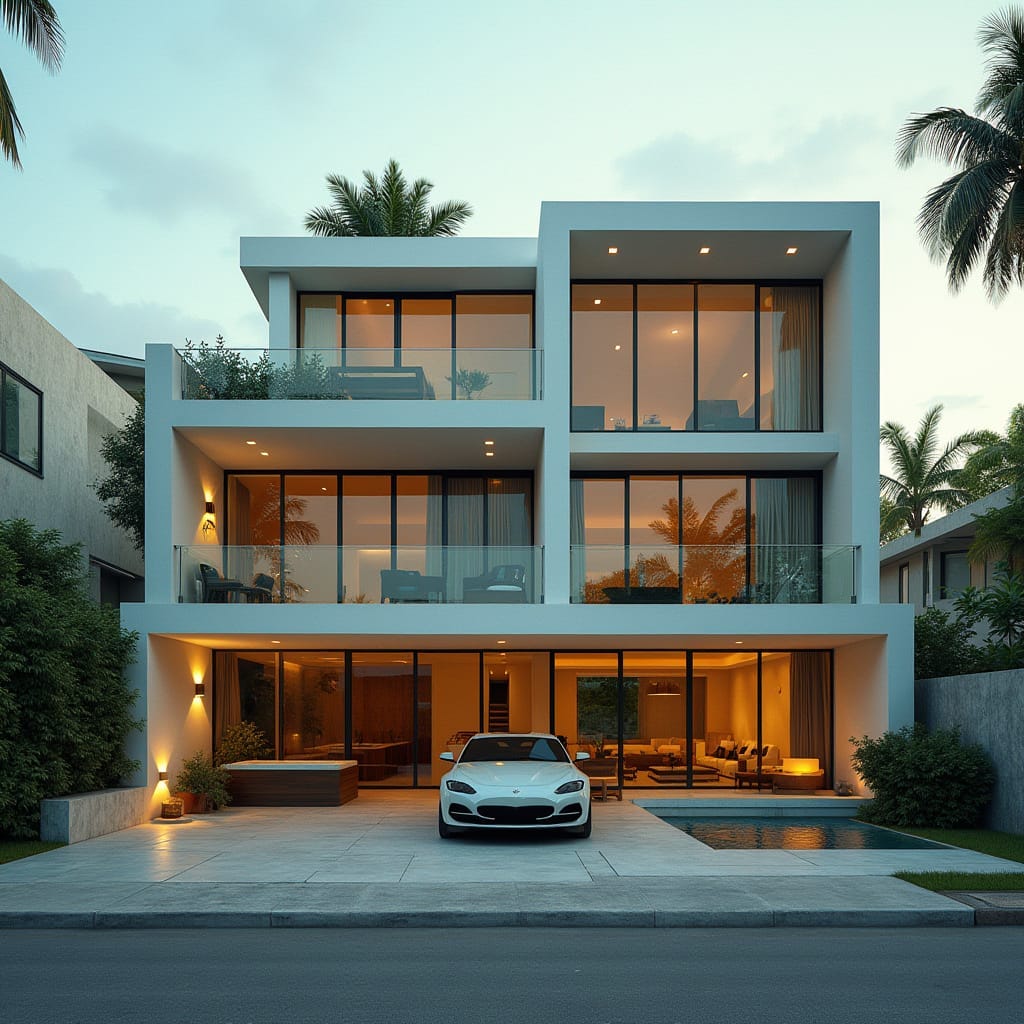
At first glance, the house appears deceptively simple.
A composition of crisp white volumes stacked beneath a tropical sky, framed by palms and softened by the warm glow of evening light. There are no grand columns, no decorative flourishes, and no attempt to overwhelm the viewer with excess. Yet it is precisely this restraint that gives the architecture its strength.
In an era when luxury homes often compete for attention through size and spectacle, this residence takes a different approach. It relies on proportion, light, transparency and careful detailing. The result is a home that feels confident rather than conspicuous.
The architecture is rooted firmly within the language of contemporary tropical modernism. Clean horizontal planes stretch across the façade, creating a sense of balance and order. Deep overhangs project outward, providing shade while visually anchoring each level. These are not simply aesthetic gestures. In a climate such as Jamaica’s, they represent intelligent responses to heat, sunlight and seasonal weather patterns.
What immediately captures the eye is the extensive use of glass. Floor-to-ceiling glazing dominates each level, creating a powerful connection between interior and exterior spaces. During the day, these openings would flood the home with natural light and invite views of the surrounding landscape deep into the living spaces. By night, the effect is reversed. The house becomes a softly illuminated lantern, revealing glimpses of activity within while maintaining an atmosphere of privacy and calm.
The building is organised across three levels, yet its considerable size is carefully moderated through the layering of volumes. Recessed terraces, balconies and setbacks prevent the structure from feeling imposing. Instead, the mass of the building is broken into smaller components, creating a scale that remains welcoming despite its obvious luxury.
This approach reflects one of the central challenges in residential architecture. Large houses can often feel cold, disconnected and oversized. Here, however, the architect has worked hard to preserve a sense of intimacy. Every balcony feels purposeful. Every opening appears considered. Nothing seems arbitrary.
The material palette is equally disciplined. White rendered surfaces dominate the exterior, providing a timeless backdrop against which the surrounding vegetation becomes part of the architectural composition. The decision is practical as well as visual. Light-coloured finishes reflect rather than absorb heat, making them particularly well suited to tropical environments.
Perhaps the most successful aspect of the design is the way it embraces the Caribbean lifestyle. This is not a house designed merely to be admired from the street. It is a house intended to be lived in.
Large sliding doors dissolve the boundary between inside and outside. Living areas flow naturally towards terraces and entertainment spaces. The outdoor spa area reinforces the resort-like atmosphere, creating the impression that everyday life here would feel remarkably close to a luxury retreat.
This relationship between architecture and lifestyle is becoming increasingly important across the Caribbean. As buyers become more globally connected, expectations are changing. Homeowners increasingly seek residences that combine international design standards with solutions tailored to local conditions. The most successful projects are not those that imitate Miami, Dubai or Los Angeles, but those that understand the realities of Caribbean living.
This house appears to understand that distinction.
There is a growing maturity within contemporary Caribbean architecture. Designers are moving beyond imported styles and beginning to create homes that respond more directly to climate, landscape and culture. This residence reflects that evolution. While its design language is international, its priorities are unmistakably tropical.
The lighting strategy deserves particular recognition. Rather than overwhelming the architecture, the carefully positioned lighting emphasises depth, texture and proportion. Warm illumination spills through the glazing, highlighting the home’s strongest features while creating an inviting atmosphere that extends beyond the walls themselves.
What makes the house memorable is not innovation alone. Modern architecture is filled with dramatic forms and experimental ideas. Instead, its appeal lies in the discipline of its execution. The architect has resisted the temptation to overcomplicate the design. Every line appears deliberate. Every volume feels resolved.
Standing before the residence, one is reminded that good architecture often has less to do with what is added than what is left out.
The house demonstrates an understanding that luxury is not necessarily defined by extravagance. Sometimes it is found in generous natural light, thoughtful proportions, seamless indoor-outdoor connections and the confidence to allow simplicity to speak for itself.
As contemporary Caribbean architecture continues to evolve, homes such as this provide an encouraging glimpse of what the future may hold. They suggest a direction that is modern without being fashionable, sophisticated without being ostentatious, and ambitious without losing sight of the environment in which they sit.
That balance is not easy to achieve.
Here, it appears to have been achieved remarkably well.
“The finest architecture does not compete with its surroundings. It frames them, elevates them and quietly becomes part of their story.” — Dean Jones