

A Port Meant to Move a Nation Is Struggling to Move Its People
Delays, rising costs and outdated rules at Kingston’s main port are testing businesses, returnees and confidence in the system


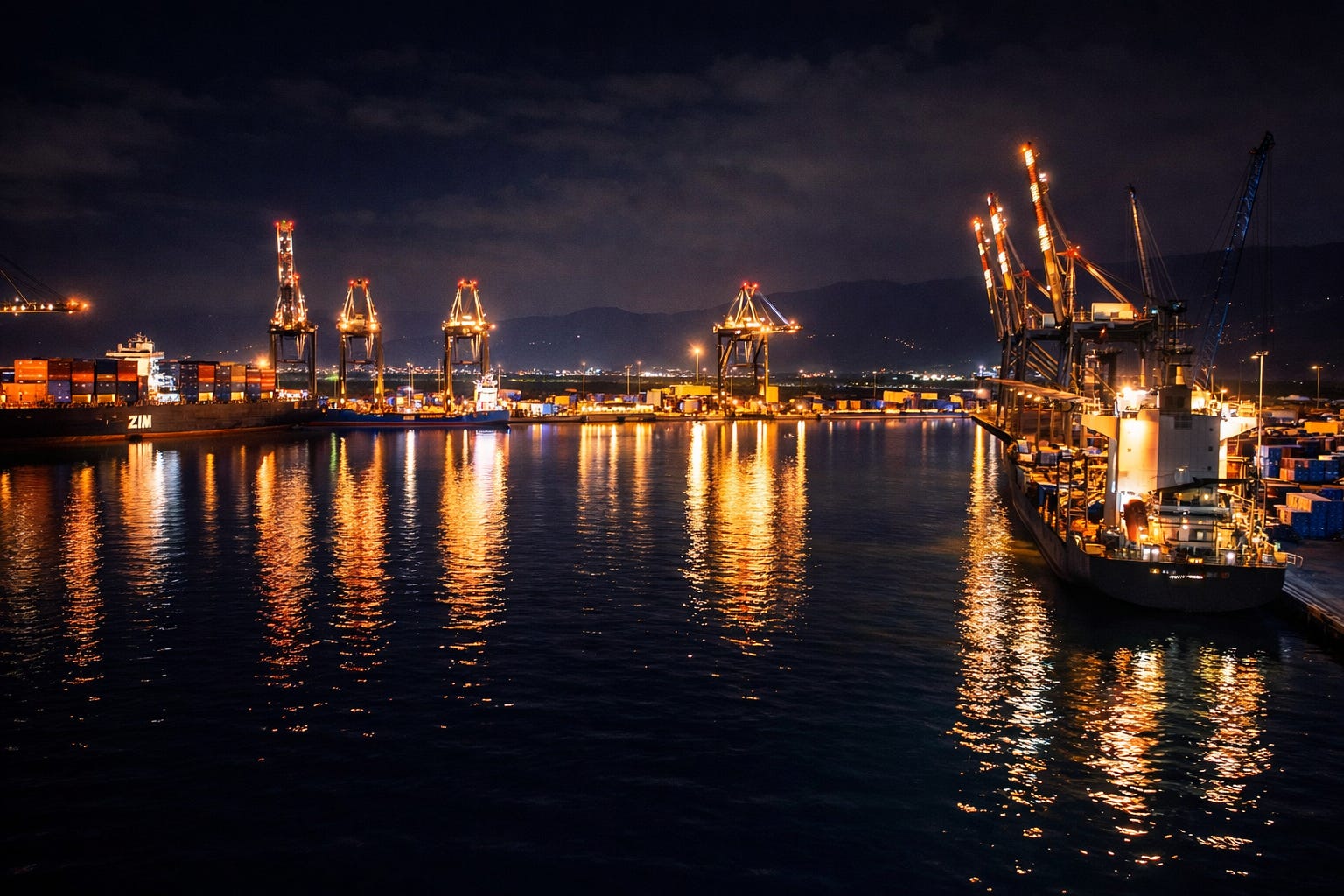
A “man-made logistics crisis” is unfolding at Kingston’s port.
Congestion is driving up costs for businesses and returning residents.
Containers are sitting for weeks — in some cases, months.
Daily storage and demurrage fees are compounding rapidly.
Returnees face complex and often outdated clearance requirements.
Modern working realities are clashing with older verification systems.
Long-standing seasonal bottlenecks remain unresolved.
The strain is exposing deeper weaknesses in Jamaica’s logistics framework.
There is a particular kind of friction that reveals itself not in noise, but in repetition.
A form requested, then requested again.
A shipment landed, then left untouched.
A process designed for movement, slowly hardening into resistance.
At the centre of it all sits the Port of Kingston, a place built for flow, of goods, of commerce, of life between islands and continents, now described by members of the People’s National Party as the site of a “man-made logistics crisis.”
The phrase is striking, but what it captures is something deeper than disruption. It suggests a system not simply overwhelmed, but out of step.
A bottleneck years in the making
Congestion at the port is not new. It arrives predictably, like the seasons, swelling around the Christmas period and receding just enough to be tolerated.
What has changed is the scale, and the consequences.
Following Hurricane Melissa, a surge of relief shipments collided with the usual seasonal peak. Containers accumulated faster than they could be cleared. Warehouses filled. Processing slowed.
“The system didn’t break overnight,” said Dean Jones, founder of Jamaica Homes. “It’s been under pressure for years. What we’re seeing now is what happens when you don’t adjust a system before the pressure arrives.”
Industry groups have cited uncollected cargo and documentation issues. But those explanations, while valid, do not fully account for the lived experience now emerging.
When delay becomes cost
At the port, time is not passive. It is priced.
Demurrage and storage fees begin as standard mechanisms to encourage efficiency. But in a congested system, they take on a different meaning.
Containers that cannot be cleared, not for lack of effort, but because of systemic delay, begin to accumulate daily charges. Over weeks, those costs can escalate sharply.
“What people are facing isn’t just delay,” Jones said. “It’s delay with a meter running. And that meter doesn’t care whether the delay was your fault or not.”
For small businesses and returning residents, the result can be severe. Goods intended for rebuilding, for resettlement, for starting again, become more expensive simply by remaining still.
“It becomes a private penalty for a public problem,” he added.
The returnee reality
Among the most affected are returning residents, individuals who have made the decision to leave established lives abroad and begin again in Jamaica.
For many, that decision includes shipping entire households across oceans.
Feedback gathered through Jamaica Homes points to a pattern of increasingly complex requirements tied to clearing those shipments.
Bank statements are requested, then supplemented. Proof of income is required. In some cases, individuals report being asked to demonstrate local employment or business activity within Jamaica.
“We’ve had people who sold their homes in the UK or the US, liquidated everything to come here,” Jones said. “And then they’re being asked to prove they’re ‘really here’ through structures that don’t reflect how people actually live anymore.”
In an era of remote work and hybrid income, traditional definitions of employment no longer hold neatly.
“People are working across countries now,” he said. “You can be fully legitimate, fully employed, and still not fit into a box that was designed 30 years ago.”
A framework from another era
The tension between modern life and older systems is perhaps most visible in the documentation itself.
The official list governing household effects for returning residents, detailing what can be imported and in what quantity, reads with a precision that reflects another time.
Televisions are capped. Appliances tightly defined. Quantities fixed in a way that does not always align with contemporary households.
“It’s like looking at a snapshot of how people lived decades ago,” Jones said. “The problem is, people don’t live like that anymore.”
In today’s homes, multiple screens, devices and hybrid living spaces are standard. What was once considered excess is now ordinary.
“When policy doesn’t evolve with reality, it doesn’t stop reality,” he added. “It just creates friction.”
The unseen risks
Beyond cost and compliance lies a more fragile concern: trust.
Accounts from stakeholders include reports of containers being opened and unpacked at the port, with goods left exposed for periods of time before collection.
For individuals shipping decades of personal belongings, the experience can be unsettling.
“You’re not shipping boxes,” Jones said. “You’re shipping your life. And once that container is opened, you’re relying entirely on a system you can’t see.”
Some have raised concerns about missing items upon collection. Others describe the difficulty of verifying contents after long delays.
These accounts are difficult to independently confirm in individual cases. But their consistency across multiple voices points to a shared unease.
“There’s a difference between delay and uncertainty,” he said. “Delay you can plan for. Uncertainty, you can’t.”
The conversations people are having
Alongside these concerns are persistent, unverified claims of informal payments being requested to facilitate faster processing.
No formal findings substantiate such allegations. Yet they continue to circulate widely.
As a matter of reporting standards, such claims remain unproven. But their prevalence reflects a deeper issue — perception.
“When hundreds of people are saying similar things, you don’t ignore it,” Jones said. “You don’t jump to conclusions either. But you ask why people feel that way.”
In systems where processes are opaque, perception can quickly become reality in the public mind.
A system under pressure
What is unfolding at Kingston is not the result of a single failure, but of convergence.
A port operating near capacity.
A surge in post-disaster imports.
Seasonal demand layered on top of structural limits.
Administrative processes that have not fully adapted to modern patterns of work and life.
Each factor is manageable in isolation. Together, they strain the system.
“This isn’t just about logistics,” Jones said. “It’s about alignment. The world has changed, but parts of the system haven’t changed with it.”
The question of responsibility
At the centre of the debate is a simple question: who should bear the cost of systemic delay?
In practice, that burden has often fallen on individuals.
Small businesses. Returning residents. Families trying to rebuild.
Opposition figures argue that this reflects a failure of planning and coordination, particularly in the context of known seasonal congestion and post-disaster demand.
They contend that systems should protect, not penalise, those already navigating difficult transitions.
“There’s a human side to this that gets lost in the process,” Jones said. “Behind every container is a story, someone starting over, someone rebuilding, someone trying to make Jamaica home again.”
A moment for attention
Ports are rarely the focus of public attention when they function well.
They become visible only when something slows, when something stops, when the system reveals itself.
What is emerging at Kingston is not simply a story of congestion, but of calibration, of whether the systems that govern movement are keeping pace with the people they serve.
“This is fixable,” Jones said. “But first, it has to be acknowledged properly. Not just as congestion, not just as seasonal pressure, but as something that needs real attention.”
The cost of standing still
The cranes still move. Ships still arrive. Containers still stack.
But beneath that movement lies a quieter reality.
A system designed for flow, asking people to wait.
A process built for certainty, producing doubt.
A gateway meant to welcome, becoming a point of friction.
And in that gap, between intention and experience — lies the true cost of standing still.