

After the “Perfect Storm,” What Comes Next?
Jamaica is still rebuilding. A third hurricane, against a backdrop of global tension, would not arrive alone.

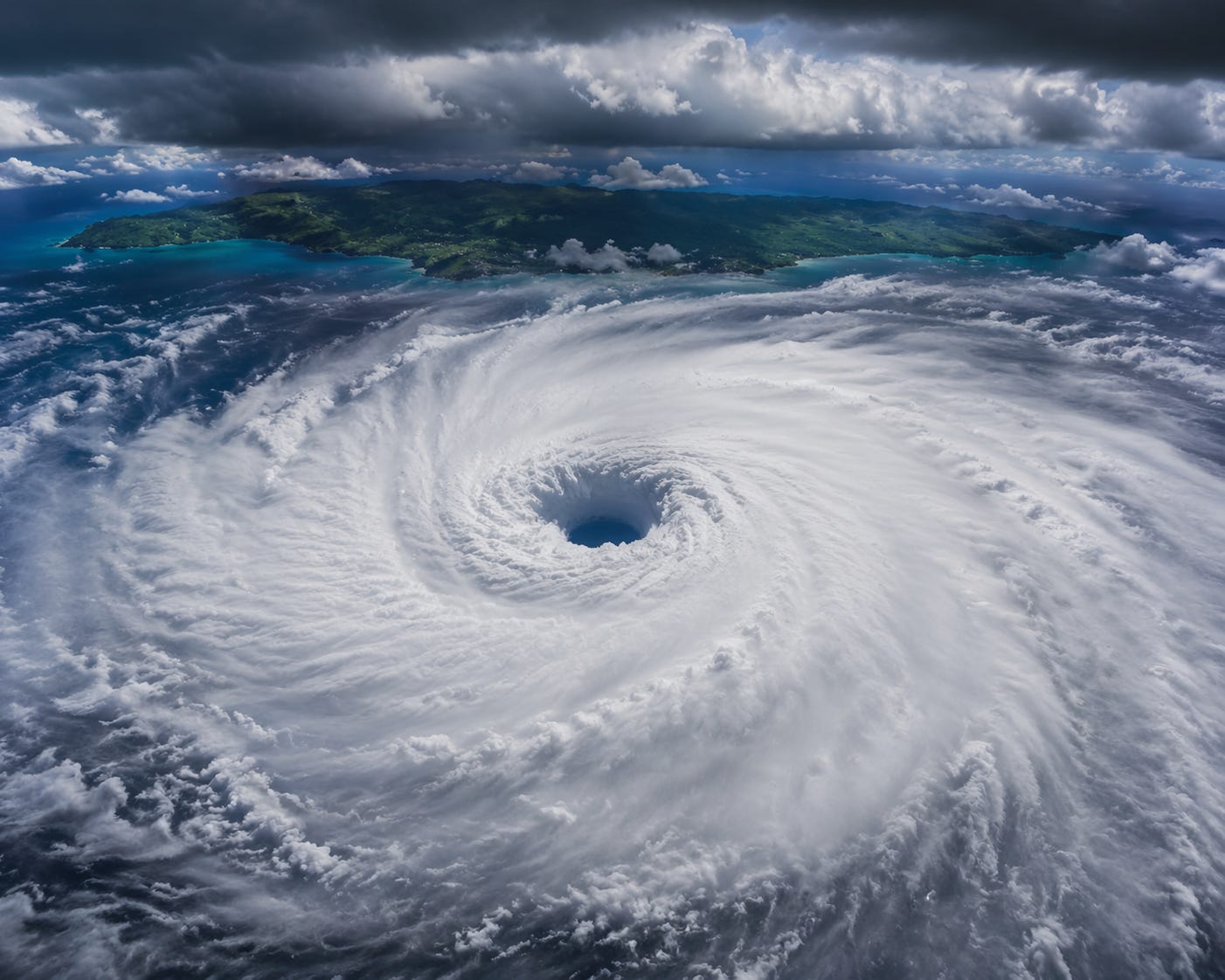
A slow-building hurricane intensified over the Caribbean before turning toward Jamaica.
Its sharply defined eye signaled unusual strength and stability.
The storm lingered, gathering energy over warm waters.
Wind, rain, and flooding combined into a single threat.
Early assumptions it would weaken proved wrong.
The event raises new questions about preparedness and resilience.
In Jamaica, people will laugh through almost anything. It is a national instinct, part resilience, part release. So when the storm was first named, there were jokes. “Melissa?” some said. “That doesn’t sound like a hurricane.” The comparisons came quickly. Hurricane Gilbert was invoked, remembered not just for its destruction, but for its force, its presence, its name. Gilbert sounded serious. Gilbert sounded strong. Melissa did not.
But the joke did not last. Hurricane Melissa lingered, intensified, and struck with a kind of calculated patience. It sat offshore, gathering strength, reorganising itself, and then moved when it was ready. Not when forecasts hoped. Not when preparation assumed. When it chose. It was, in every sense, what many would later call a “perfect storm.” Not just for its meteorology, but for its timing. Because it did not hit a prepared country. It hit a country already recovering from Hurricane Beryl. It hit systems already stretched, households already weakened, infrastructure already compromised.
Now imagine this: a third hurricane in 2026. Not in isolation, not in a vacuum, but in a world that is itself becoming more unstable. Across the globe, tensions between the United States, Israel, and Iran continue to simmer, with periodic escalation threatening wider conflict. Energy markets have already shown sensitivity to these tensions. Oil prices have edged upward, supply chains have tightened, and the cost of moving goods, fuel, and materials has become more volatile.
For a small island economy like Jamaica, that matters. “Jamaica does not experience global shocks as headlines, it experiences them as higher costs,” says Dean Jones, a realtor and project manager. “Fuel goes up, everything goes up. Construction, transport, food, electricity. Now place that reality alongside a hurricane recovery, and you begin to see how pressure builds quietly, but relentlessly.”
This is where the idea of a “perfect storm” begins to evolve into something more complex. Because what would a third hurricane be called? If Melissa was the perfect storm, then a 2026 event, layered on top of geopolitical tension, rising oil prices, and an unfinished recovery, becomes something else entirely. A compound storm. A convergence. A collision of pressures. The meteorological event would only be one part of the story. The economic shock could be just as severe.
Jamaica remains in a delicate phase of recovery. More than 100,000 household damage assessments have been conducted since Melissa. Thousands of homes still bear the marks of temporary repair, patched roofs, weakened structures, unfinished works. Government programmes, including the Shelter Recovery Programme and the ROOFS initiative, are working to close the gap, but the gap remains. A new hurricane would not simply damage homes again. It would expose the limits of partial recovery.
“What we are seeing is not just vulnerability to storms, but vulnerability between storms,” Jones notes. “There is a window where people are neither fully secure nor fully displaced. Another event inside that window changes everything.” Housing would be the most immediate casualty. Families living in compromised structures would face a second or third round of loss. What was once repairable could become irrecoverable. Displacement would increase, not necessarily because the storm is stronger, but because the baseline is weaker.
Infrastructure would follow. Roads already repaired once could fail again. Drainage systems, cleared but not fully upgraded, could be overwhelmed. Electricity networks, restored but still exposed, could see repeated outages. Water systems, particularly in rural areas, could once again be disrupted. The pattern is not linear. It is cumulative.
Health risks would rise alongside it. Floodwaters bring contamination. Damp conditions encourage fungal growth. Overcrowded or temporary housing increases exposure. A health system still stabilising after previous shocks would face renewed strain, particularly in communities already operating at the margins. Education, too, would absorb the impact. Many students have already experienced disruption, learning in temporary or shared spaces. A new storm could extend that instability, affecting not just buildings, but continuity. Learning loss does not always make headlines, but it compounds over time, quietly shaping outcomes.
And then there is the economy. Tourism, Jamaica’s economic engine, is resilient, but not immune. Each storm brings cancellations, repairs, insurance claims, and reputational risk. When storms come in quick succession, recovery time shrinks. The margin for error disappears. Agriculture would again feel the shock. Crops destroyed, supply chains interrupted, food prices rising. Inflation, which may have eased after the last storm, could return quickly through the simple reality of reduced supply.
Now layer in the global picture. Rising oil prices driven by geopolitical instability would increase the cost of everything Jamaica needs to rebuild. Lumber, steel, cement, all imported, all transported, all sensitive to fuel costs. Reconstruction becomes more expensive precisely when it needs to accelerate. Insurance mechanisms provide some relief. The Caribbean Catastrophe Risk Insurance Facility has already demonstrated its value, with rapid payouts following Melissa. But insurance is a buffer, not a solution. It provides liquidity, not permanence.
“Financial instruments can buy time,” Jones says. “They cannot buy resilience on their own. That has to be built, deliberately, over time, and often at higher upfront cost.” This is where the concept of the “perfect storm” becomes inadequate. Because perfection implies a single moment, a peak, a climax. What Jamaica could face is not a moment, but a sequence. Not a single storm, but a system of pressures aligning, climate, economics, infrastructure, and global instability, all converging within a narrow window.
If Melissa was the perfect storm, then this would be something closer to a sustained test, a stress event across multiple fronts. And yet, there is another side to this story. Because Jamaica has also shown something else over the past two years: adaptation. Preparedness efforts are already underway. Communities are being urged to clean gullies, secure properties, and reinforce structures. Government programmes are targeting not just repair, but resilience. There is growing recognition that rebuilding must go beyond replacing what was lost. It must improve what exists.
At a national level, this means stronger building standards, better drainage systems, more resilient infrastructure, and smarter land use planning. At a community level, it means coordination, awareness, and shared responsibility. At an individual level, it means preparation, securing roofs properly, understanding flood risks, storing emergency supplies, and planning not just for the storm, but for the days and weeks after it.
Hope, in this context, is not abstract. It is practical. It is found in preparation, in learning from recent experience, and in recognising that resilience is not built in calm periods alone. It is built in the choices made between events. “We have an opportunity, right now, between storms,” Jones reflects. “Not just to repair, but to rethink. To build differently. To prepare properly. Because the next event, whenever it comes, will test not what we say, but what we have actually done.”
Jamaica has faced storms before. It will face them again. The question is not whether another hurricane will come. It is whether, when it does, the country will still be recovering, or finally ready. That answer is being shaped now.