

Antigua's $200 Million Bet on the Future of Luxury Tourism
A new resort rising on an Antigua beach is about more than hotel rooms. It is a bet on artificial intelligence, sustainability, and a tourism model aimed at attracting higher-spending visitors.

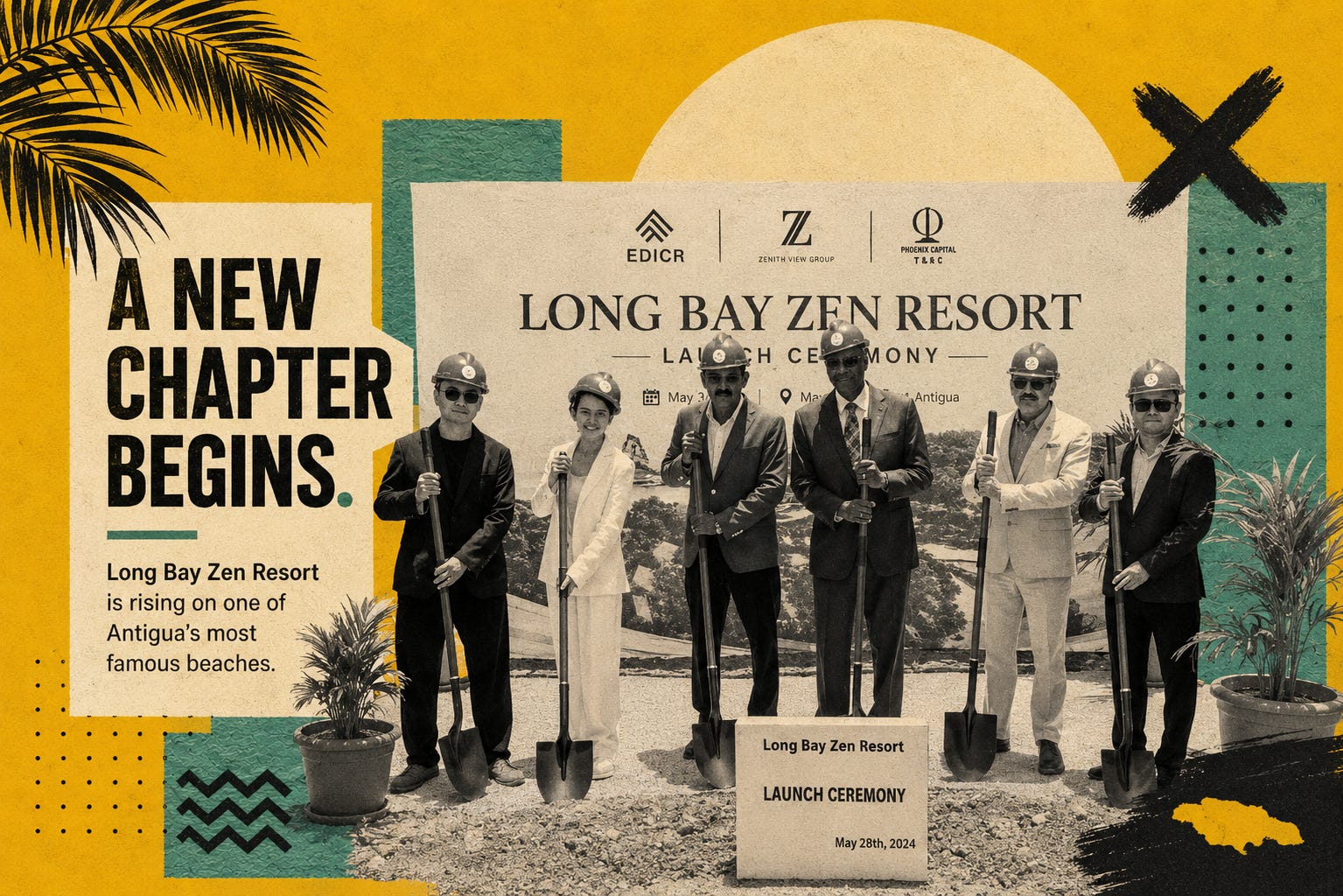
On the northeastern coast of Antigua, where turquoise water meets one of the island’s most celebrated stretches of sand, bulldozers have begun clearing the ground for a project that supporters believe represents the future of Caribbean tourism.
The Long Bay Zen Resort is expected to cost US$200 million. When completed, it will contain just 113 luxury accommodations.
That figure alone tells a story.
In an era when many destinations continue to chase larger visitor numbers, Antigua appears to be pursuing a different strategy. Rather than attracting more tourists, it wants to attract wealthier ones. Rather than building another large beachfront hotel, it is investing in exclusivity, technology, wellness, sustainability, and what developers describe as “quiet luxury.”
If the numbers are accurate, the development represents an investment of roughly US$1.77 million per room, placing it among the most expensive resort developments per key in the Caribbean.
The project arrives at a moment when tourism across the region is undergoing a profound transformation.
For decades, Caribbean governments measured success largely through arrivals. More flights, more cruise ships, more hotel rooms, more visitors.
Today, many are asking a different question.
What if fewer visitors could generate greater prosperity?
That question lies at the heart of Antigua and Barbuda’s tourism strategy.
At the sod-turning ceremony, Prime Minister Gaston Browne made it clear that the government is deliberately targeting the upper end of the global travel market. He pointed to ultra-luxury properties where guests routinely spend thousands of dollars per night and suggested this is precisely the segment Antigua hopes to attract.
The logic is straightforward. High-net-worth travelers spend more on accommodation, dining, excursions, transportation, wellness services, and destination weddings. They create demand for luxury real estate, marina facilities, private aviation, and high-end retail.
For small island states with finite land and environmental resources, attracting visitors who spend more while placing less pressure on infrastructure has become an increasingly attractive proposition.
Yet Long Bay Zen Resort is not simply another luxury hotel.
In many ways, it appears to be an experiment.
The development’s backers have promised a property powered by renewable energy, supported by intelligent infrastructure, equipped with artificial intelligence-based guest services, and designed around low-carbon operations. Plans include automated transportation systems, smart technology integration, renewable energy solutions, and desalination facilities intended to reduce pressure on local resources.
The language being used is notably different from traditional tourism marketing.
Developers speak not only about beaches and sunshine but about artificial intelligence, smart infrastructure, sustainability, climate resilience, and technological innovation.
The resort is being presented as part luxury retreat and part demonstration project for what the future of Caribbean tourism could become.
That is perhaps unsurprising when one examines the background of the project’s principal investor.
Sophie Zhong is not widely known in international hospitality circles. Unlike many major resort developers, her professional background appears rooted less in tourism and more in technology, gaming, investment migration, data analytics, and international business development.
The company associated with the project, the Ediacaran Group, has operated across sectors that include gaming, global mobility services, technology, citizenship-by-investment consulting, and digital transformation.
Its arrival in luxury tourism therefore represents an intriguing shift.
Rather than a hotel company moving into technology, this appears to be a technology-oriented investment group moving into hospitality.
That distinction may prove significant.
As artificial intelligence, automation, and data-driven personalization increasingly shape how consumers interact with businesses, the hospitality sector is rapidly evolving. Hotels are becoming technology platforms as much as physical destinations. Guest experiences are increasingly customized through data, predictive systems, digital concierge services, and smart-room technologies.
Long Bay Zen appears positioned to sit directly at that intersection.
Yet there is another story embedded within the development, one that extends beyond tourism.
Government officials repeatedly highlighted the fact that the investors became citizens of Antigua and Barbuda through the country’s Citizenship by Investment Programme.
That emphasis was unlikely to be accidental.
Citizenship-by-investment programmes have often attracted criticism internationally, with opponents questioning whether they create meaningful long-term benefits for host countries. Antigua’s government appears eager to present Long Bay Zen as evidence that such programmes can do more than generate application fees.
The narrative is compelling.
Investors arrive through the citizenship programme. They establish roots in the country. They invest additional capital. They become stakeholders in the nation’s future. Eventually, they undertake transformative projects that create jobs, increase tourism capacity, and expand economic activity.
Whether Long Bay Zen ultimately validates that argument remains to be seen, but officials clearly view the project as a showcase example.
There are, however, unanswered questions.
During the groundbreaking ceremony, Browne made a brief but curious reference to the developers experiencing setbacks linked to investments in a financial institution that had encountered difficulties.
He praised them for continuing to invest despite those challenges.
The remark was striking because no further details were provided.
Which institution was involved? How significant were the losses? Were the investors shareholders, creditors, depositors, or strategic partners? Did those challenges affect the financing of the resort?
At present, those questions remain unanswered.
For journalists and analysts, it is perhaps the most intriguing loose thread in the entire story.
Meanwhile, the location itself adds another layer of significance.
Long Bay is among Antigua’s most recognizable coastal destinations. Prime beachfront parcels across the Caribbean are becoming increasingly scarce, and competition for premium coastal land continues to intensify.
Developments in such locations inevitably raise questions about environmental protection, coastal resilience, water use, and ecosystem preservation.
Developers insist sustainability sits at the center of the project. They have pledged renewable energy systems, low-carbon operations, intelligent resource management, and environmentally conscious design.
Yet as with every major coastal development in the Caribbean, the ultimate test will not be the promises made during groundbreaking ceremonies but the realities delivered after construction begins.
There is also the matter of employment.
Browne repeatedly emphasized that tourism workers should be able to earn enough to afford mortgages and support their families. It was a notable statement because it framed tourism not merely as a generator of jobs but as a pathway to asset ownership and economic mobility.
Whether luxury tourism can consistently deliver that outcome remains a question many Caribbean governments continue to wrestle with.
The answer may determine whether projects like Long Bay Zen are viewed as engines of national development or simply as enclaves of prosperity.
For now, optimism dominates the conversation.
Tourism arrivals remain strong. Air connectivity continues expanding. Antigua is attracting new investment. Luxury travel demand remains resilient despite economic uncertainty in parts of the world.
Against that backdrop, Long Bay Zen Resort represents something larger than a hotel.
It is a statement about where Antigua believes the future is headed.
A future where technology and hospitality merge.
A future where sustainability becomes a selling point rather than a regulatory obligation.
A future where citizenship programmes are marketed as gateways to long-term investment.
And a future where Caribbean tourism competes not on volume, but on value.
Whether that vision succeeds will not be known for years.
But on a quiet stretch of Antigua’s northeastern coast, the foundations are now being laid for a project that could become one of the region’s most closely watched tourism experiments.