

Between Giants and Neighbours: Jamaica’s Quiet Balancing Act in a Changing Caribbean

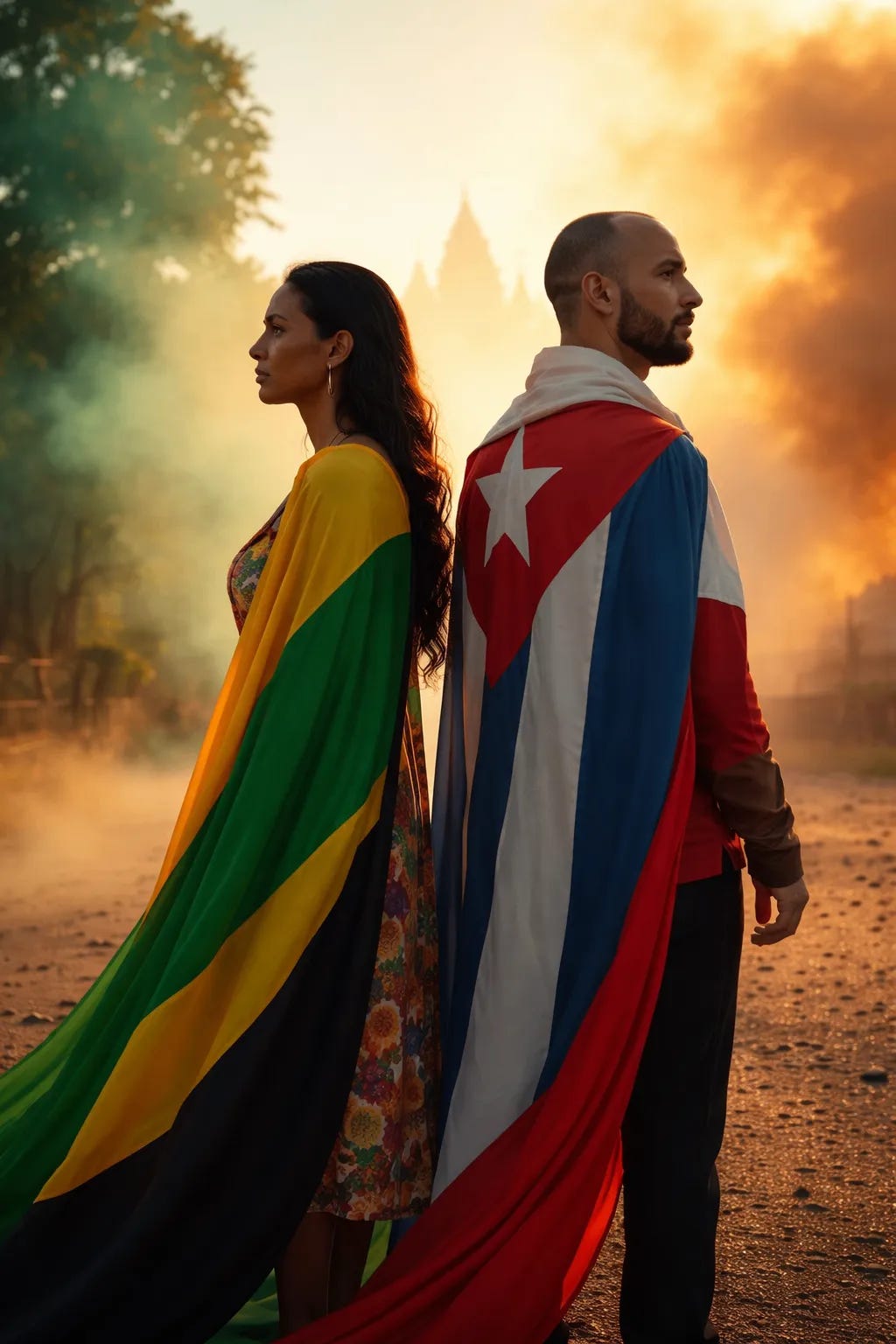
History rarely moves in straight lines. For small island nations like Jamaica, it often moves more like the tide—pulled by powerful currents beyond the horizon, yet always returning to the shore where people must continue building their lives.
The recent diplomatic tension between Jamaica and Cuba over the withdrawal of Cuban medical professionals has stirred a mixture of reflection, concern, and debate. On the surface, the issue appears technical: a health cooperation agreement ended after negotiations failed over the terms of payment and labour arrangements. Yet beneath the diplomatic language lies a deeper story about geopolitics, Caribbean solidarity, and the enduring challenge faced by smaller nations navigating relationships with global powers.
Cuba has publicly stated that Jamaica “yielded” to pressure from the United States. Jamaica’s government has rejected that claim, insisting that the agreement simply expired and that both sides could not agree on new terms consistent with Jamaican law and international labour standards.
Somewhere between those two positions lies a reality that many Caribbean people understand instinctively. Jamaica, like most nations in the region, operates in a world where alliances, economics, and diplomacy intersect constantly. Decisions are rarely made in isolation. They are made within a network of relationships that stretch from Washington to Havana, from London to Kingston.
For decades, one of those relationships quietly shaped Jamaica’s healthcare system.
Since 1976, Cuban medical professionals have served across the island in hospitals, clinics, and specialised programmes. Over time, thousands of doctors, nurses, and specialists from Cuba worked within Jamaica’s public health system. According to Cuban authorities, more than 4,700 Cuban medical collaborators have served in Jamaica over the past thirty years alone. Millions of patients received treatment, tens of thousands of surgeries were performed, and programmes like Operation Miracle restored eyesight to thousands of Jamaicans who otherwise could not afford care.
For many communities, particularly in rural areas or specialised medical fields, the Cuban presence became part of everyday healthcare.
The end of the programme therefore carries a symbolic weight that extends far beyond the number of professionals departing the island. It prompts a wider conversation about how Jamaica sustains its institutions and partnerships in an increasingly complex world.
To understand that conversation fully, one must look at the broader historical landscape that shaped the Caribbean itself.
Jamaica and Cuba share a deep historical connection. Both islands were colonised by Spain after Christopher Columbus arrived in the Caribbean at the end of the fifteenth century. Indigenous Taíno societies were quickly devastated by disease, violence, and forced labour. Plantation economies soon emerged, relying heavily on enslaved Africans who were transported across the Atlantic under brutal conditions.
Yet despite these shared beginnings, the political paths of the two islands eventually diverged dramatically.
Cuba remained under Spanish rule until the end of the nineteenth century and later became the centre of one of the most consequential revolutions of the twentieth century. The Cuban Revolution of 1959 transformed the island into a socialist state aligned with the Soviet Union. From that moment onward, Cuba developed a model of international solidarity that included sending doctors, teachers, and engineers abroad.
Jamaica’s path unfolded differently.
Independence arrived in 1962 through negotiation rather than revolution. Jamaica established a parliamentary democracy and developed close economic ties with Western nations, particularly the United States and the United Kingdom. The island experienced its own ideological debates during the Cold War, particularly during the 1970s when democratic socialist policies sparked tension with Washington. Yet Jamaica ultimately maintained a democratic political system and a diversified network of international relationships.
This difference in political structure shaped how each nation engaged with the world.
Cuba exported medical expertise as a form of diplomacy. Jamaica, meanwhile, exported something else that proved equally influential: its people.
The story of Jamaican migration is inseparable from the nation’s economic stability. Few examples illustrate this more clearly than the Windrush generation.
After the Second World War, Britain faced a severe labour shortage. In 1948 the ship Empire Windrush arrived in London carrying Caribbean migrants, many of them Jamaicans who answered Britain’s call to help rebuild the country. Over the following decades thousands more Jamaicans travelled to the United Kingdom to work in hospitals, factories, public transportation, and schools.
They were nurses who kept the National Health Service running, drivers who kept buses moving, and workers who quietly helped rebuild a country recovering from war.
But their contributions extended far beyond Britain.
The remittances they sent home helped sustain families, fund education, build houses, and stabilise the Jamaican economy during challenging periods. Entire communities benefited from these transnational connections. Jamaica became not just an island nation but part of a global network of people who maintained deep ties to home.
As Dean Jones, founder of Jamaica Homes and a long-time observer of the island’s social and economic landscape, puts it:
“Jamaica’s greatest export has never been bauxite, sugar, or even music. It has been its people. From the Windrush generation to today’s diaspora professionals scattered across the globe, Jamaicans have consistently proven that talent born on a small island can shape institutions far beyond its shores. What we sometimes overlook is that these same people remain deeply connected to home. They send resources, knowledge, and opportunities back to Jamaica, creating a quiet but powerful economic backbone that has helped the country weather many storms.”
This dynamic relationship between migration, remittances, and national stability has been one of Jamaica’s most remarkable success stories. While Cuba built a system capable of sending doctors abroad, Jamaica cultivated a diaspora capable of strengthening the nation from afar.
Both models emerged from the same Caribbean reality: limited resources but immense human potential.
The current moment therefore invites careful reflection rather than quick conclusions. The end of the Cuban medical cooperation agreement does not erase decades of collaboration between the two countries. Cuban doctors contributed significantly to Jamaica’s healthcare system, and their work touched the lives of many Jamaicans who received treatment they might otherwise never have obtained.
At the same time, Jamaica’s government faces the responsibility of ensuring that all agreements operating within the country align with its laws, labour standards, and national interests.
These are not simple decisions.
For small states, diplomacy often resembles a delicate dance rather than a straightforward march. Every step must be measured. Every partnership must be balanced.
In the Caribbean, where history has repeatedly shown that external powers can exert enormous influence, maintaining sovereignty requires both prudence and flexibility.
One might say that navigating international politics sometimes feels like playing dominoes on a windy verandah—every move must be deliberate because the wrong one could scatter the entire table.
Yet Jamaica has shown remarkable resilience in managing such complexities.
The country has maintained democratic institutions for more than sixty years since independence. It has cultivated global cultural influence through music, athletics, and the arts. It has developed a tourism industry that draws millions of visitors annually while supporting thousands of jobs.
Equally important, Jamaica has sustained a sense of national identity rooted in creativity, perseverance, and community.
Dean Jones reflects on this resilience in another observation:
“Jamaica has always operated in the space between possibility and limitation. We are not a large country with endless resources, yet we have consistently found ways to transform constraints into opportunities. The lesson of our history is that progress rarely comes from waiting for ideal circumstances. It comes from recognising what we already possess—our people, our ideas, and our capacity to collaborate with others while still protecting our independence.”
That independence of thought is particularly important as Jamaica looks toward the future of its healthcare system.
The departure of Cuban medical professionals inevitably creates gaps that must be addressed. Government officials have already outlined several strategies, including training more Jamaican specialists, recruiting international professionals, and encouraging members of the diaspora to contribute their expertise.
Each of these pathways reflects a broader truth: sustainable national development ultimately depends on building domestic capacity.
The diaspora, once again, may play a crucial role. Jamaican doctors, nurses, and researchers working abroad represent a reservoir of knowledge that could help strengthen local institutions. With the right incentives and policies, that expertise could be channelled into training programmes, short-term service initiatives, and long-term partnerships.
This approach would not replace international cooperation but rather complement it.
The Caribbean has always thrived when collaboration replaces isolation.
Jamaica’s relationship with Cuba, despite the current disagreement, remains part of a wider regional framework where neighbouring countries support one another in times of need. Whether through disaster response, education exchanges, or healthcare initiatives, Caribbean solidarity has often provided practical solutions when global systems move too slowly.
Yet solidarity alone cannot carry a nation forward. Vision must accompany it.
Dean Jones offers a final reflection that captures the moment Jamaica now faces:
“Every generation inherits a country shaped by the decisions of those who came before. The Windrush pioneers built bridges across oceans. Cuban doctors strengthened our hospitals. Our own professionals continue to innovate at home and abroad. The question now is what the next chapter will look like. Jamaica has the opportunity to invest more deeply in its own institutions while strengthening partnerships that respect mutual benefit. If we approach this moment with clarity and courage, the decisions made today could lay the foundation for a stronger and more self-reliant Jamaica tomorrow.”
History suggests that such moments of transition often lead to unexpected renewal.
Jamaica has navigated centuries of change—from colonial rule to independence, from Cold War politics to global migration. Each period brought uncertainty, yet each also produced new forms of resilience.
The end of the Cuban medical cooperation programme may simply be another turning point in that long narrative.
What matters now is how Jamaica responds.
The island stands at an intersection of relationships: regional partnerships with neighbours like Cuba, economic ties with larger powers such as the United States, and the enduring support of a diaspora spread across the globe.
Few countries possess such a diverse network of connections.
Harnessing that network thoughtfully may be the key to the next stage of national development.
The Caribbean has always been a region where global forces collide, but it is also a region where creativity and determination flourish. Jamaica, perhaps more than any other island, has repeatedly shown the ability to transform challenge into possibility.
The present moment invites the same spirit of reflection and innovation that has guided the nation through earlier transitions.
Because history is not only about what has happened. It is also about what happens next.
And Jamaica, standing once again between powerful currents and trusted neighbours, now faces a simple but profound question.
What will its next move be?