


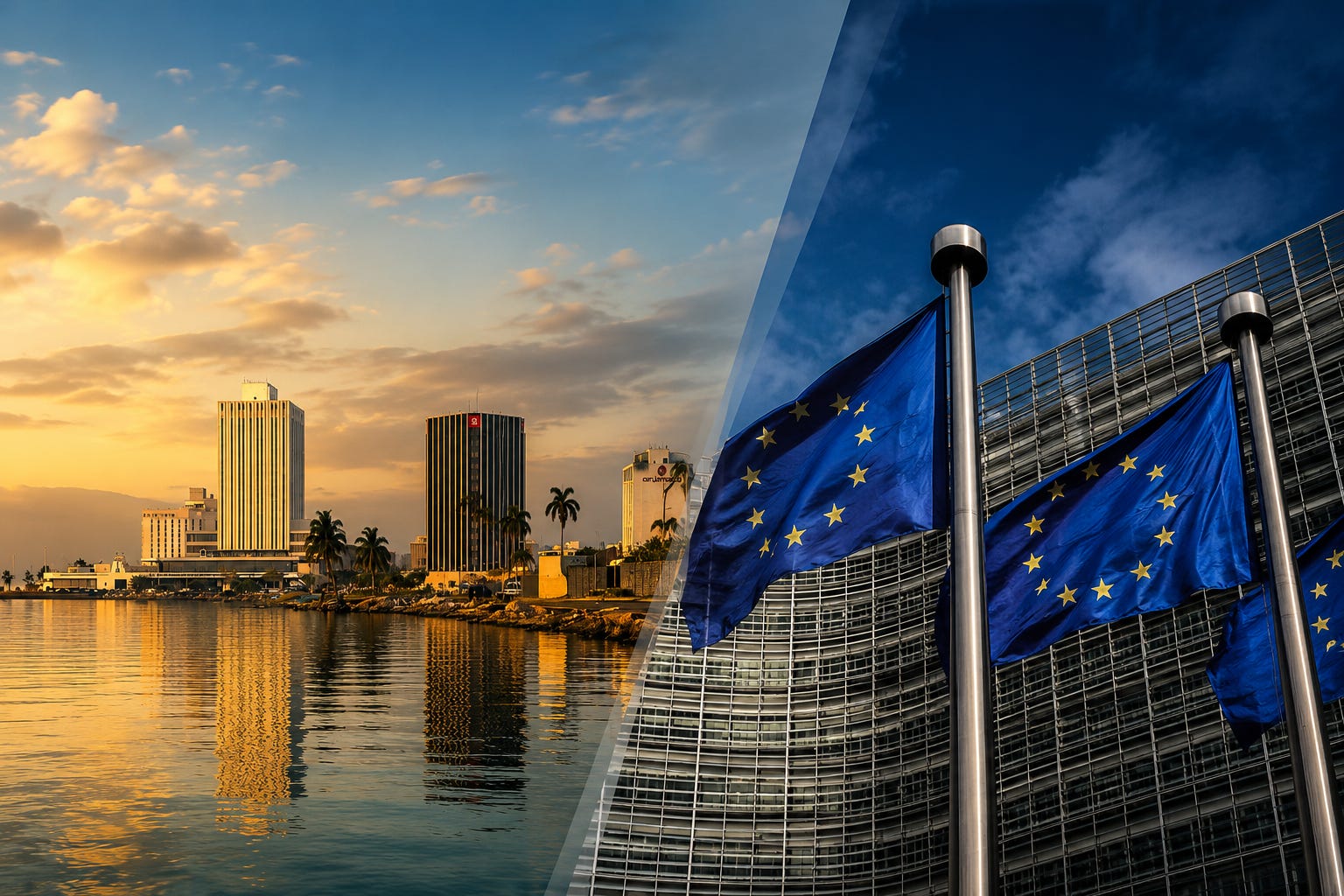
The EU is increasingly positioning Jamaica as a strategic partner rather than simply an aid recipient.
European officials now describe Jamaica as a “partner of solutions” in climate, digital and geopolitical cooperation.
Jamaica continues to export global talent, culture and influence while struggling to retain long term economic value at home.
The EU’s Global Gateway programme reflects a wider shift toward investment, trade and strategic alliances across the Caribbean.
Jamaica’s future strength may depend less on natural resources and more on education, innovation and institutional capacity.
The bigger question is whether Jamaica can build the systems needed to turn global influence into lasting national power.
The relationship between Jamaica and the European Union is undergoing a quiet but significant transformation. For decades, much of the language surrounding Caribbean development centred on aid, vulnerability and dependency. Now, the tone coming from Brussels is beginning to change.
At Europe Day celebrations in Kingston, EU Ambassador Dr Erja Askola described Jamaica not simply as a country in need, but as a “partner of solutions” and a “political ally” in an increasingly unstable world. The statement may sound diplomatic on the surface, but beneath it sits a deeper geopolitical shift.
The European Union is increasingly positioning Jamaica as strategically important in areas including climate diplomacy, digital transformation, democratic governance, logistics and sustainable development. Through initiatives tied to the EU’s Global Gateway Investment Agenda, cooperation is now expanding into renewable energy, digital infrastructure, climate resilience, logistics modernisation and sustainable shipping.
Official EU statements tied to Europe Day 2025 highlighted “50 years of partnership” with Jamaica and referenced support for decarbonising Kingston Harbour, improving digital connectivity, strengthening climate adaptation and modernising infrastructure. The EU’s own Jamaica delegation describes the relationship as centred around three flagship areas: digital transition, green transition and sustainable logistics transformation.
The language matters because it reflects how Jamaica is increasingly being viewed internationally. Not merely as a tourism destination or aid recipient, but as a stable democratic partner sitting at the intersection of climate vulnerability, geopolitics, logistics and Caribbean influence.
Yet the contradictions remain impossible to ignore.
Jamaica is still officially viewed by the EU and wider international institutions as a developing country. That classification is tied not only to income levels, but also to climate vulnerability, debt history, productivity gaps, import dependence and exposure to external shocks.
And perhaps nowhere is that contradiction clearer than in Jamaica’s relationship with its own people.
“Jamaica has already given the world an extraordinary amount relative to its size,” said Dean Jones, founder of Jamaica Homes. “We exported culture before many countries even understood the value of cultural influence. We exported music, language, athletic excellence, diplomacy, resilience and talent. Jamaica itself became a global brand. The challenge is that too much of our intellectual and economic gravity still leaves with our people.”
That reality has defined Jamaica for generations. The country trains nurses, engineers, teachers, academics, developers, creatives and professionals who often build their most productive years overseas. The diaspora has become one of Jamaica’s greatest strengths, but also one of its greatest structural contradictions.
“The issue is not simply brain drain,” Jones continued. “The issue is that the centre of gravity rarely stays here. Imagine if Jamaican graduates entered global consultancy networks, technology firms, engineering partnerships and creative industries while the strategic ownership, operational headquarters and long term wealth creation remained rooted in Jamaica. That changes everything. That is how smaller countries become globally influential.”
His argument mirrors a broader question increasingly emerging across the Caribbean: how does a small state become equal in a world dominated by larger powers?
The answer, increasingly, may have less to do with size and more to do with strategic value.
The EU’s repositioning of Jamaica appears tied to exactly that logic. Jamaica offers political stability, democratic continuity, geographic importance, English language access, regional influence through CARICOM, and growing relevance in climate diplomacy. Europe also increasingly sees the Caribbean as strategically important amid global instability, supply chain fragmentation and the transition toward greener economies.
At the same time, Jamaica sits at a crossroads.
Oil or gas discoveries could potentially strengthen the economy, reduce import dependence and increase geopolitical leverage. But history shows that natural resources alone rarely create truly developed societies. Countries become sustainably powerful through institutions, education, innovation and long term planning.
“Norway did not become Norway because it found oil,” Jones said. “It became Norway because it built systems around the oil. Jamaica’s greatest long term resource may already be its people. The future economy may belong less to countries sitting on oil fields and more to countries that can organise talent, technology, creativity and strategic alliances.”
That may ultimately be the deeper significance behind the EU’s language.
For perhaps the first time in decades, Jamaica is increasingly being viewed not only through the lens of vulnerability, but through the lens of capability.
The real question now is whether Jamaica is prepared to build the kind of long term national strategy capable of matching that new international perception.