

Bob Marley’s Final Journey and the Fragility of the Jamaican Body
The death of Jamaica’s greatest cultural prophet revealed something deeper about faith, identity, medicine, and the complicated relationship Jamaicans have long held with the body, suffering, and surv


May 11, 1981.
The news travelled across Jamaica slowly at first, then all at once. Radios. Rum shops. Street corners. Small district shops with transistor speakers crackling under zinc roofs. Bob Marley was dead.
He was only 36 years old.
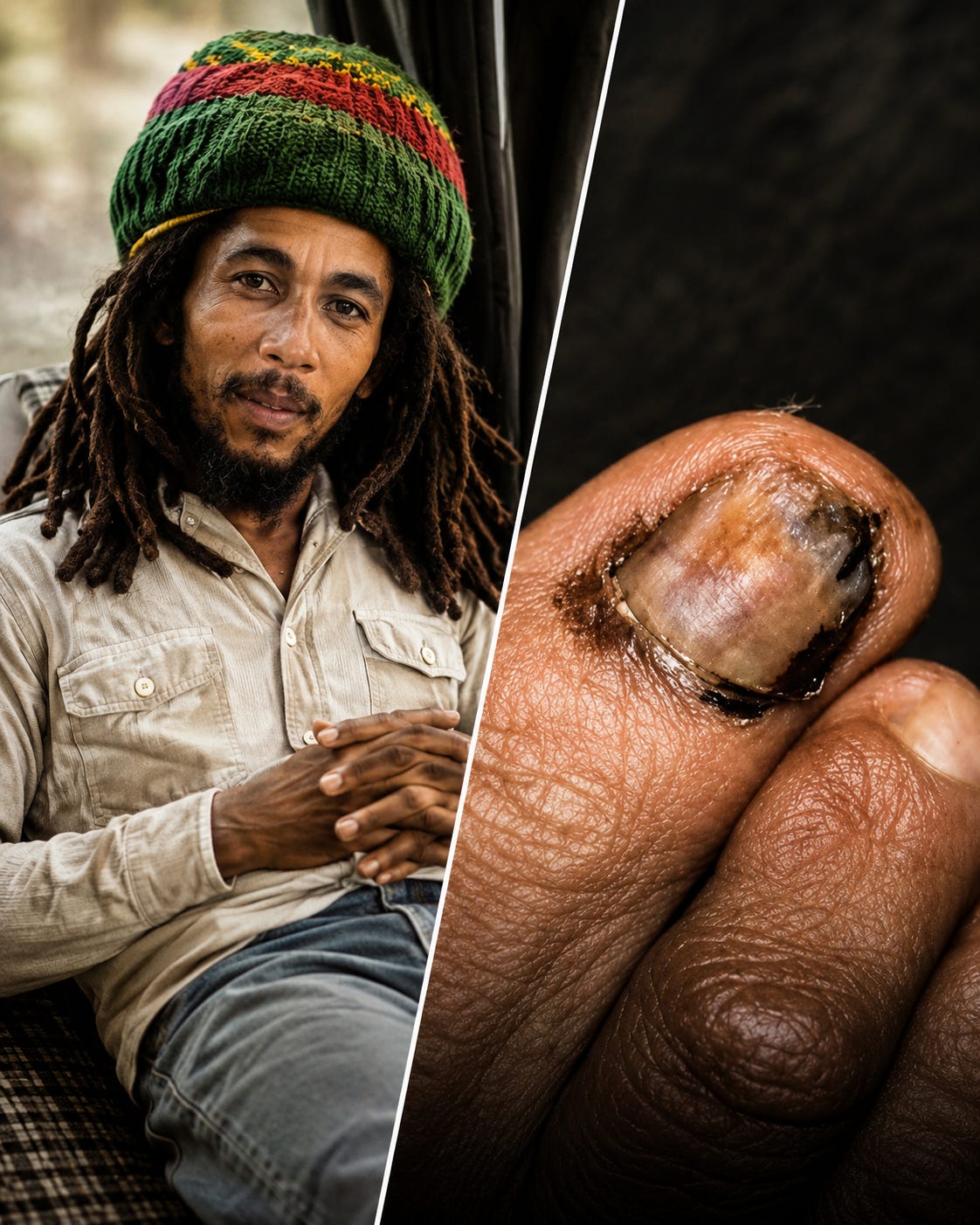
Not killed by gunfire, despite surviving the infamous 1976 assassination attempt. Not lost in a plane crash or some dramatic stage collapse fitting of global superstardom. Bob Marley died from cancer, a rare and aggressive melanoma that began beneath his toenail.
For many Jamaicans then, and even now, the detail feels almost impossible. A man who seemed spiritually untouchable, physically powerful, almost mythological in presence, taken by something so small. A dark spot beneath a toe.
But Jamaica has always lived close to paradox.
Marley’s illness began after a football injury in Paris in 1977. Beneath the nail of his toe, doctors discovered acral lentiginous melanoma, a rare form of skin cancer more commonly diagnosed in people with darker skin. Physicians advised immediate amputation to stop the spread.
He refused.
That refusal has echoed through Jamaican cultural memory for decades, not simply as a medical decision, but as a deeply spiritual one. Marley’s Rastafarian faith viewed the body as sacred and whole. To remove part of it was, to him, a violation of divine order. Like many Jamaicans of his generation, particularly those shaped by colonial distrust and Afro-spiritual traditions, healing was not viewed solely through the lens of Western medicine.
Faith, bush remedies, endurance, prayer, and spiritual conviction often existed alongside, and sometimes against, formal healthcare systems.
Instead of amputation, Marley underwent a less invasive procedure removing the nail bed and surrounding tissue while preserving the toe. For a time, he continued touring, recording, performing, and carrying the growing weight of global fame. But the cancer spread quietly through his body, into his lungs, liver, and brain.
By 1980, the deterioration had become visible.
There were collapses during runs. Exhaustion on stage. The physical shrinking of a man whose image had come to symbolize resistance itself. He eventually sought alternative treatment in Germany under Dr. Josef Issels, whose controversial holistic methods attracted patients from around the world searching for hope beyond conventional medicine.
Nothing stopped the disease.
In May 1981, while attempting to return home to Jamaica, Marley’s condition worsened mid-journey. He was hospitalized in Miami, where he died far from the hills and coastline that shaped him. Reports from the time describe him weighing barely 77 pounds.
There is something profoundly Jamaican in that final unfinished journey home.
Because for Jamaicans, whether migrant workers, returning residents, or global cultural figures , home is rarely just geography. It is emotional ground. Memory. Identity. Land. The place where the body believes it belongs even at the very end.
Three years later, Legend was released.
The compilation album would become the best-selling reggae album in history, transforming Marley from international artist into permanent global icon. His face became a symbol recognized in cities he never visited. His music entered protests, classrooms, beaches, political rallies, college dormitories, and family gatherings across continents.
Yet there remains a haunting reality beneath the mythology: the man himself never witnessed the scale of what he became.
Jamaica often experiences this kind of delayed recognition. Greatness acknowledged fully only after departure. Legacy crystallized after loss.
But Marley’s death also opened quieter conversations Jamaicans still struggle with today, about healthcare access, medical skepticism, masculinity, faith, and the tendency to endure pain silently until it becomes catastrophic.
Even now across Jamaica, many men postpone screenings. Many families still rely first on spiritual certainty, herbal treatment, or endurance before formal intervention. In rural districts especially, illness is often managed privately, quietly, sometimes too long. Not simply because of ignorance, but because history taught many Caribbean people to distrust institutions that rarely treated them with dignity.
The story of Bob Marley’s death is therefore not merely celebrity tragedy. It is a reflection of the Caribbean condition itself: the collision of belief and science, strength and vulnerability, tradition and modernity.
And perhaps that is why the story still lingers so powerfully more than four decades later.
Because beneath the iconography, beneath the merchandise and murals and tourist mythology, Jamaicans still recognize the human truth inside it.
A brilliant son of the island trying, like so many others, to hold together faith, identity, body, and destiny in an uncertain world.
In the end, even Marley could not outrun mortality.
But somehow, through the music, the warnings, the honesty, and the unfinished journey home, he became something else entirely.
Not immortal.
Just permanently woven into the emotional architecture of Jamaica itself.
I must be the white sheep of the Jamaican family, because I don't trust formal medicine either.
Before you posted this, I was unaware.
God's love,
Rabble Shall