


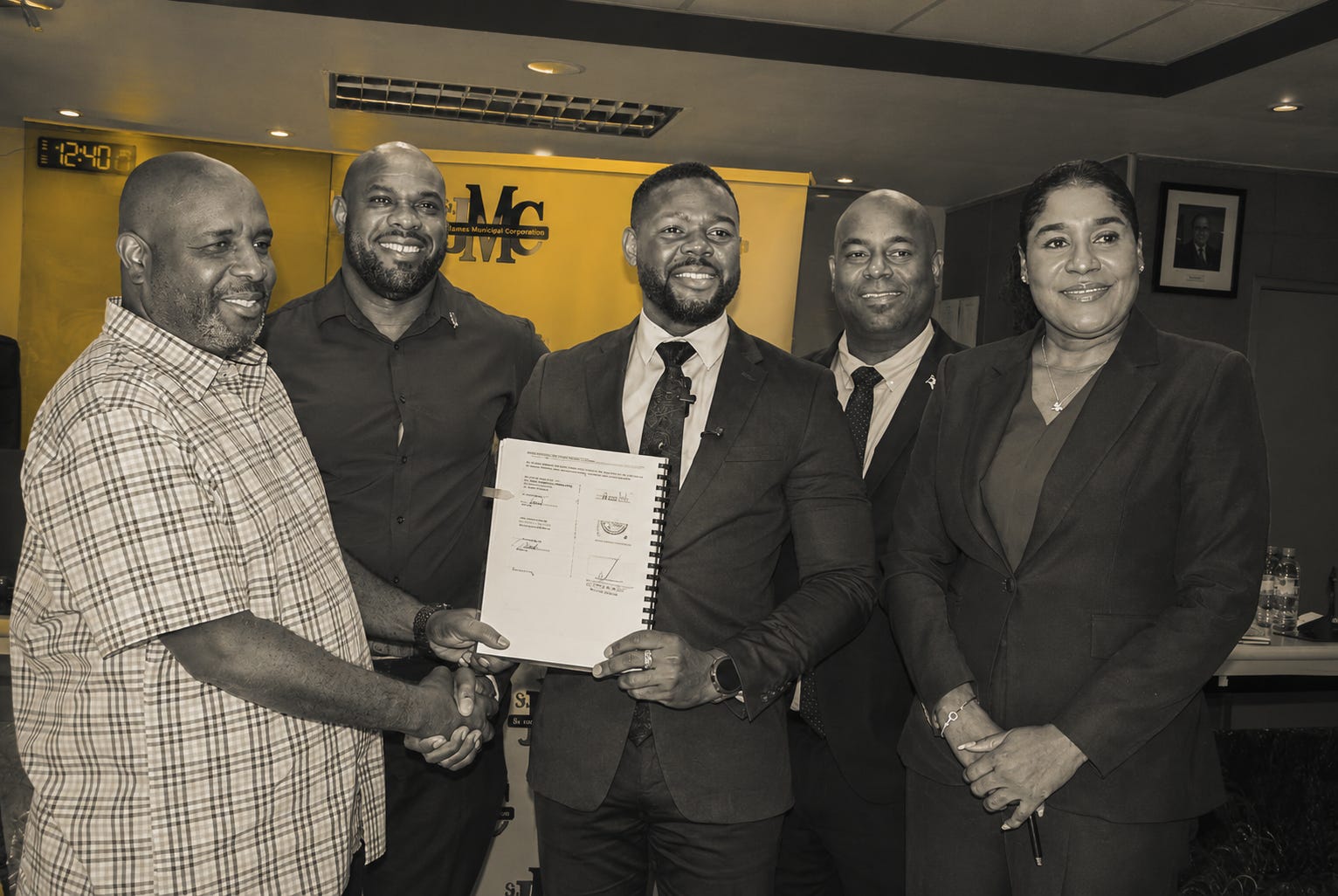
A decades-long effort to regularise one of Montego Bay’s most controversial commercial settlements has moved into a new phase following the signing of an $84-million infrastructure contract for the Bogue Industrial Estate in St James.
The St James Municipal Corporation has awarded the contract to Odel Allen Construction, with work scheduled to begin on July 2 and continue for approximately six months. Once completed, the upgraded estate will be offered for sale to its current occupants, many of whom have operated businesses on the property for more than two decades.
The project represents a significant step towards resolving a longstanding land tenure issue that has shaped discussions around property ownership, investment security, and commercial development in western Jamaica.
From Occupation to Ownership
The five-hectare property, commonly known as Bogue Lands, contains 26 commercial lots occupied by business operators since around 2003. Over the years, occupants have consistently argued that they should not be regarded as squatters, pointing to substantial investments made in their businesses and the wider industrial area.
Negotiations between the municipal corporation and occupants have focused on creating a pathway to legal ownership. According to officials, infrastructure improvements were a key condition before any sale agreements could move forward.
The works will include roads, water infrastructure, street lighting, fire hydrants and other services typically required for subdivision approval and compliance certification.
For many businesses operating on the site, the upgrades could finally provide the certainty that comes with formal land ownership. That certainty often becomes one of the most valuable assets a business can possess, opening doors to financing, expansion opportunities and long-term investment planning.
Why It Matters for Real Estate
While the project centres on a commercial industrial estate, it highlights a wider issue across Jamaica’s property sector: the challenge of regularising long-occupied lands.
Across the island, there are numerous examples of residential and commercial communities where occupants have lived or operated for years without formal title. Resolving these situations can unlock significant economic value, not only for occupiers but also for local authorities and the wider economy.
Formal ownership creates clearer property records, supports investment confidence and allows land to be incorporated more fully into the formal economy. It can also increase property values by reducing uncertainty around tenure.
The Bogue Lands initiative demonstrates how infrastructure investment is often a prerequisite for transforming informal or semi-formal settlements into recognised developments capable of meeting modern planning standards.
Revenue for Municipal Development
The eventual sale of the lots is also expected to generate new revenue for the St James Municipal Corporation.
Officials have indicated that a fresh valuation of the property will be undertaken once infrastructure works are complete. The proceeds from the sales are expected to support municipal projects, including improvements to public facilities within Montego Bay.
This reflects an increasingly important reality for local authorities across Jamaica. Land assets held by municipal corporations can represent significant untapped value, particularly when infrastructure improvements and proper planning approvals are brought together.
For cash-strapped municipalities facing growing demands for roads, public spaces and community facilities, unlocking value from underutilised land assets may become an increasingly attractive strategy.
A Test Case for Land Regularisation
The Bogue Industrial Estate project may ultimately be viewed as more than a local infrastructure programme. It could become a useful case study in how local government approaches land regularisation, particularly where long-standing occupants have invested heavily in properties without securing formal ownership.
The success of the initiative will likely depend on maintaining transparency throughout the valuation and sale process while ensuring that the interests of both the public and occupiers are protected.
If completed successfully, the project could provide a model for addressing similar land tenure challenges elsewhere in Jamaica.
For Montego Bay, however, the immediate focus is on delivering the infrastructure. After years of negotiations, legal considerations and political debate, the next six months could determine whether one of the city’s longest-running property disputes finally reaches a lasting resolution.