


Jamaican architecture has never stood still. It has always responded — to climate, to culture, to necessity. From timber board houses raised off the ground to catch the breeze, to deep verandas that softened the sun and welcomed community, the built environment has long reflected how Jamaicans live, adapt, and endure.
What we are seeing now feels like another turning point.
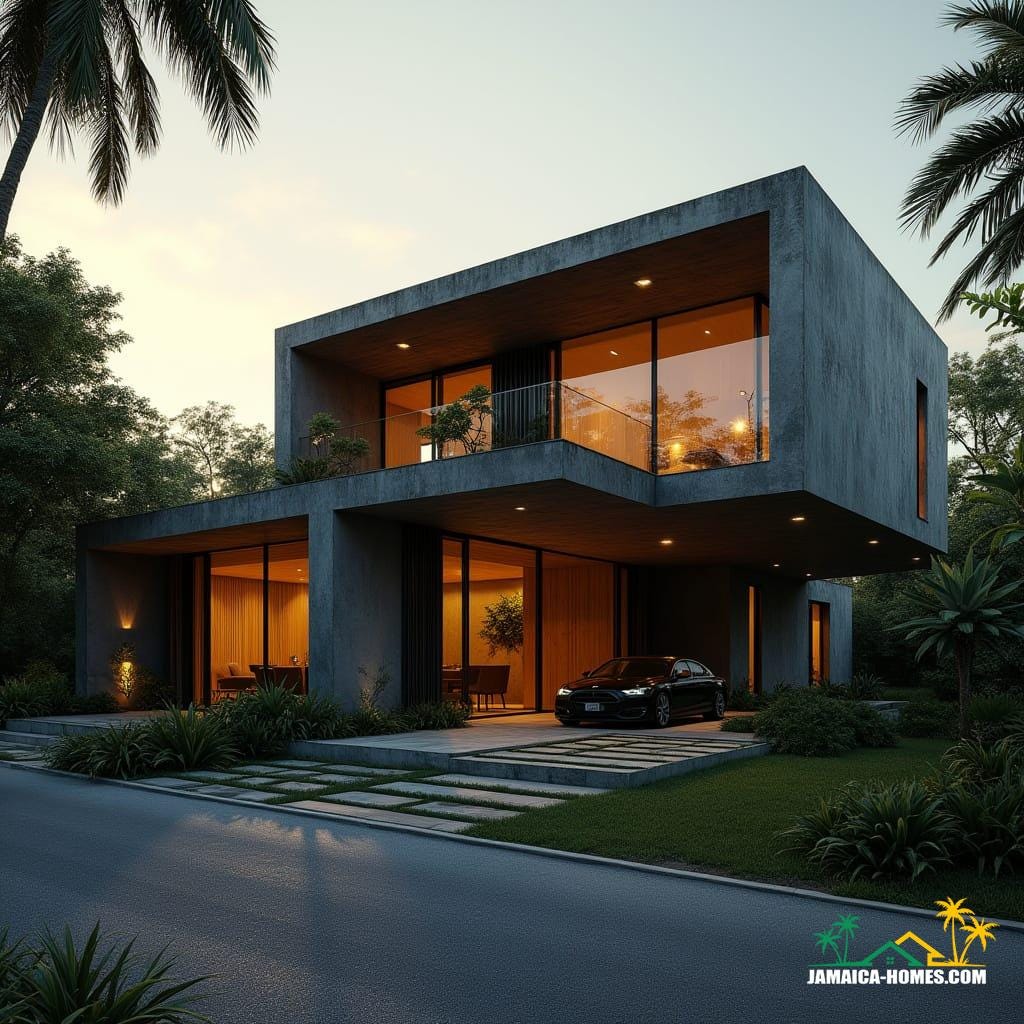
Across the island, a new architectural language is emerging. Clean lines. Strong geometry. Square and rectangular forms pushing outward — windows that protrude with confidence, flat planes of reinforced concrete and steel, and rooftops that are no longer an afterthought but a destination. These are not just stylistic choices. They are practical, defensive, and forward-looking responses to the realities of modern Jamaican life.
In the past, the pitched tile roof was king. It still has its place, and it will continue to serve existing homes for years to come. But new construction is telling a different story. Flat, reinforced concrete roofs are becoming the default — not because they are fashionable, but because they make sense. They resist hurricanes. They reduce maintenance. They offer usable space. They allow water tanks, solar panels, air-conditioning systems, and services to be tucked away neatly, safely, and accessibly.
In one instance, after Hurricane Melissa removed the roof from a substantial residence, the owner opted for a fundamental structural upgrade rather than a like-for-like repair. The building was taken back to its load-bearing elements. Timber roof members and connections were removed, and a new structural framework was introduced. Reinforcement steel was mechanically and chemically anchored into the existing ring beams, columns, and walls to ensure full structural continuity. A monolithic reinforced concrete roof slab was then cast across the entire footprint of the building.
This was not simply remedial work; it was a structural re-engineering of the building envelope. The result was a roof system designed to resist uplift, lateral wind forces, and progressive failure — significantly reducing the home’s vulnerability to future hurricane events.
That instinct — to rebuild stronger, smarter, and with intent — is becoming widespread.
Rooftops are now being designed as living spaces. Pools elevated above the street. Steel canopies providing shade. Gyms, bars, TV lounges, and social spaces all integrated into the uppermost level of the home or apartment block. What was once dead space is now premium real estate. And importantly, it’s space that works with Jamaica’s climate, not against it.
Running alongside this structural evolution is a quieter technological shift. Hurricane-resistant glazing is now being specified in more developments, designed to withstand impact and pressure when storms pass through. Heavy-gauge steel doors — often fitted with fingerprint access and smart locking systems — have become standard in many new builds across the island. Over the past five years, these features have moved from “nice to have” to “must have.” Solar panels are following the same path, increasingly seen not as upgrades, but as practical, long-term investments — a very Jamaican response: build strong, build smart, and plan ahead.
Jamaica is not alone in this evolution.
Around the world, architects and engineers are rethinking how buildings interact with natural forces. In Japan, structures are increasingly built on seismic base-isolation systems — effectively placing buildings on engineered bearings or “coils” that absorb and dissipate earthquake energy before it reaches the structure above. These systems don’t fight the movement; they manage it. China has adopted similar approaches at scale, particularly in dense urban environments where resilience is non-negotiable.
Globally, research is pushing even further — toward smart damping systems, adaptive materials, and structural technologies designed not just to reduce damage, but to one day virtually eliminate it. At the same time, new building materials are emerging at pace: higher-performance concretes, advanced composites, lighter and stronger steels, and systems that combine durability with speed of construction.
Jamaica may not be leading these developments — yet — but it is no longer watching from the sidelines.
As import pathways improve, as manufacturing scales, and as technologies become more affordable, the gap will continue to close. There is real hope that improvements around Jamaica’s ports and logistics infrastructure will influence not just the quantity of materials entering the island, but their quality and cost. When innovation arrives without doubling in price, adoption accelerates. That’s where meaningful change happens.
As Dean Jones of Jamaica Homes puts it:
“What we’re seeing isn’t just a change in how homes look — it’s a change in how Jamaicans think about permanence, resilience, and value.”
And again:
“Modern Jamaican architecture is learning to anticipate risk instead of reacting to it. That’s a powerful shift.”
The renderings that follow sit within this wider context. They are not fantasies. They are responses. Each one reflects a Jamaica that is becoming more confident in its design language — more comfortable with steel and concrete, more strategic with space, and more willing to look upward, outward, and forward.
This is not about abandoning tradition, but extending it. Jamaican building has always shown an intuitive understanding of climate, terrain, and endurance. The lesson is not to replicate the past, but to carry its intelligence forward — combining time-tested principles with modern materials, engineering, and technology to meet the demands of today and tomorrow.
As these images unfold, consider not just what you see, but what they suggest. A future where Jamaican homes are tougher, smarter, and more expressive. Where rooftops become living rooms, and technology integrates quietly into everyday life. This moment matters. Emerging from recent hurricanes, Jamaica stands at a point where the goal is no longer simply to recover, but to build back stronger. Architecture, in this sense, becomes an act of confidence — not chasing trends, but shaping places that anticipate risk, respect the past, and prepare thoughtfully for what comes next.