

Cameras On, Cameras Off: Jamaica’s Policing Reform Meets Its Limits
An ambitious push for transparency collides with operational realities, leaving a critical question unresolved about when accountability truly applies.

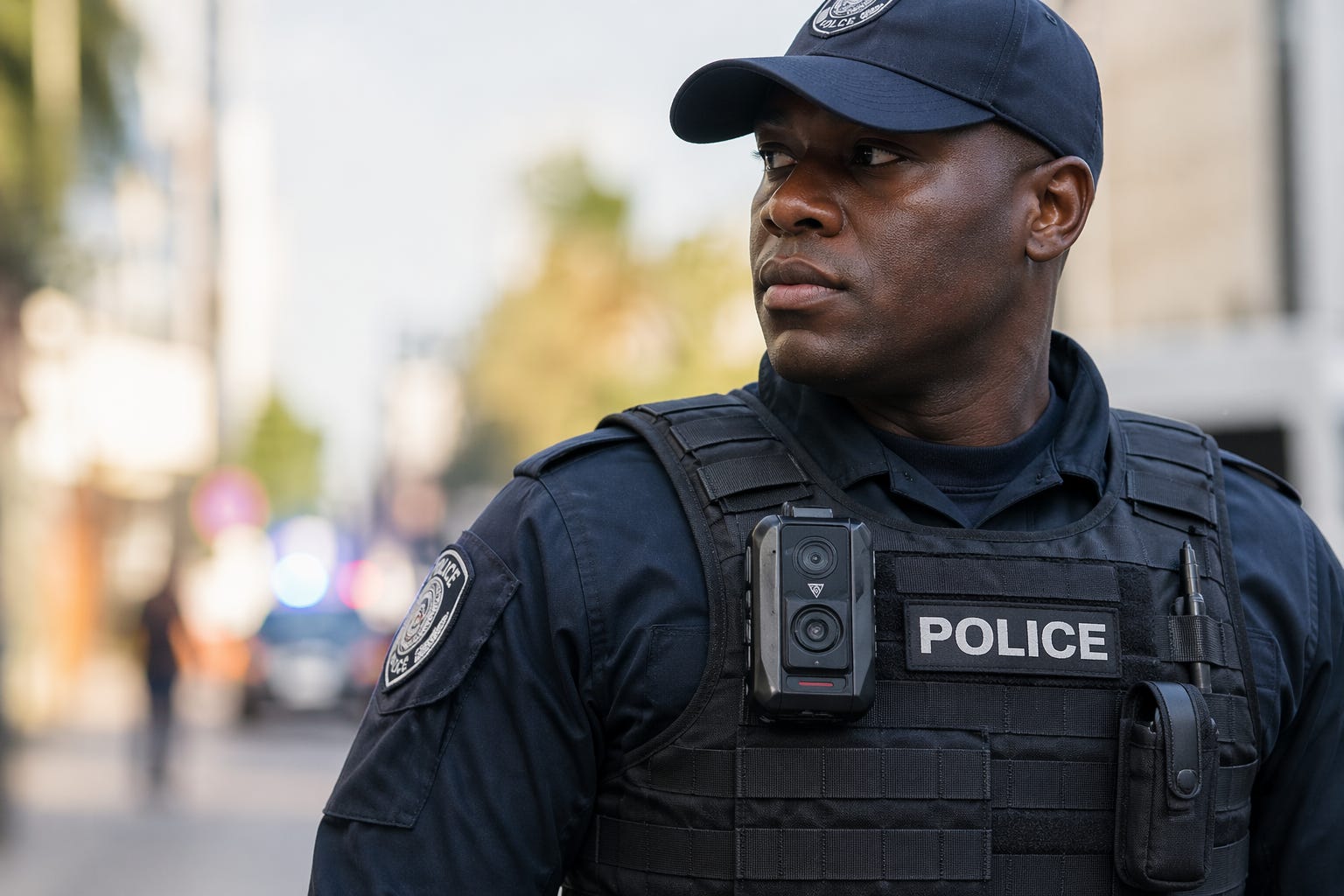
Government backs full rollout of body cameras across the police force
Security minister draws a hard line on their use during armed operations
Civil society concerns persist amid rising scrutiny of police shootings
Technology promises trust, but discretion may define its limits
The language of reform is confident. Body-worn cameras, long associated with modern policing, are presented as a cornerstone of accountability in Jamaica. The Government has committed to full deployment across the Jamaica Constabulary Force, positioning the technology as essential to transparency, professionalism, and public trust.
It is a compelling vision. Cameras that record encounters, preserve evidence, and offer protection to both citizen and officer. A system that promises to reduce disputes over what happened in the heat of an interaction. A visible signal that policing, in a modern Jamaica, is to be both effective and answerable.
Yet within this vision sits a contradiction that is difficult to ignore.
The same administration that insists cameras are not optional has also accepted that they will not be used in some of the most consequential moments in policing. According to the Minister of National Security, officers will not wear cameras when confronting armed gunmen. The reasoning is blunt. Cameras could make officers targets. In high-risk operations, survival takes precedence over documentation.
The position is not without logic. Armed confrontations are chaotic, fast-moving, and often lethal. Equipment that distracts or exposes an officer could carry real risk. But it is precisely in these moments, when force is most likely to be used, that public demand for accountability is at its highest.
The result is a policy that appears complete in principle but selective in practice.
This tension is not unique to Jamaica. Across jurisdictions, body-worn cameras have been introduced with the promise of transforming policing culture, only to encounter the limits of technology when faced with operational realities. The lesson, repeated often enough, is that cameras do not create accountability on their own. They must be consistently applied, governed by clear rules, and trusted by those who rely on them.
In Jamaica’s case, the framework remains unsettled. Approximately one thousand cameras have been procured, with more on the way. The Government has signalled financial commitment. The Jamaica Constabulary Force has embraced the technology at a leadership level. Yet deployment is left to the discretion of the police commissioner, framed as a matter of operational judgment rather than fixed policy.
That discretion is where the reform will ultimately be tested.
The official narrative places cameras within a broader ecosystem of technological modernization. Surveillance networks, command centres, digital case management systems. Together, they form a picture of a force evolving, becoming more data-driven, more coordinated, more capable.
There is evidence that such tools can shape behaviour. Officials point to a reduction in confrontations during road checks, where the presence of cameras appears to have altered interactions between officers and the public. It is a small but telling example. Visibility, even in limited form, can change conduct.
But road checks are not where the deepest questions lie.
Public concern in Jamaica has often centred on fatal police encounters, particularly in planned operations targeting suspected gunmen. These are the moments that define perceptions of justice and legitimacy. They are also the moments now explicitly carved out from routine camera use.
The implication is stark. The technology designed to build trust may be absent when trust is most at risk.
Government officials have framed calls for universal camera use as impractical, even dangerous. The argument extends further. Constant recording, it is suggested, risks reinforcing a narrative of mistrust, a lingering belief that authority figures act improperly. In this view, technology should support professionalism, not imply its absence.
It is a delicate balance. Trust cannot be mandated, nor can it be assumed. It is built through consistent experience. Through systems that are seen to work not only when convenient, but when it matters most.
Oversight mechanisms exist. The Independent Commission of Investigations continues to review cases involving the police. Conviction rates for officers remain low, a statistic that can be read in more than one way. Either as evidence of limited wrongdoing, or as a reflection of the difficulty in securing accountability within complex investigations.
Cameras were meant to simplify that equation.
Internationally, the record is mixed. Studies have shown that body-worn cameras can reduce complaints and, in some cases, the use of force. But they have also revealed a more nuanced reality. Outcomes depend heavily on policy design. When officers control when cameras are activated, gaps emerge. When footage is incomplete, disputes persist. Technology, in the absence of strict governance, can mirror the same inconsistencies it was meant to resolve.
There is, beneath the policy debate, a quieter economic calculation.
Security is not an abstract concept in Jamaica. It shapes where people choose to live, what they are willing to pay for property, and whether capital flows into or away from communities. It influences mortgage decisions, insurance costs, and the confidence required to invest in long-term development. In this sense, policing is not only a matter of public order. It is part of the architecture of the housing market and the wider economy.
Body-worn cameras sit directly within that architecture. Not as a technical upgrade, but as a signal. A signal that interactions with the state can be verified. That disputes can be resolved with evidence rather than assertion. That systems exist to protect both citizen and officer in equal measure.
Where that signal is consistent, confidence tends to follow.
For overseas investors, for members of the diaspora considering a return, for families weighing the decision to settle or relocate, perception matters as much as reality. A policing system seen to be fair, measured, and accountable becomes part of the country’s appeal. It reduces uncertainty. It lowers the perceived risk of engagement, whether that engagement is buying property, opening a business, or simply choosing to stay.
But confidence is rarely built in fragments.
If the presence of cameras is understood to be selective, applied in routine settings but absent in moments of greatest consequence, the signal becomes less clear. Assurance turns conditional. The very mechanism designed to strengthen trust risks introducing ambiguity instead.
The question, then, extends beyond policing.
Can a system designed to enhance accountability also serve as a foundation for economic confidence if its application is uneven?
Jamaica’s broader ambition is unmistakable. A safer country. A more investable one. A place where growth is supported not only by opportunity, but by trust in the institutions that underpin it.
In that ambition, the role of policing is central.
And so, the success of body-worn cameras will not be measured only in footage captured or disputes resolved. It will be measured in something less visible but far more consequential.
Whether people believe the system holds, even when it matters most.