


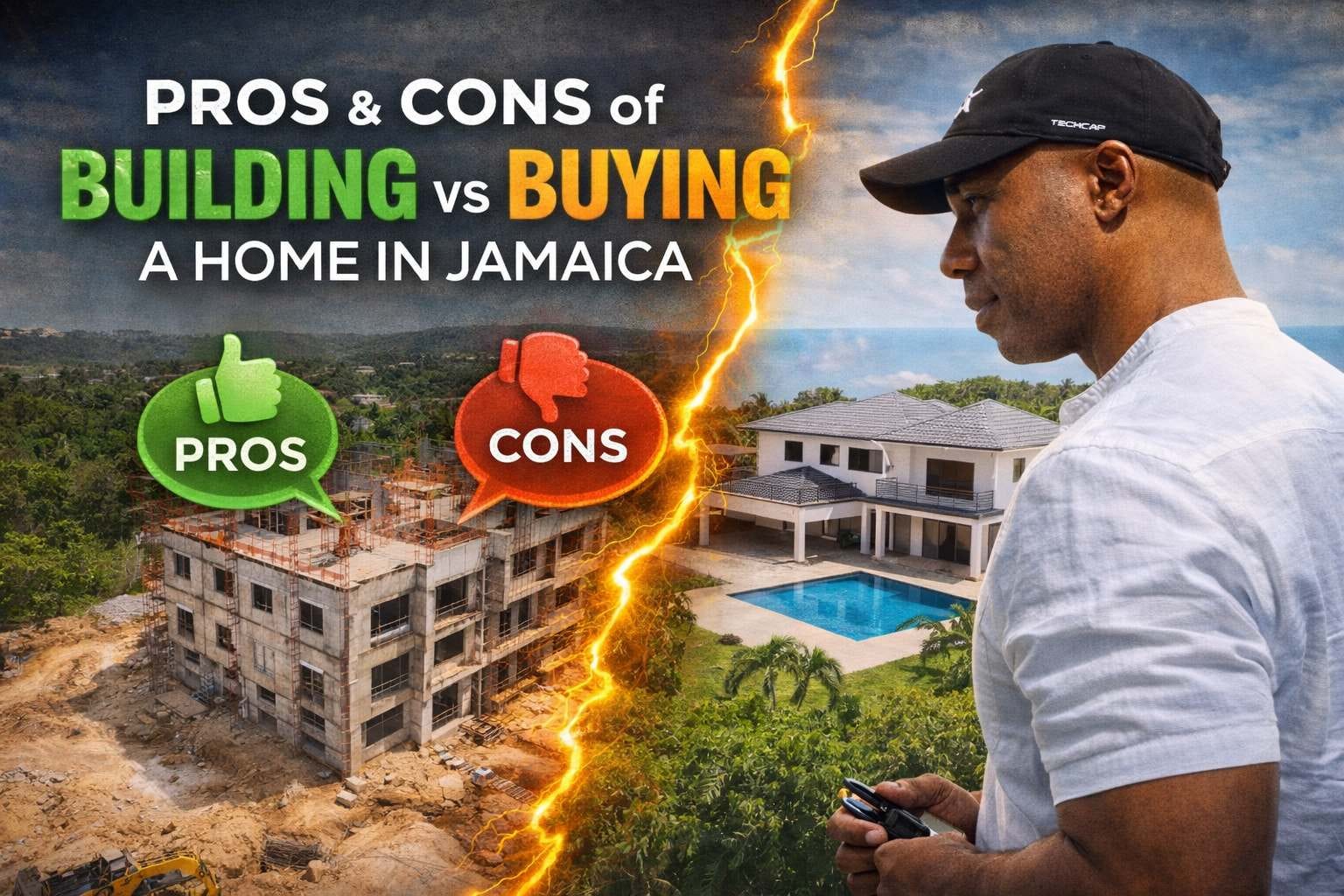
There is something deeply emotional about a house that begins as an empty piece of land.
No walls.
No windows.
Just earth, possibility, and a quiet promise.
Stand on a plot of land in Jamaica long enough and you begin to understand why so many people dream not just of owning a home here, but building one with their own vision etched into the concrete.
It is not merely a financial decision. It is a cultural instinct.
Across Jamaica, from the hills of St. Andrew to the plains of Clarendon and the growing communities of St. Catherine, thousands of homes have been built not simply because people needed somewhere to live, but because building carries a story. A story of migration, ambition, sacrifice, and ultimately coming home.
And nowhere is that story clearer than in the legacy of the Windrush generation.
The Long Journey Home
In the late 1940s and 1950s, thousands of Jamaicans boarded ships and travelled to Britain in search of opportunity. The arrival of the Empire Windrush in 1948 has since become one of the defining moments in Caribbean migration history.
They went to work.
Factories in Birmingham.
Hospitals in London.
Transport systems across the United Kingdom.
Life abroad was rarely easy. Winters were harsh. Work was demanding. But the dream many carried quietly in their minds was simple: one day they would return home.
And when they did, they would build.
Across rural Jamaica today, you can still see the evidence of that dream. Large concrete houses — sometimes standing proudly on hillsides — built gradually over years of hard work overseas. Many of them started with money saved from night shifts and double shifts abroad.
Some were finished quickly.
Others took decades.
But the intention was always clear.
“For generations of Jamaicans, building a house back home was never just construction. It was a declaration that no matter how far we travelled, our roots still belonged here.” — Dean Jones, Founder of Jamaica Homes
The tradition continues today. Jamaicans living in London, Toronto, New York, and Miami still send money home to purchase land and construct houses — not always immediately, but eventually.
Because in Jamaica, building a house often means building a return ticket for the future.
Building vs Buying: A Question of Vision
At some point in the journey toward homeownership, every buyer faces a question:
Should you build a home, shaping every wall and corner to suit your life?
Or should you buy a home that already exists, ready for you to move into?
In some countries the answer may come down purely to cost or convenience. But in Jamaica, the decision is wrapped up in tradition, land ownership patterns, family expectations, and the simple fact that many Jamaicans grow up watching homes being built around them.
Construction is part of the national landscape.
Steel rods rising from half-finished columns.
Concrete mixers humming in the morning heat.
Neighbours offering advice from across the fence.
It is, in many ways, a community activity.
The Allure of Building From Scratch
There is something undeniably powerful about building a home from the ground up.
You start with a vision.
Perhaps a veranda catching the evening breeze.
A kitchen large enough for Sunday dinners.
Maybe an extra floor planned for the future — because in Jamaica, houses are often designed not just for today, but for the generations that follow.
When you build, the house becomes an extension of the family itself.
Layouts can reflect how Jamaicans actually live. Large gathering spaces. Separate entrances for rental units. Outdoor areas that allow the indoors and outdoors to blend seamlessly together.
In a climate where sunlight and breeze are everyday companions, architecture becomes part of lifestyle.
And because everything is new — wiring, plumbing, roofing — there can be a reassuring sense that the home begins its life with a clean slate.
Modern construction also allows homeowners to incorporate better ventilation, smarter energy use, and stronger building practices that reflect lessons learned over decades of experience in Caribbean weather conditions.
Of course, new construction rarely happens in silence.
Anyone who has lived in a growing Jamaican development will know the familiar rhythm: hammering in the morning, concrete trucks rolling in, and the occasional neighbour debating loudly whether the column “look level.”
It is, in its own way, the soundtrack of progress.
The Reality Check of Construction
Yet building a home, however inspiring, is rarely a simple process.
Construction costs in Jamaica can fluctuate depending on materials, labour availability, and location. Cement, steel, imported fixtures — all can rise or fall in price.
Then there are the hidden elements people sometimes overlook at the beginning:
Land preparation.
Drainage.
Professional drawings and approvals.
Utility connections.
The blank canvas that looked so inviting at the start can slowly reveal itself to be a complex puzzle of decisions.
Time is another factor.
A home may take months — sometimes longer — to complete depending on scale, planning, and unforeseen delays. For families who need somewhere to live immediately, this waiting period can present challenges.
But patience is something Jamaicans have always understood.
After all, many of those Windrush homes were built one floor at a time, as savings allowed.
The Quiet Appeal of Buying an Existing Home
While building captures the imagination, buying an existing home offers a different kind of comfort.
Certainty.
You can walk through the front door and immediately understand the space. The rooms already exist. The neighbourhood already has its rhythm.
Established communities across Jamaica often carry a character that takes years to develop — mature trees, familiar shopkeepers, neighbours who know one another.
For many buyers, that sense of belonging is priceless.
There is also the practical benefit of timing.
Buying an existing home often allows families to move in far more quickly than waiting for a construction project to finish.
In a busy life filled with work, school runs, and everyday responsibilities, that simplicity can be extremely valuable.
And in many cases, existing homes can also offer cost advantages compared to building a new property of similar size and quality.
The Trade-Offs That Come With Older Homes
Yet buying an existing home comes with its own set of compromises.
Inventory in desirable areas can sometimes be limited. When demand rises, competition for the best properties increases.
Older homes may also require maintenance or upgrades.
Roofs age. Plumbing systems need modernisation. Kitchens built twenty years ago may not match modern expectations.
None of these issues are necessarily deal breakers — but they are realities buyers must consider when weighing their options.
In truth, the perfect home rarely exists.
Most homeowners eventually adapt a space to fit their lives, whether through renovations or simply learning to appreciate what the property already offers.
Why Guidance Matters
Whether building or buying, navigating Jamaica’s property market can be complex.
Financing arrangements, land titles, contracts, and construction agreements all require careful attention.
That is where experienced real estate professionals can play an important role — helping buyers avoid costly mistakes and understand the true implications of each decision.
As Dean Jones often reminds clients:
“The smartest property decisions are rarely the fastest ones. A home should be chosen with patience, wisdom, and a clear vision of the life you want to build inside it.” — Dean Jones
Real estate is not just about transactions.
It is about people making one of the most significant investments of their lives.
The Deeper Meaning of Home
In the end, the choice between building and buying is deeply personal.
Some people feel drawn to the creative journey of construction — watching an idea slowly become a structure that will stand for decades.
Others find comfort in a home that already exists, ready to welcome them immediately.
Both paths are valid.
Both lead to the same destination.
And perhaps that is why the tradition of Jamaicans building homes has endured for generations.
Because a house here is rarely just about property value or square footage.
It is about identity.
About family.
About belonging.
“When Jamaicans build a home, they are doing more than pouring concrete. They are anchoring their future in the place that first shaped them.” — Dean Jones
And so the quiet ritual continues.
A piece of land.
A vision.
And somewhere in the distance, the echo of a journey that began long ago — when people left this island with hope in their hearts and the promise that one day, somehow, they would return and build.