

Crown, Memory, and the Road Ahead
Jamaica’s relationship with the Queen was never simple, and perhaps that is exactly why it still matters now

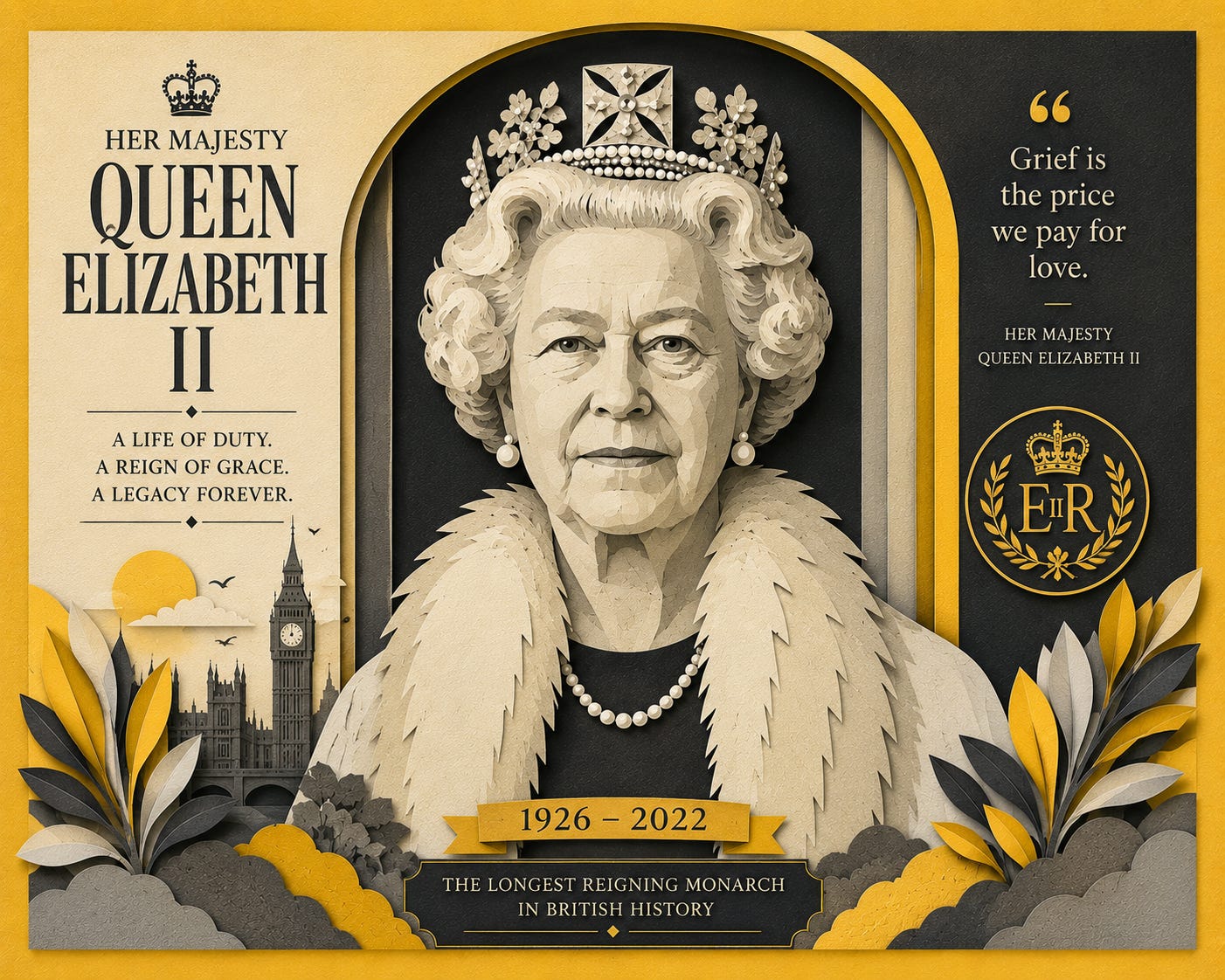
When Queen Elizabeth II ascended to the throne in 1952, Jamaica was still a British colony. By the time she died in September 2022, she had reigned through Jamaica’s independence, the rise of the Windrush generation, the expansion of modern Kingston, the growth of the tourism economy, and the emergence of a confident Jamaican identity increasingly willing to question whether the monarchy still belonged at the centre of national life.
Her reign lasted 70 years. Few world leaders, monarchs, or political systems remained constant for that length of time. In Jamaica, that continuity mattered more than people sometimes admit.
The Queen first visited Jamaica in November 1953, less than two years after becoming monarch. She was the first reigning sovereign ever to visit the island. Contemporary reports described enormous crowds gathering to see her motorcade, with some estimates placing attendance at around 250,000 people at a time when Jamaica’s population stood near 1.5 million.
She would eventually visit Jamaica six times, in 1953, 1966, 1975, 1983, 1994, and 2002. Those visits stretched across almost the entire modern political life of independent Jamaica.
And that matters historically because Jamaica itself changed dramatically during those decades.
On August 6, 1962, Jamaica gained independence from Britain. Yet unlike some countries that fully severed constitutional ties with the Crown immediately, Jamaica chose to remain a constitutional monarchy within the Commonwealth, keeping the Queen as Head of State while political authority shifted to an elected Jamaican government.
That constitutional arrangement created one of the most fascinating contradictions in modern Caribbean history. Jamaica became independent, but the Crown remained woven into the country’s legal and institutional framework.
The office of the Governor-General was established in 1962 to represent the monarch locally. Today, the Governor-General resides at King’s House, one of the most symbolically important properties in the country. Constitutionally, the Governor-General acts on behalf of the monarch, now King Charles III, although executive authority is exercised within Jamaica’s parliamentary democracy.
Real estate and land sit quietly underneath much of this story.
Many of Jamaica’s modern property systems were inherited from Britain. Land registration, probate procedures, title systems, surveying practices, inheritance structures, and aspects of conveyancing law evolved directly from British legal traditions established during colonial rule. Even debates surrounding family land, estate division, Crown land, and property taxation carry echoes of that shared legal history.
The connection between Britain and Jamaica also became deeply physical through migration.
Thousands of Jamaicans travelled to Britain during the Windrush era to help rebuild the United Kingdom after World War II. Many found work in transport, healthcare, construction, manufacturing, and public services. They sent money home, bought land, built houses, financed extensions, paid mortgages, and supported relatives across Jamaica for decades.
Entire communities across the island were partly financed through British earnings. In that sense, Jamaican and British housing markets became linked through diaspora life. A nurse in London might help build a home in St Elizabeth. A bus driver in Birmingham might buy a lot in Clarendon. A Jamaican family’s ability to own property often became tied directly to migration patterns shaped during the Queen’s reign.
For many in that generation, the Queen represented stability, continuity, and discipline. That sentiment was especially common among sections of the Caribbean diaspora living in Britain. Many admired her consistency and sense of duty even while acknowledging the wider controversies surrounding the monarchy itself.
And that distinction remains important.
Because respect for Queen Elizabeth II as an individual did not necessarily erase criticism of the institution she represented.
The British monarchy remains historically connected to empire, colonial rule, slavery, extraction of wealth, and systems of inequality that shaped much of the Caribbean. Jamaica’s plantation economy, historic land ownership patterns, and social hierarchies emerged under imperial structures tied to the Crown. Critics argue that those historical realities cannot simply be separated from the monarchy’s legacy.
That debate has intensified in recent years, particularly following wider global discussions around race, reparations, colonialism, and the Windrush scandal in Britain.
The Queen’s final visit to Jamaica in 2002 revealed some of that complexity already emerging publicly. Even then, republican sentiment was becoming more visible within parts of Jamaican society, although polling at the time suggested many Jamaicans still viewed the Queen positively.
Since her death, the constitutional conversation has accelerated further.
In December 2024, Jamaica formally introduced legislation aimed at removing the monarch as Head of State and transitioning toward becoming a republic. The move followed a broader regional trend already visible across the Caribbean.
Barbados formally became a republic on November 30, 2021, removing Queen Elizabeth II as Head of State while remaining a member of the Commonwealth. That transition was viewed by many across the region as symbolic of a wider Caribbean effort to complete the final constitutional stages of independence.
Jamaica now appears to be moving cautiously in a similar direction.
Importantly, however, this shift is not necessarily driven by hostility toward the late Queen herself. In fact, many Jamaicans who support republicanism still speak respectfully about Elizabeth’s reign. The argument is often less about one individual and more about what national identity should look like in the twenty first century.
And perhaps that is why the Queen’s legacy in Jamaica remains so layered.
Her reign touched nearly every major chapter of modern Jamaican development, independence, migration, tourism, urban expansion, constitutional reform, diaspora growth, and property ownership among them. Whether viewed with admiration, criticism, or a mixture of both, she became part of the architecture of Jamaican life for more than seven decades.
Now Jamaica stands between two eras.
One defined by a monarch whose image shaped generations across the Commonwealth, and another increasingly focused on defining Jamaican sovereignty entirely on Jamaican terms.
History rarely moves in clean lines. Sometimes it moves through institutions, through migration, through family memory, through land ownership, and through buildings that quietly outlive the people who once governed them.
The Crown’s story in Jamaica was never only about royalty.
It was also about houses, inheritance, identity, migration, law, belonging, and the long complicated relationship between a small Caribbean island and Britain itself.