


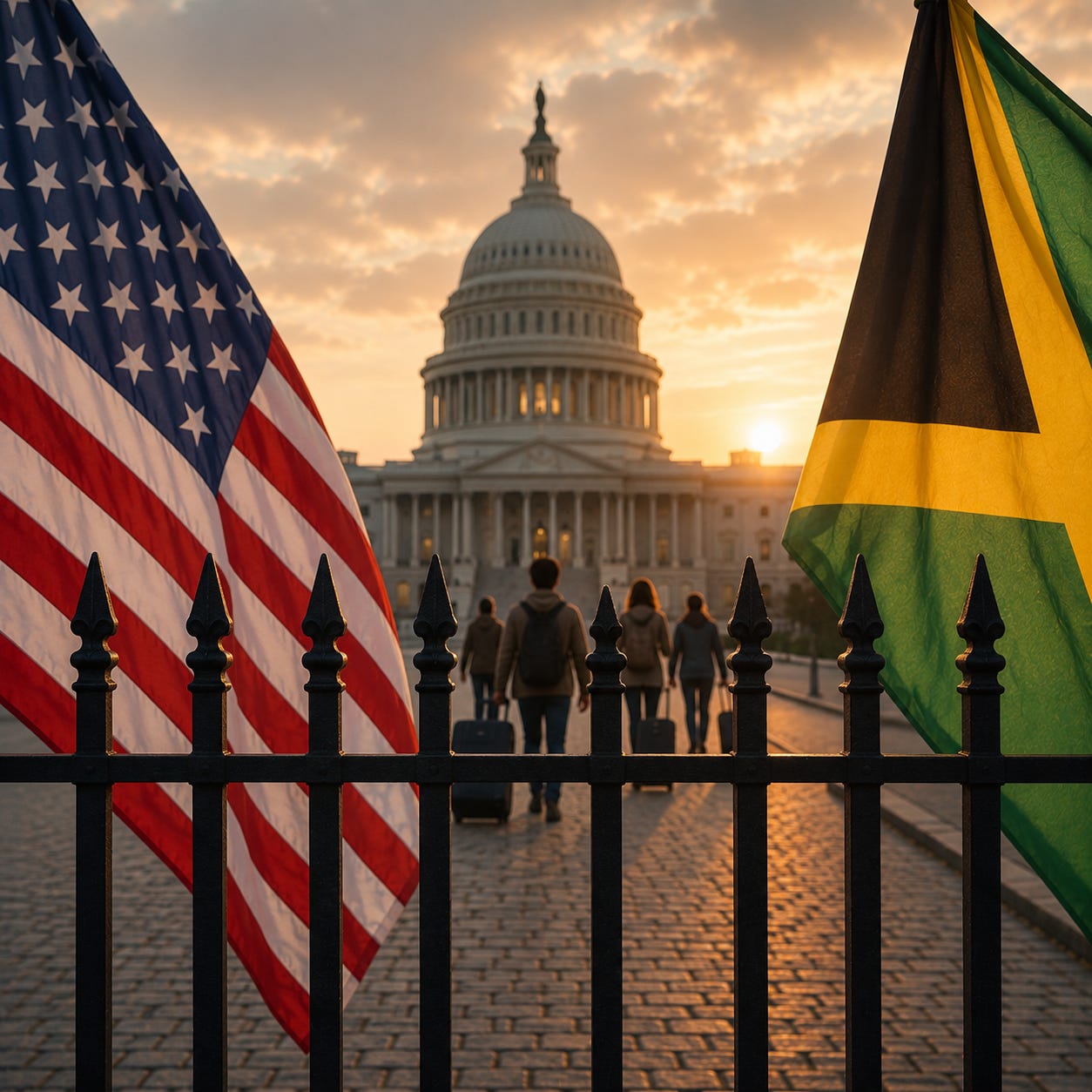
Jamaica is reportedly in discussions with the United States regarding a Third Country Nationals agreement that could see non-Jamaican deportees transferred to the island after being removed from the United States.
The proposed arrangement has already generated significant public debate. It should.
At its heart lies a simple question that the Government must answer clearly and honestly.
What exactly does Jamaica gain?
The United States gains something obvious. It gains another destination for individuals it wishes to remove from its territory. It gains another partner willing to assist with a politically sensitive immigration challenge. It gains flexibility in carrying out deportation policies that have become increasingly difficult and controversial.
The benefits to Washington are clear.
The benefits to Jamaica are not.
Supporters may argue that the agreement strengthens relations between Kingston and Washington. That may be true. The United States is Jamaica’s most important economic partner. Millions of visitors arrive from America every year. Remittances from Jamaicans living in the United States help support countless households. Cooperation between the two countries is important and should continue.
But diplomacy alone cannot be the answer to every difficult question.
A sovereign nation should be able to ask whether a proposed arrangement serves its own interests, not merely the interests of a larger and more powerful ally.
Jamaica is not suffering from a shortage of challenges that require government attention.
The country continues to face pressures in housing, healthcare, education, crime reduction, infrastructure and economic growth. Communities across the island continue to struggle with inadequate roads, water systems and public services. Young people continue to leave in search of better opportunities abroad. Businesses continue to complain about labour shortages in critical sectors.
Against that backdrop, many Jamaicans may reasonably ask why the Government is dedicating time and resources to managing individuals who have no connection to Jamaica.
These are not Jamaican citizens.
They are not members of the Jamaican diaspora.
They are not individuals seeking to contribute to Jamaica’s development.
They are people whom another country has decided it no longer wishes to accommodate.
That distinction matters.
The Government has sought to reassure the public that this is a transit arrangement rather than a permanent settlement programme. Officials have indicated that the numbers would be limited and that criminal offenders would not be accepted.
Those assurances are important.
They are also not enough.
The history of immigration policy around the world demonstrates that temporary arrangements often become more complicated than initially anticipated.
What happens if an individual’s country of origin refuses to accept them?
What happens if legal challenges prevent their onward transfer?
What happens if asylum claims emerge?
What happens if individuals remain on the island longer than expected?
What happens if Jamaica becomes responsible for accommodation, healthcare, security or administrative oversight?
These are not theoretical concerns.
They are practical questions that deserve practical answers.
The issue is not whether the proposed numbers are twenty-five people every two weeks or ten thousand people over several years.
The issue is responsibility.
Every individual transferred under such an agreement creates obligations, costs and risks. Even where those costs appear modest on paper, they consume administrative attention and public resources.
The Government has a duty to explain why those resources should be directed toward managing foreign deportees rather than addressing domestic priorities.
There is also a broader principle at stake.
Small nations frequently find themselves navigating the interests of larger powers. That reality is not unique to Jamaica. It is part of international politics.
However, there is a difference between cooperation and dependency.
Cooperation occurs when both parties derive clear and measurable benefits.
Dependency occurs when one party assumes the burden while the other receives most of the advantage.
Many Jamaicans will look at this proposal and wonder which category it falls into.
The answer matters because public confidence depends upon transparency.
If Jamaica is receiving significant economic support, investment commitments, development funding, security cooperation or other tangible benefits, the public deserves to know.
If no such benefits exist, the public deserves to know that too.
A mature democracy should not be afraid of that conversation.
The Government may ultimately conclude that the agreement is in Jamaica’s national interest. That is its right.
But national interest cannot simply be asserted. It must be demonstrated.
At present, many Jamaicans appear unconvinced.
They see a proposal that primarily helps the United States address a domestic political challenge. They see potential risks being transferred to Jamaica. They see unanswered questions about costs, accountability and long-term consequences.
Most importantly, they see little evidence of how their own lives will improve as a result.
That may be the central weakness of the proposal.
Successful public policy usually offers a clear answer to a simple question.
How does this help Jamaica?
Until that question is answered convincingly, scepticism will remain justified.
A strong relationship with the United States is important. Few would dispute that.
But friendship between nations should not require one country to inherit responsibilities that properly belong to another.
Jamaica’s first obligation is not to solve America’s immigration challenges.
Jamaica’s first obligation is to Jamaica.