


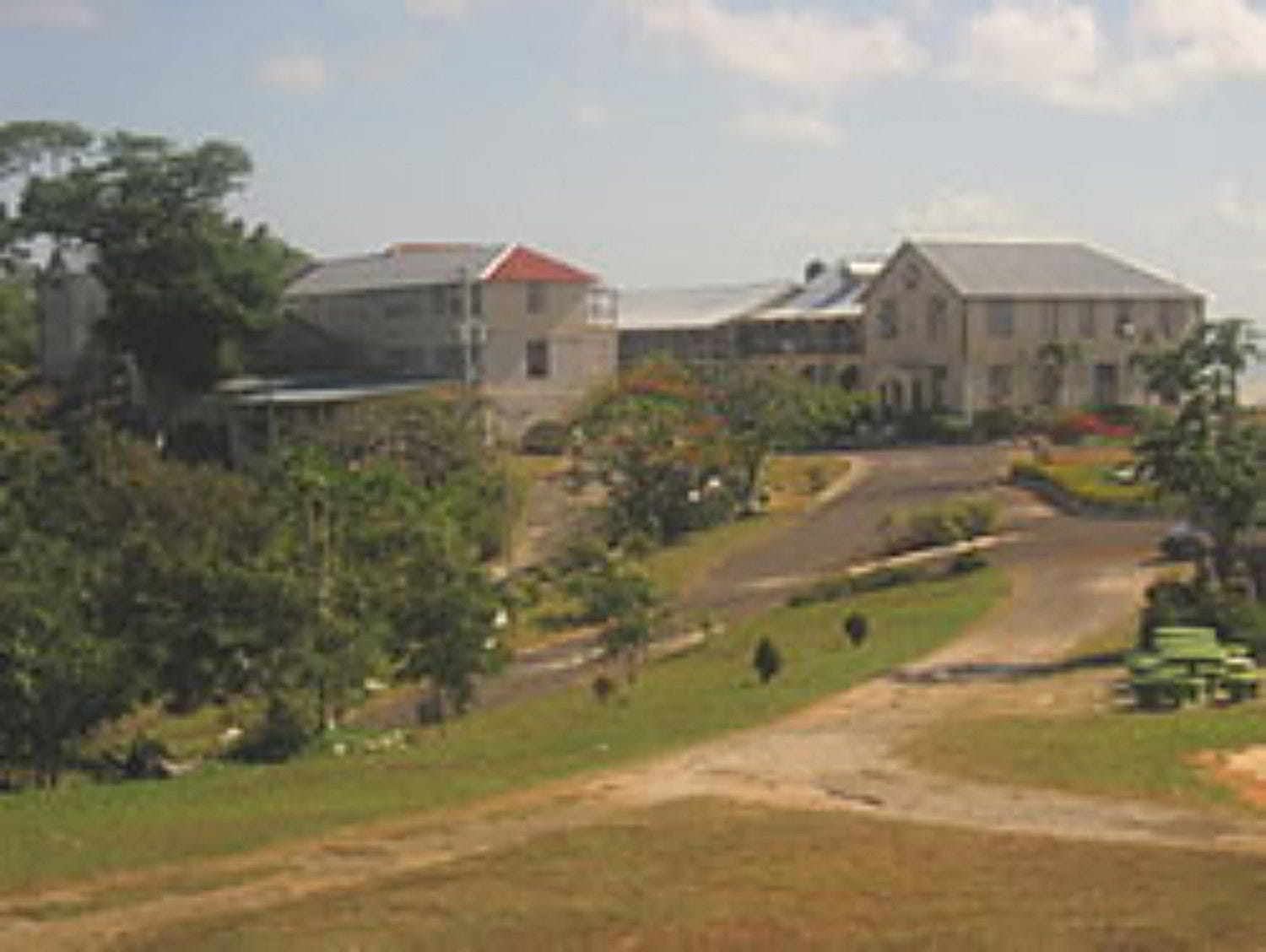
Location: St. Elizabeth, Jamaica
Hampton School originated from the Munro and Dickenson Trust, established through Robert Hugh Munro’s will in 1797. Munro left a portion of his estate to his nephew Caleb Dickenson and the Churchwardens of St. Elizabeth to create a school for poor children. Dickenson expanded the estate, and upon his death in 1821, he left instructions for the funds to be used for education. However, it was not until 1855 that part of the original bequest was used, leading to the formation of the “Governors and Trustees of Munro and Dickenson Free School and Charity.”
In 1856, a free boys’ school was opened, later known as Munro College. A girls’ school was started in 1858 at Potsdam but moved several times before settling in Stirling. By 1884, the girls’ school had fewer than 12 students. In 1885, a new headmistress, Miss McCutcheon, reopened the school at Malvern House, but by 1891, it was relocated to Hampton, formerly Fort Rose. The property was purchased in 1896, and the school was renamed Hampton.
In 1890, the Trustees introduced a system of Lady Principal and Headmistress, with Mrs. Julia Comrie as Principal and Miss Geddes as Headmistress. However, by 1893, the Trustees reverted to the original system, appointing Miss Holden as Headmistress. Miss Holden introduced subjects like drawing, painting, and music, transforming the school into a reputable institution. By 1904, the school had over 60 girls.
Miss Barrows succeeded Miss Holden, overseeing significant growth in the school’s infrastructure, including new music rooms and dormitories. Miss Campbell, Principal from 1922 to 1932, is remembered for her efforts to build the Chapel, a key feature of the campus.
Today, Hampton School continues to provide a well-rounded education to approximately 950 students, one-third of whom are boarders.
Calder Hall
Calder Hall was completed under Trustee Mr. Henry Maxwell’s supervision and opened in 1913. It was named after Mr. John Vassal Calder, the long-serving chairman of the Trust. The building features a cut-stone base, timber upper floor, and a gable roof with dormer windows. The ground floor remains a hall and common room, while the upper floor now serves as a staff room, known as “Parnassus.”
Administrative Office Building
Originally the great house of the Hampton estate, this two-story building dates back to the nineteenth century. It has a timber upper floor with a lower level of nogging, a verandah with timber columns and handrails, sash windows, and a hip roof.
Wesley Gammon Building
Named after former Principal Wesley Gammon, this building was constructed during Miss Maud Barrows’ tenure. It has a cut-stone base with a timber upper floor and a hip roof, with a shed roof covering the timber balcony.
The Chapel
The Chapel, a stone structure with a gable roof, features an east window considered the finest stained glass window in Jamaica. Designed by James Balantyne of Edinburgh, it was built during Miss Campbell’s leadership. The Chapel’s foundation stone was donated by Mr. McLeod, builder of the Scottish War Memorial.
Val Halla
Val Halla, the music room, was built during Miss Maud Barrows’ leadership. The cut-stone structure, with a concrete addition on its left side, features sash windows, a gable roof, and a verandah with timber posts and handrails. Val Halla continues to be a central part of the school’s music program.