

Harmony Hall: Jamaica’s Living Monument Where History, Architecture and Investment Converge
From plantation estate to cultural powerhouse, a St. Mary landmark quietly anchors a new corridor of growth

Key points
Late 19th century estate house turned national monument and art gallery
Located in Tower Isle, St. Mary, near Ocho Rios and Ian Fleming International Airport
Declared a national monument in 2003, tied to Jamaica’s national anthem history
Positioned within a growing tourism and investment corridor in north-east Jamaica
Tucked into the lush hills of Tower Isle, St. Mary, Harmony Hall stands not just as a preserved relic of Jamaica’s past, but as a working symbol of how heritage, culture, and real estate continue to intersect in modern Jamaica.
Originally built in the late nineteenth century as the estate house of a modest pimento and lime plantation, the property has evolved alongside the island itself. Over time, its agricultural base shifted to bananas and later coconuts, reflecting broader changes in Jamaica’s rural economy . Today, the building carries a different kind of yield, cultural, historical, and increasingly, economic.
A house that followed the island’s history
Harmony Hall’s story mirrors Jamaica’s own transformation. It served not only as a plantation house, but also as a Methodist manse and private residence. During the late 1930s, it housed the family of Reverend Hugh Sherlock, who would later write the lyrics to Jamaica’s national anthem, a detail that places the property firmly within the country’s national narrative .
This layering of uses, agricultural, religious, residential, has left behind more than just architectural traces. It has embedded the site within the social memory of the parish and the wider nation.
Declared a national monument by the Jamaica National Heritage Trust in 2003, Harmony Hall is now formally recognised as part of Jamaica’s protected heritage stock .
Architecture that tells a wider Caribbean story
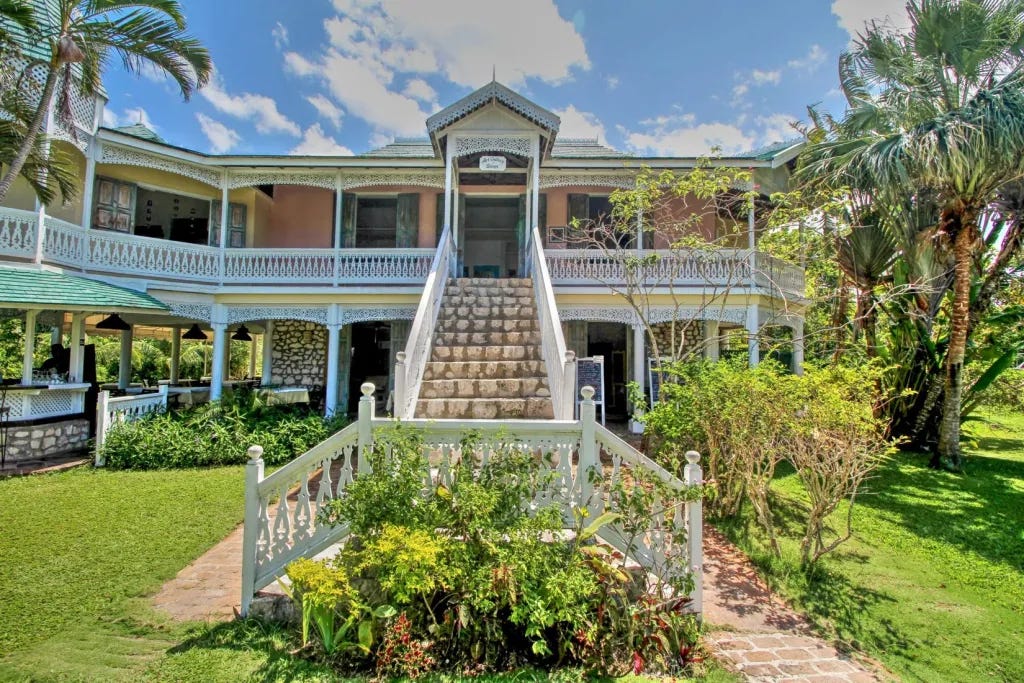
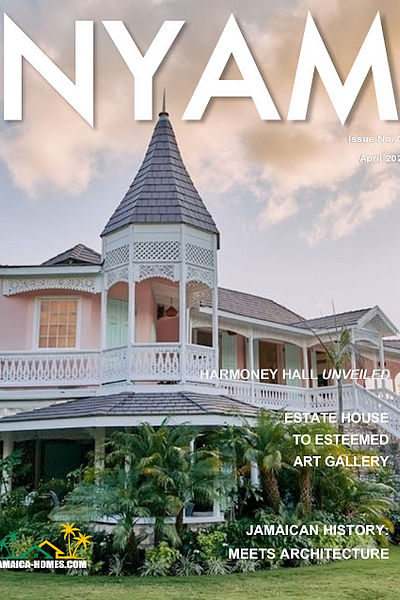
The building itself is a striking example of Jamaican-Georgian architecture, combined with Victorian influences. Its fretwork, gingerbread trim, and elevated structure reflect design adaptations made for the Caribbean climate, heat, humidity, and storms, while retaining the elegance of colonial-era aesthetics .
Unlike purely preserved museum structures, Harmony Hall has been maintained through active use. Restoration efforts have focused on preserving original design features rather than replacing them, allowing the building to remain both functional and historically authentic.
This approach reflects a broader shift in heritage management across Jamaica, where preservation is increasingly tied to viable use, not static conservation.
Reinvention through art and culture
The most significant turning point in Harmony Hall’s modern history came in 1980, when it was acquired and transformed into an art gallery by Annabella and Peter Proudlock. That transition marked a deliberate shift from private residence to public cultural space .
Since then, the Harmony Hall Art Gallery has built a reputation as one of the island’s most respected creative venues, showcasing both Jamaican and international artists. Its exhibitions, workshops, and events have positioned it as a cultural hub in St. Mary, drawing visitors beyond the traditional tourism centres.
The addition of the well-known Summerhouse restaurant, led by Jamaican culinary figures Suzanne and Michelle Rousseau, further elevated the property’s profile, blending food, art, and heritage into a single destination experience .
A strategic location in a shifting economic corridor
While Harmony Hall’s historical and cultural value is well established, its location is increasingly part of a larger economic story.
Situated just minutes from Ocho Rios and close to Ian Fleming International Airport, the property lies within what analysts are beginning to view as an emerging development corridor stretching across St. Ann and St. Mary. Increased airlift, improved infrastructure, and sustained tourism demand are gradually shifting attention eastward from traditional hotspots .
The property itself sits on just over half an acre with main road frontage, characteristics that are increasingly rare for heritage sites of this scale and visibility. Its proximity to established resorts and transport links adds to its strategic relevance.
Heritage as an investment class
In a real estate market often driven by new builds and gated communities, Harmony Hall represents a different category, heritage property with adaptive reuse potential.
Its continued use as a gallery, event space, and cultural venue demonstrates how historic assets can generate economic activity while preserving identity. Weddings, exhibitions, and tourism-related events now form part of its operational model, reinforcing the idea that heritage sites can be both culturally and financially sustainable.
More broadly, the property highlights a growing opportunity within Jamaica’s real estate sector: the repositioning of historic buildings as income-generating cultural assets, particularly in areas benefiting from tourism expansion.
A quiet anchor in Jamaica’s evolving landscape
In an era where Jamaica’s development narrative is often dominated by large-scale housing schemes and coastal resort expansion, Harmony Hall offers a quieter, but equally important, perspective.
It shows how place, memory, and architecture can be preserved without being frozen in time. It also illustrates how smaller, strategically located heritage properties can contribute to local economies, tourism diversification, and national identity.
More than a century after its construction, Harmony Hall remains active, relevant, and increasingly valuable, not just as a building, but as a model for how Jamaica’s past can inform its future.