


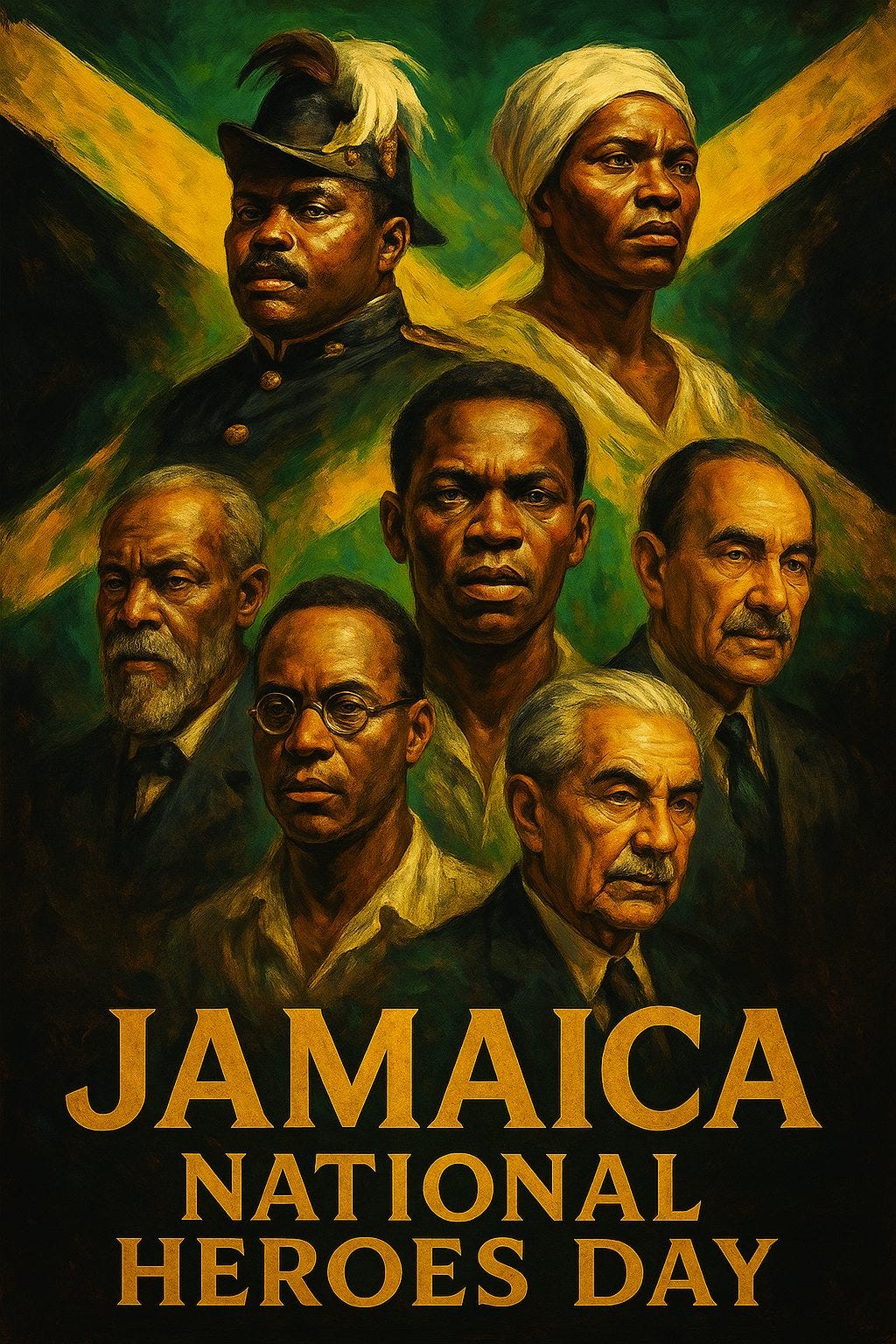
Before there were deeds, there was defiance. Before there were titles of land, there were titles earned in struggle—Queen, Prophet, Warrior, Premier—voices who built more than walls; they built belonging. Every acre of Jamaica tells their story, from the hills where Nanny’s drums beat freedom into the soil, to the plains where Sam Sharpe’s faith rose like dawn over chains. The same ground where Paul Bogle marched and George William Gordon spoke truth to power now bears the footprints of Garvey’s dream, and the handshakes of Manley and Bustamante building not houses, but a home called independence.
Today, we trade in property, but they traded in purpose. We sell land, yet they sold nothing—for their worth was never measured in dollars but in the liberty that turned a colony into a country. So before the listings, before the contracts and keys, remember this: every home in Jamaica stands upon their courage, and every title deed rests on the foundation of their fight for freedom.
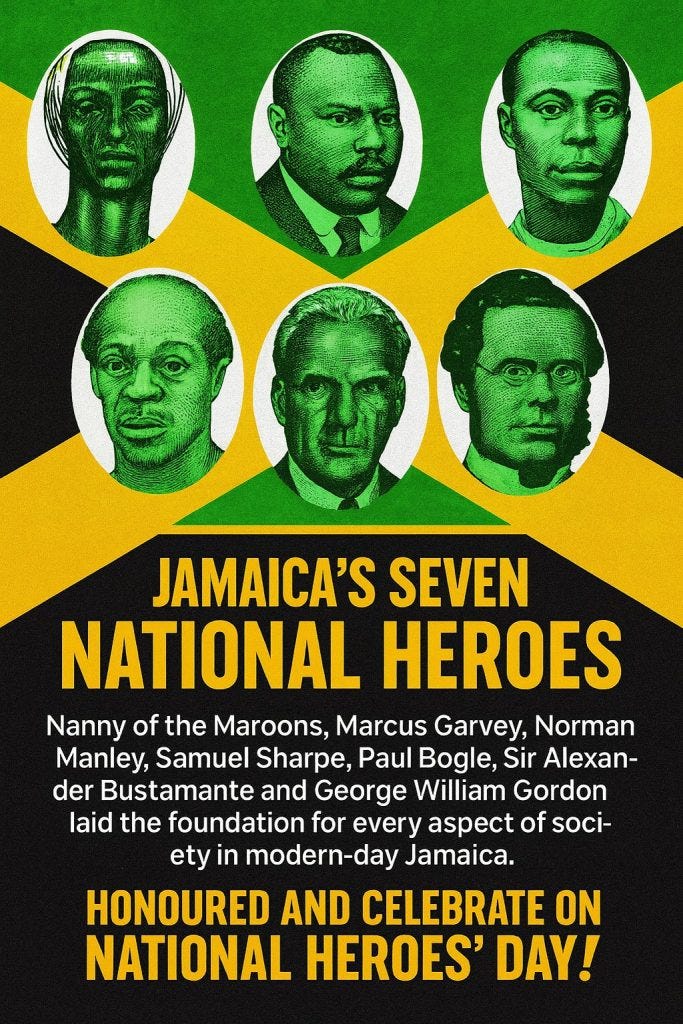
1680s–1690s: A leader is born; resistance cultures take root
c.1686 — Nanny of the Maroons (later “The Right Excellent Nanny”) is traditionally held to have been born around this time. While exact details are scarce, oral history identifies her as an Akan/Asante woman who became a leader among the Windward Maroons in Jamaica’s Blue Mountains.
Across the island, communities of Africans who escaped enslavement (the Maroons) consolidate in rugged interiors, shaping a culture of autonomous resistance that will frustrate the British for decades. (Context from Maroon histories cited below.)
1700–1720: Maroon settlement and strategy
By 1720 — Nanny and Quao (often remembered as her brother) are leading Windward Maroons from a strategic stronghold later called Nanny Town. From here the Maroons stage raids, free enslaved people, and wage guerrilla war against British troops.
1728–1734: The First Maroon War intensifies
British forces attack Windward settlements repeatedly; Nanny’s communities evacuate and regroup (later New Nanny Town). This prolonged campaign shows the effectiveness of small-unit tactics and terrain mastery against a larger army.
1739–1741: Treaties and land
1739–1740 — Peace treaties between the British and the Maroons end major hostilities.
1741 — A formal land grant of 500 acres is recorded for Nanny’s people, an official recognition of the Windward Maroons’ autonomy and leadership.
1750s–1760s: Queen Nanny’s passing (approximate)
c.1750s–1760s — Nanny dies (exact date uncertain). Maroon oral tradition maintains her burial at “Bump Grave,” Moore Town. Despite uncertainty, her legend endures as a symbol of resistance and community rule.
1801: Birth of a catalyst
1801 — Samuel Sharpe is born into slavery in St James. He will become a Baptist deacon and a critical organizer among enslaved Jamaicans.
1820–1822: Two future martyrs arrive
c.1820 — George William Gordon is born (the son of a planter and an enslaved mother). He will become a businessman, a magistrate, and an outspoken critic of colonial abuses.
c.1822 — Paul Bogle is born (likely free) in Stony Gut, St Thomas; later a Baptist deacon and Gordon’s political ally.
1831–1832: The Baptist War and its shockwaves
Dec 25, 1831 — Sharpe helps organize a mass general strike that becomes the Baptist War (aka the Christmas Rebellion), involving as many as 60,000 enslaved people—Jamaica’s largest uprising.
Jan 1832 — Colonial troops and allied Maroons suppress the revolt; reprisals are brutal. Sharpe is captured and later executed.
May 23, 1832 — Samuel Sharpe is hanged in Montego Bay. His courage and the scale of the rebellion become immediate arguments in Britain for ending slavery.
1834 — British Parliament passes the Abolition Act (apprenticeship system first). 1838 — Full emancipation in Jamaica. Sharpe’s sacrifice is widely understood to have accelerated abolition.
Intertwining note: Nanny’s guerrilla victories a century earlier had shown that freedom was thinkable and defensible; Sharpe’s movement proved that mass collective action could force legal change in London.
1860–1865: Rising protest in post-emancipation Jamaica
Early 1860s — Severe economic distress, drought, and inequitable courts push rural Jamaicans to desperation, especially in St Thomas-in-the-East. Gordon, an Assemblyman, denounces Governor Eyre’s policies and champions poor Jamaicans; Bogle organizes in the countryside.
Oct 7–11, 1865 — Bogle leads supporters from Stony Gut to Morant Bay Courthouse; militia open fire on protesters after stones are thrown, killing seven. A broader rebellion follows.
Oct 23, 1865 — Eyre declares martial law; George William Gordon is seized in Kingston, moved to Morant Bay, tried under martial law, and hanged the same day.
Oct 24, 1865 — Paul Bogle is captured and hanged. The crackdown kills hundreds; yet Gordon’s and Bogle’s moral claims for justice reshape Jamaican politics in the long run.
Intertwining note: Sharpe’s critique of slavery becomes Bogle’s and Gordon’s critique of post-emancipation injustice—a continuous line of protest from bondage to civil rights.
1884–1893: Two cousins who will found modern party politics
Feb 24, 1884 — William Alexander Clarke (later Sir Alexander Bustamante) is born in Hanover. He will lead labour and politics through mid-20th-century transformation.
Aug 17, 1887 — Marcus Mosiah Garvey is born at St Ann’s Bay; he will ignite a global Pan-African movement in the 1910s–20s.
Jul 4, 1893 — Norman Washington Manley (Bustamante’s cousin) is born in Manchester; a Rhodes Scholar, war veteran and lawyer who becomes the architect of Jamaican self-government.
1914–1927: Garveyism and a mass Black movement
July 1914 — Garvey launches the Universal Negro Improvement Association (UNIA) in Kingston: “One God! One Aim! One Destiny!”
1916–1919 — In the United States, Garvey builds UNIA into a mass movement; Negro World newspaper circulates widely; Black Star Line shipping venture is formed (1919).
Oct 1919 — Assassination attempt on Garvey in Harlem; he survives and continues organizing.
1923 — U.S. authorities convict Garvey on mail-fraud charges related to Black Star Line; 1927 deportation to Jamaica. (A controversial case long challenged by scholars and later subject to renewed pardon campaigns.)
Intertwining note: Garvey’s global call for Black pride, economic self-help, and unity gives ideological backbone to later Jamaican nationalism; his words echo in future leaders’ rhetoric, and even in popular culture (“Emancipate yourselves from mental slavery”).
1930s: Labour upheaval, parties, and constitutional change
1938 — Island-wide labour protests explode. Norman Manley helps found the People’s National Party (PNP); Bustamante becomes the era’s dominant labour champion and soon breaks away to form his own trade union (BITU).
1943 — Bustamante formally founds the Jamaica Labour Party (JLP) to contest elections.
1944 — Britain grants universal adult suffrage and a new constitution; Jamaica holds modern party elections, cementing Manley and Bustamante as rivals—and (increasingly) as co-architects of self-rule.
1950s: The road to internal self-government
1953 — Bustamante becomes Chief Minister under the new constitution; the island edges toward autonomy.
1955–1959 — Norman Manley serves as Chief Minister (1955) and then as Jamaica’s first Premier (1959), steering constitutional negotiations and preparing institutions for sovereignty.
1961–1962: Decision time—Federation or independence
1961 — A referendum rejects continued membership in the West Indies Federation, a campaign on which Manley allows a free vote; Bustamante pushes decisively for separate Jamaican independence.
1962 (April) — JLP wins the election; Aug 6, 1962 — Jamaica becomes independent, and Bustamante is sworn as the first Prime Minister.
1964–1969: Honours, reburials, and the founding fathers’ legacy
Nov 10–11, 1964 — Marcus Garvey’s remains are returned from London and reinterred in National Heroes Park. On Nov 11, he is proclaimed Jamaica’s first National Hero. (Later, when the national honours system is formally created, he will also receive the Order of National Hero.)
1968–1969 — Jamaica establishes the Order of National Hero (National Honours and Awards Act), first conferred 1969. That year, the Government officially invests several heroes with the Order, including Garvey, Bustamante, Manley, Bogle, and Gordon (some were already proclaimed national heroes earlier).
Sep 2, 1969 — Norman Manley dies in Kingston; weeks later, on Oct 18, 1969, he is formally conferred with the Order of National Hero (with his cousin Bustamante). The two are remembered jointly as founders of Jamaican independence.
1970–1977: Closing a century of struggle
Mar 31, 1982 (context note for honours) — Although outside the “to 1977” frame, it’s essential to note that the Government later conferred the Order of National Hero on Nanny and Samuel Sharpe (both long deceased) on this date, formally placing the 18th- and early-19th-century freedom struggles at the apex of national memory.
Aug 6, 1977 — Sir Alexander Bustamante dies—the last of the seven National Heroes to pass and the only one to be invested as a National Hero during his lifetime. His death, poignantly, falls on the 15th anniversary of Independence Day.
Why “intertwined”?
Nanny’s 18th-century insurgency made freedom plausible—and set a template for organizing communities, defending territory, and negotiating with empire.
Sharpe’s mass action reframed the moral and political imperative for abolition in Britain, hastening the legal end of slavery (1834–1838).
Bogle–Gordon carried the struggle into the age of citizenship—demanding justice, representation, and fair courts after slavery. Their 1865 martyrdom haunted colonial governance and nourished a Jamaican idea of rights.
Garvey gave Jamaica and the diaspora an ideology of dignity and self-reliance, which inspired later nationalism and cultural identity.
Manley–Bustamante translated this moral and ideological inheritance into institutions—parties, universal suffrage, constitutional milestones—and ultimately independence.
Extended, year-by-year braid (selected highlights)
1686–1741: Maroon ascent
c.1686 — Birth of Nanny.
1720 — Nanny and Quao established in Blue Mountains; Nanny Town emerges as a command centre.
1728–1734 — First Maroon War peaks; British expeditions fail to extinguish Windward resistance.
1739–1740 — Treaties recognize Maroon autonomy.
1741 — Land grant for Nanny’s people.
c.1750s–1760s — Nanny dies; her legend cements the moral authority of Maroon self-rule.
1801–1838: From plantation to Parliament’s conscience
1801 — Birth of Sharpe.
1831–1832 — Baptist War; Sharpe’s execution and the parliamentary reckoning that follows. 1834 Abolition Act; 1838 full freedom.
1820–1865: Post-emancipation justice on trial
c.1820 / c.1822 — Births of Gordon and Bogle.
Oct 11, 1865 — Morant Bay protest; militia fire on crowd.
Oct 23–24, 1865 — Executions of Gordon and Bogle under martial law.
1884–1927: Two cousins and a Pan-Africanist
1884 — Birth of Bustamante.
1887 — Birth of Garvey.
1893 — Birth of Manley.
1914 — Garvey launches UNIA in Kingston.
1916–1919 — Garvey’s global rise; Black Star Line formed.
1919 — Garvey survives assassination attempt in New York.
1923–1927 — Garvey imprisoned, deported; returns to Jamaica then leaves for London.
1938–1944: From strikes to suffrage
1938 — PNP founded by Manley; labour upheavals crest; Bustamante dominates worker politics.
1943–1944 — JLP formed (1943); universal adult suffrage introduced; party competition begins.
1953–1962: Internal self-rule to Independence
1953 — Bustamante, Chief Minister.
1955–1959 — Manley, Chief Minister then Premier.
1961 — Referendum rejects Federation membership.
1962 — JLP wins; Independence on Aug 6; Bustamante first PM.
1964–1969: Memory and nationhood
1964 — Garvey’s body repatriated and proclaimed first National Hero (Nov 11).
1969 — Creation/conferment of Order of National Hero; Garvey, Bustamante, Manley, Bogle, Gordon invested under the new system.
Sep 2, 1969 — Manley dies; Oct 18, 1969 — Manley and Bustamante publicly styled “The Right Excellent.”
1977: The final farewell
Aug 6, 1977 — Bustamante dies, the last of the seven to “close his eyes,” on Independence Day’s 15th anniversary.
(Postscript for completeness)
Mar 31, 1982 — The Government confers the Order of National Hero on Nanny and Samuel Sharpe, cementing the seven we honour today.
Brief biographical through-lines (why each matters to the others)
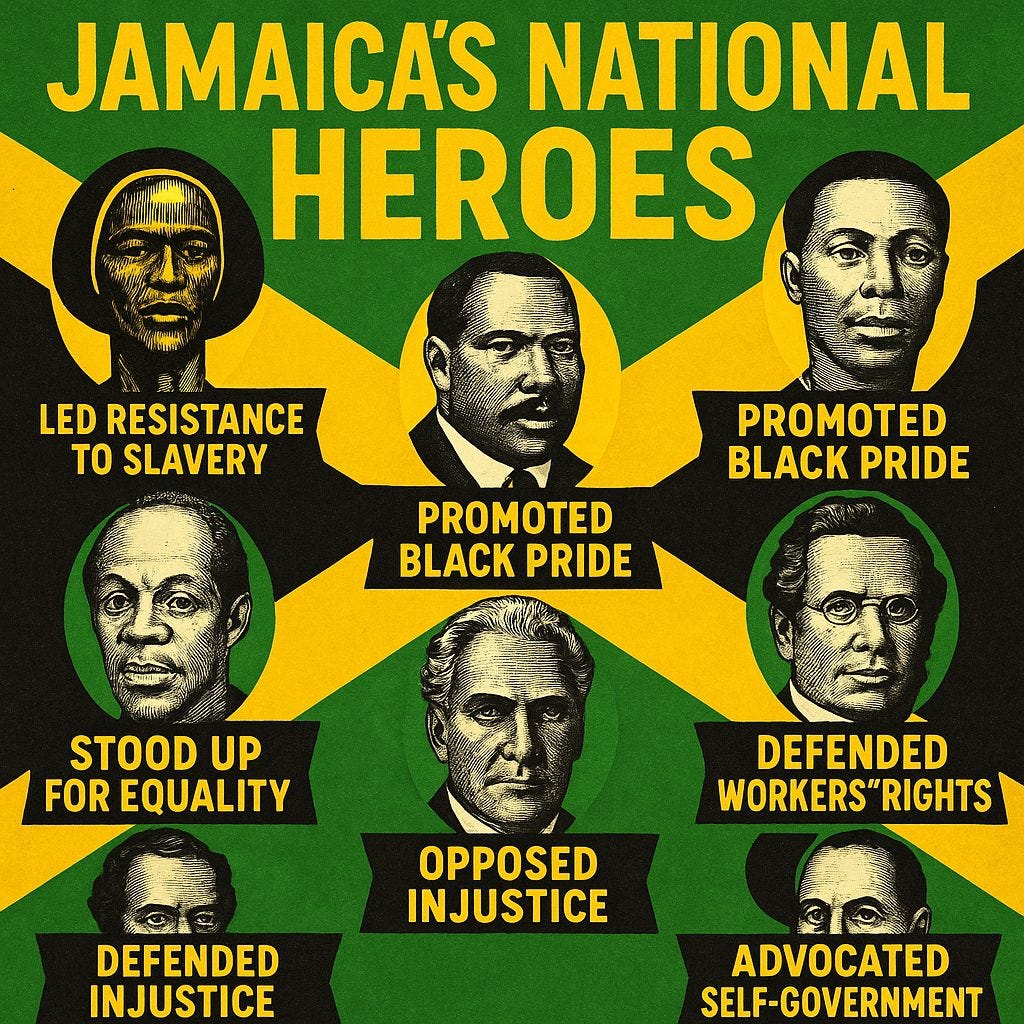
Nanny of the Maroons (c.1686–c.1760) — Led Windward Maroons in the First Maroon War, negotiated land and autonomy (1741). Her community model of freedom inspired later generations and proved that resistance can win recognition.
Samuel Sharpe (1801–1832) — As a Baptist deacon, used religious networks to coordinate a mass strike/uprising (1831–32) that jolted British politics en route to abolition (1834/1838). Moral suasion + organized action becomes a Jamaican tradition.
George William Gordon (c.1820–1865) & Paul Bogle (c.1822–1865) — An elite critic and a rural organizer combine to challenge post-emancipation injustice in 1865, paying with their lives. Their alliance anticipates modern civil-rights coalitions across class and geography.
Marcus Garvey (1887–1940) — Build a diasporic mass movement (UNIA), business experiments, and a global press to proclaim Black pride and self-help; his repatriation and proclamation as the first National Hero in 1964 shows how diaspora ideas feed Jamaican nationhood.
Norman Manley (1893–1969) & Sir Alexander Bustamante (1884–1977) — Canny organizers who convert moral ideals into parties, constitutions, and independence—often as rivals, always as nation-builders. Their joint investiture (1969) acknowledges two paths to the same Jamaica.
About honours and dates (to reconcile the records)
National Hero vs. Order of National Hero: Jamaica proclaimed Garvey a National Hero in 1964 when his body was repatriated and reburied; the statutory Order of National Hero (ONH) was created later by the National Honours and Awards Act (1969) and first conferred that same year. In 1969, Garvey, Bustamante, Manley, Bogle, and Gordon received the Order; Nanny and Sharpe were conferred ONH on Mar 31, 1982.
Key references for verification
Jamaica Information Service hero pages and awards pages (official government source).
PBS “American Experience” Garvey Timeline (for 1964 repatriation/proclamation).
National Library of Jamaica profiles (Manley biography; Garvey reburial note).
Encyclopædia Britannica (Garvey overview).
Academic/credible summaries of the Baptist War and Morant Bay events.
Wikipedia entries for quick cross-checks of births/deaths where official pages are silent (Sharpe, Bogle, Gordon, Bustamante) — corroborated against JIS where possible.
National Heroes’ Day in Jamaica — Public Holiday Overview
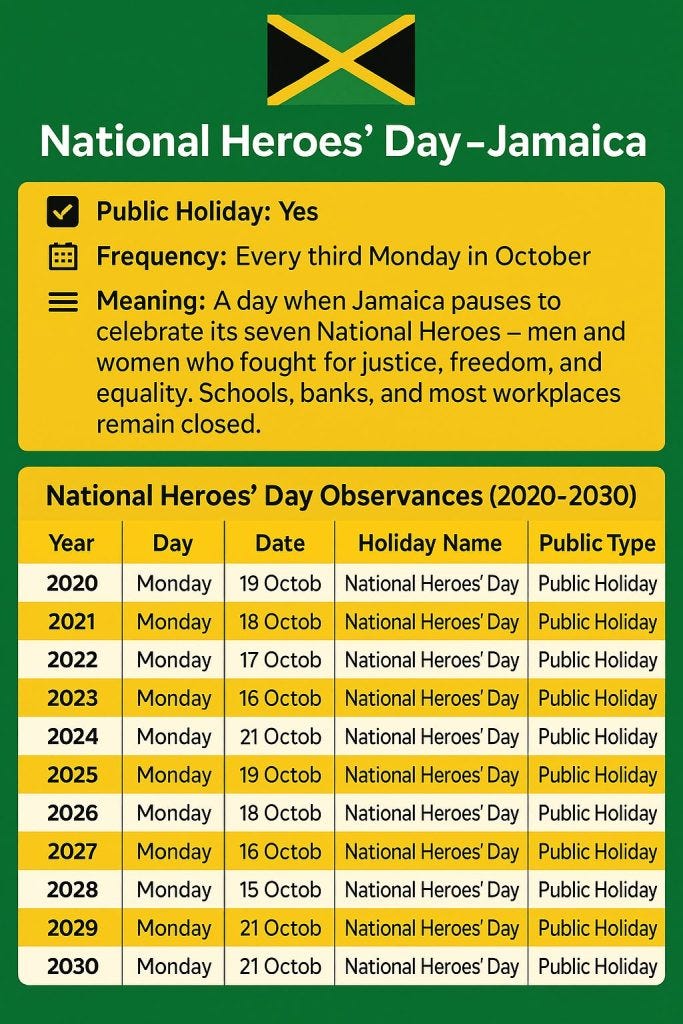
Status: National Heroes’ Day is a public holiday in Jamaica. Schools, government offices, and most businesses remain closed to honour Jamaica’s national heroes who shaped the country’s independence and identity.
A Note of Reflection
Each year, the nation honours:
Marcus Garvey – champion of Black pride and unity.
Nanny of the Maroons – fearless leader and freedom fighter.
Samuel Sharpe – Baptist deacon and revolutionary.
Paul Bogle – advocate for social justice and reform.
George William Gordon – defender of human rights.
Norman Manley – founder of modern Jamaican politics.
Sir Alexander Bustamante – Jamaica’s first Prime Minister.
Disclaimer
The views expressed in this article are those of Dean Jones in his personal capacity and do not necessarily represent the views of Jamaica Homes, its affiliates, or any other organization. The historical details presented are based on publicly available records and oral traditions, which may include approximations or interpretive summaries. This article is intended for educational and inspirational purposes only. Any references to property, housing, or development are informational and do not constitute legal, financial, or investment advice. Readers are encouraged to seek professional guidance before making decisions relating to real estate or finance. All cultural and historical references are shared with the utmost respect for Jamaica’s heritage and its people. Any unintentional errors or omissions are regretted and will be corrected upon request.