

House-hunting in 2045: Not Science Fiction, but a Warning Shot for Jamaica Today

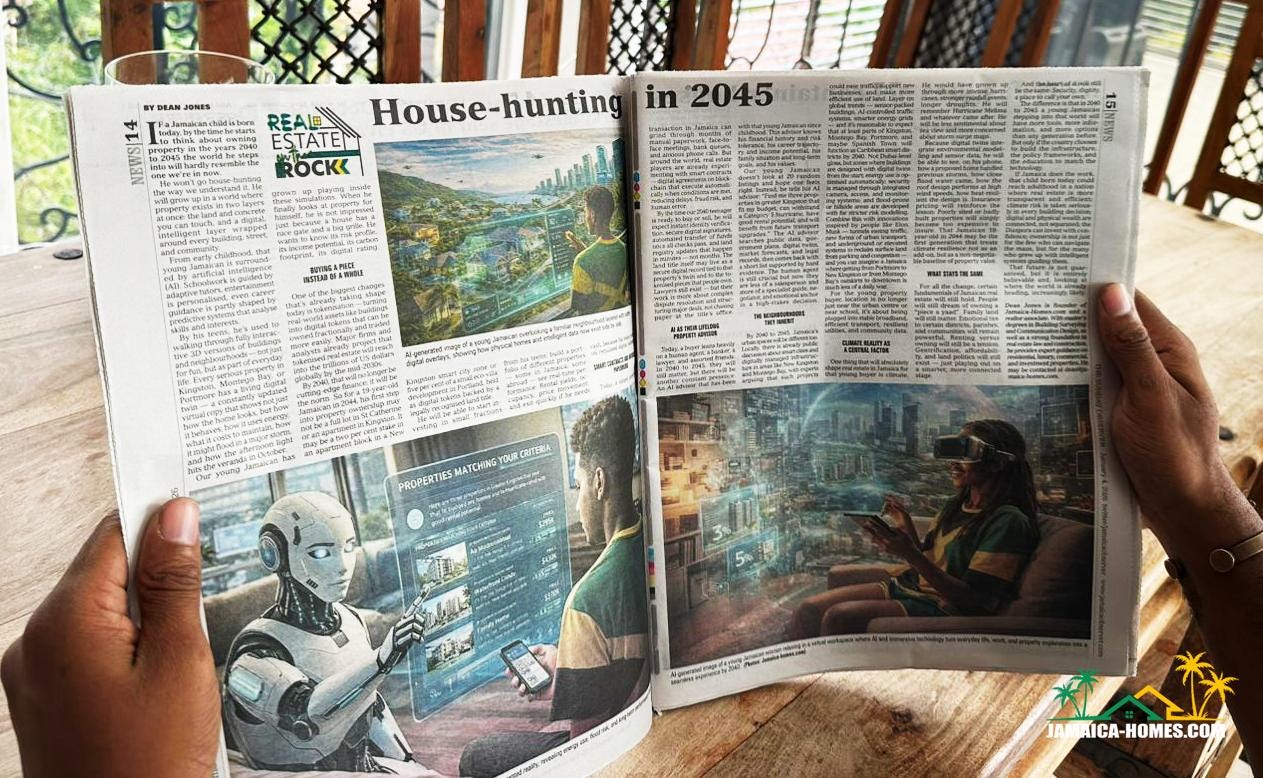
Dean Jones’ House-hunting in 2045 is not, despite first impressions, a piece of speculative futurism designed to dazzle readers with shiny technology. It is something far more uncomfortable and far more useful: a provocation. It asks Jamaicans—especially policymakers, planners, professionals, and investors—to confront a simple question now, not in 2045: are we preparing young Jamaicans to inherit a property system that works for them, or one that quietly locks them out?
At its core, the article is not about artificial intelligence, blockchain, or digital twins. It is about agency—who gets access to property, who understands risk, who can build wealth, and who is left navigating an opaque maze designed for an earlier century.
Jones’ framing, centred on a Jamaican child born today, is deliberate. It forces the reader to shift perspective away from nostalgia and personal experience and toward generational responsibility. The future buyer he describes will not be impressed by aesthetics alone. That detail matters. It signals a deep cultural shift: property value moving from appearance and status to data, performance, and resilience.
The Digital Layer: Why “Virtual” No Longer Means Unreal

One of the strongest ideas in the article is the concept of property existing in two layers at once: physical and digital. This is not metaphorical flourish. It reflects what is already happening globally in advanced real estate markets, where buildings are increasingly designed, sold, insured, and managed through live digital models.
Jones’ use of the term living digital twin is particularly important. This is not a static 3D tour or a polished marketing video. It is a continuously updated mirror of a building’s behaviour—energy use, flood exposure, maintenance cycles, and structural stress.
Public comments on the article rightly point out that parts of this future are already here. COVID-19 accelerated virtual tours, remote transactions, and international purchasing at a pace no one predicted. What Jones does, however, is connect these tools into a system, rather than treating them as isolated conveniences.
The implication is profound: when buyers grow up inside simulations, ignorance becomes inexcusable. A future Jamaican buyer who can see storm performance data or energy inefficiency in seconds will not accept vague assurances. This shifts power away from gatekeepers and toward informed consumers.
That alone could quietly revolutionise Jamaican real estate.
Fractional Ownership: From “Piece a Yaad” to Portfolio Thinking
Perhaps the most disruptive idea in the article is not AI, but tokenisation—the idea that Jamaicans may enter property ownership by buying pieces rather than whole titles.
This challenges one of the most emotionally charged ideas in Jamaican society: that ownership must be absolute to be meaningful. Jones does not dismiss the dream of a full title; instead, he reframes the journey. A two per cent stake in a New Kingston development may not sound romantic, but it represents something historically rare in Jamaica: early, legitimate access to property-backed wealth.
For young people locked out by rising prices, fractional ownership could function as a financial apprenticeship. They learn how property performs, how markets fluctuate, how income is generated, and how risk behaves—long before they attempt to buy a full home.
Critically, Jones grounds this idea in legality. He does not present tokenisation as a loophole or workaround, but as something backed by recognised land titles and regulated markets. That distinction matters in a country where informality has long created generational insecurity.
For the Jamaican diaspora, this could be transformative. Distance, mistrust, and bureaucratic friction have historically discouraged investment. A transparent, tradable, digitally verifiable stake lowers emotional and financial barriers at once.
Smart Contracts and the End of the Paper Chase
Anyone who has attempted a Jamaican property transaction understands the quiet exhaustion Jones describes: months of waiting, repeated visits, missing documents, and anxiety driven by opacity.
The article’s vision of smart contracts is not anti-lawyer, despite common misconceptions. Instead, it represents a reallocation of professional intelligence. When routine transfers become automated and verifiable, legal expertise moves upward—toward structuring, strategy, and dispute resolution.
This matters for Jamaica because our inefficiencies are not neutral; they are exclusionary. Lengthy processes disproportionately punish first-time buyers, small investors, and those without insider networks. Automation, done correctly, becomes a social equaliser.
Jones’ argument is subtle but firm: speed is not just convenience—it is justice.
Smart Neighbourhoods: Less Flash, More Function
The section on future Jamaican neighbourhoods is where the article is most grounded—and most misunderstood by critics who fixate on comparisons to Dubai or Silicon Valley.
Jones explicitly rejects spectacle. He imagines not futuristic skylines, but functional intelligence: better traffic flow, smarter energy use, integrated flood management, and data-informed development decisions.
Public comments suggesting this could happen sooner than 2045 are not contradictions—they are confirmations. The tools exist. What is missing is coordination, policy alignment, and political will.
What changes most radically in this vision is the definition of location. Proximity to town gives way to connectivity, resilience, and system reliability. Broadband, utilities, and transport efficiency become as important as postcode.
This reframing matters for equity. It creates the possibility that value can be distributed across regions, not trapped in a few overheated zones.
Climate Reality: From Optional Feature to Price Mechanism
Jones’ climate argument is arguably the most important—and the most urgent. Unlike other trends, climate change does not wait for readiness.
The article correctly identifies insurance as the enforcer of future discipline. Poorly sited, badly built homes will not merely be undesirable; they will be financially untenable.
The idea that a teenager in 2044 will casually check flood performance and heat resilience data is not futuristic—it is inevitable. What changes is cultural attitude. Sea views lose their romance when storm surge maps are one swipe away.
This is where the article quietly becomes a policy critique. If Jamaica does not integrate climate data into planning, valuation, and lending, the market will do it brutally and unevenly.
What Endures: Identity, Emotion, and Belonging
Despite its technological sweep, the article’s closing strength lies in what it refuses to discard. Family land, emotional ties, and the deep cultural meaning of “a piece a yaad” remain intact.
Jones understands that property is never just an asset in Jamaica; it is history, dignity, and security woven together. Technology does not replace that—it either supports it or erodes it.
The future he sketches is not guaranteed. That is the point. It is conditional on education, governance, infrastructure, and intent. The systems that guide young Jamaicans can either widen access or quietly reinforce inequality.
A Commentary, Not a Prediction
House-hunting in 2045 should not be read as prophecy. It is a mirror held up to the present. Many of the tools described already exist. The question is whether Jamaica integrates them deliberately—or inherits them passively, shaped by external interests.
The most telling public response to the article may be the quiet consensus beneath the debate: this future is closer than we think. The real risk is not technological failure, but institutional hesitation.
Jones has not written about the future to impress us. He has written to warn us that time is not neutral. The child born today will arrive at adulthood whether the systems are ready or not.
What Jamaica chooses to build—legally, digitally, environmentally—will determine whether that young person enters the property market empowered, informed, and protected… or simply more efficiently excluded.
That is not a 2045 question. It is a 2026 one. https://www.jamaicaobserver.com/2026/01/04/house-hunting-2045/