


A Story Shaped by Land, Legacy, and the Quiet Ambition of a Small Island
There are places in the world where geography simply gets on with its job: hills rise, rivers cut through valleys, and coastlines meander along the edge of civilisation. And then there is Jamaica—an island where the land does more than hold us up. It shapes ambition, inspires reinvention, and occasionally gives birth to ideas that ripple far beyond its shoreline.
One such idea is the all-inclusive resort. Not the version with tents on European beaches or communal dining halls made from plywood. No. The modern, romantic, sea-breeze-soaked all-inclusive—the one millions flock to each year—was moulded right here in Jamaica.
To understand how, we need to walk backward through time: through plantations and great houses, through collapsing sugar estates, through visionary hoteliers who looked at the coastline not as an obstacle, but as an opportunity waiting patiently in the sun.
The Land Before the Resorts
For centuries, Jamaica’s land was trapped in a pattern old as the colonial world itself. The British carved it into sugar estates; a thin slice of society controlled thousands of acres, while everyone else worked them under the most brutal conditions imaginable. After emancipation, former slaves searched for footholds—small plots, hillside farms, a piece of earth they could finally call their own. But the coast, that shimmering ribbon of possibility, remained largely out of reach.
Time, of course, has its own architecture. Markets crash, empires weaken, and what was once immovable softens. By the early 20th century, sugar estates began to fragment. Portions were sold, sometimes reluctantly, sometimes out of necessity. And into this shifting map stepped a new kind of investor—one who saw value not in cane fields, but in coves, bays, and the seductive promise of warm Caribbean waters.
Tourism, still a fledgling industry, quietly began stitching itself into Jamaica’s coastline.
Frenchman’s Cove: A Whisper of Reinvention
Our first major clue in the evolution of the all-inclusive appears in Portland, at a cove so perfectly sculpted it feels like nature’s architectural doodle.
In the late 1950s, Frenchman’s Cove took shape on a former estate. By 1962, it was open—an experiment wrapped in elegance. Here, tucked between lush hills and a river-fed beach, guests paid a single sum and received everything: not just meals and wine, but staff, privacy, and even helicopter transport if they desired. It attracted royalty, musicians, actors—people accustomed to rooms with quiet opulence and windows that framed paradise.
What Frenchman’s Cove proved was not simply that Jamaica could host the world’s elite. It proved something subtler: that a resort could be an entire world unto itself. A complete experience, curated and contained. A sanctuary, not just accommodation.
The seed was planted. But it would take another mind—and another stretch of coastline—to turn the concept from boutique experiment into a global blueprint.
Tower Isle and the Irresistible Logic of Reinvention
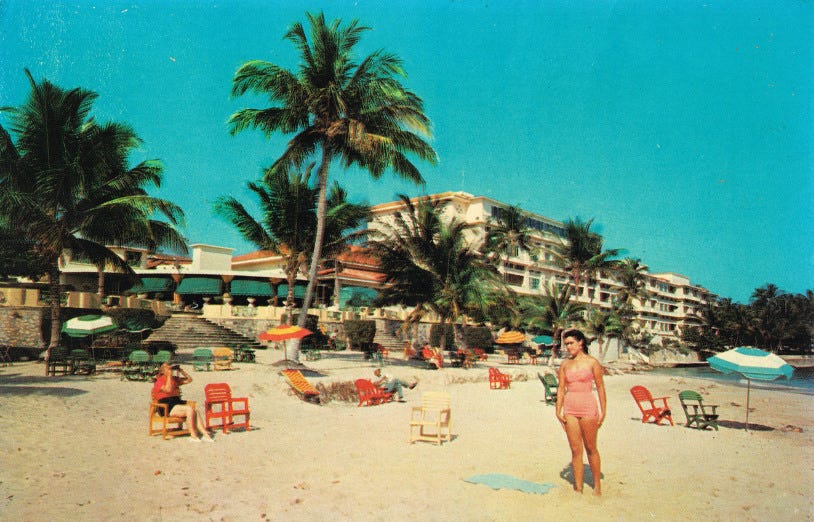
To reach the next chapter, we head west to Ocho Rios, where a hotel opened in 1949 on a headland facing its own tiny offshore island. Tower Isle, as it was known, was Jamaica’s first year-round resort—a bold ambition at a time when tourism was still a seasonal dalliance.
Its creator was a businessman with an eye not just for buildings, but for possibility. He opened his doors to Jamaicans as well as foreign guests, dissolving the old colonial lines that once divided hospitality.
But his true stroke of genius came almost thirty years later.
By the late 1970s, the world had seen Europe’s early attempts at all-inclusive living—village-style camps, communal eating, activities bundled into one price. But the formula lacked romance. It lacked a sense of crafted experience. And crucially, it lacked the natural theatre that Jamaica’s coastline effortlessly provides.
So in 1978, Tower Isle transformed. It became the world’s first fully all-inclusive, couples-only resort—a space designed not for crowds or families, but for two people seeking connection. One price unlocked everything: dining, drinks, sailing, scuba diving, island picnics, even trips to Jamaica’s famous waterfalls. The boundaries of the resort extended beyond the property line; suddenly, the island itself became part of the package.
It was simple. Elegant. Revolutionary.
The Coastline Reimagined
Once the concept took root, the transformation of Jamaica’s real estate was all but inevitable.
Look at a map of Jamaica today and you’ll see it clearly: long arcs of coastline defined not by crops but by experiences. Resorts in Montego Bay, Runaway Bay, Negril—they occupy land that once served entirely different purposes. In place of sugar cane, we have swim-up bars. Instead of estate walls, we have gatehouses that open into curated worlds of calm.
This reshaping created four major ripples across Jamaican real estate:
1. The Rise of Resort Belts
Entire districts became tourism engines, with land prices reflecting their new purpose. A beachfront acre was no longer a matter of beauty—it was a matter of economic gravity.
2. Inland Settlements Growing in Tandem
Behind every five-star facade sits a workforce, and behind the workforce sits housing, transport, shops and schools. Development inland often mirrors the prosperity of the coast.
3. The Birth of Mixed-Use Resort Real Estate
Suddenly, a villa wasn’t just a home. It was an income-generating asset. A condo could be both private escape and hotel suite. Investors discovered they could buy into a lifestyle, not just a structure.
4. The Short-Term Rental Revolution
Many Jamaicans began offering curated, mini all-inclusive experiences of their own. A room, a driver, meals from the host’s kitchen—modest, personal, and deeply Jamaican.
Each of these shifts is built on the same belief that reshaped Tower Isle in 1978: that land here is not merely something to stand on, but something to build an experience around.
The Complicated Beauty of Exclusivity
Of course, every design—architectural or social—has its compromises. As resorts multiplied, questions of access surfaced. Who owns the coastline? Who gets to enjoy it? How do you preserve natural assets when development surges ahead?
Policies emerged. Environmental standards tightened. Public access routes were negotiated. Because even as Jamaica’s tourism asset grew, there was a quiet awareness that beaches belong to everyone, and the coastline, though economically powerful, must remain ecologically intact.
This tension between opportunity and stewardship continues to shape Jamaica’s development choices.
Did Jamaica Invent the Modern All-Inclusive?
The honest answer is this:
Europe may have invented the idea of bundling costs. But Jamaica invented the all-inclusive resort as the world now recognises it—romantic, refined, self-contained yet open to adventure.
Frenchman’s Cove created the first luxurious “everything included” sanctuary.
Tower Isle refined the model into something scalable, desirable, and emotionally resonant.
Brands that followed transformed the coastline into a global stage for the concept.
The world didn’t just adopt the idea. It adopted Jamaica’s version of it. The one shaped by topography, turquoise water, and a national instinct for hospitality that feels effortless.
The Next Design is Already Emerging
Today, the conversation has shifted again. New resorts contemplate sustainability, community inclusion, farm-to-table supply chains, marine protection, and residential integration. Developers speak not just of hotels, but of ecosystems—where guests, locals and the environment coexist in a more thoughtful choreography.
If Frenchman’s Cove was the sketch, and Tower Isle was the blueprint, then this moment feels like the next iteration: the architectural refinement stage, where beauty and responsibility share the same drafting table.
Jamaica will continue experimenting. It always has. The island’s greatest talent, after all, is its ability to reimagine the familiar—to take existing ideas and reshape them until they feel entirely new.
And the all-inclusive?
It’s the perfect example. A global industry, yes—but one unmistakably drawn from Jamaican lines, Jamaican land, and Jamaican imagination.
The world may build its own versions.
But the original DNA—sunlit, sea-cooled, quietly brilliant—will always belong to this small island that dared to dream bigger than its borders.