



Jamaica has always understood property as something deeply human. A house is not just shelter; it is inheritance, security, sacrifice, and, often, the single largest investment a family will ever make. From modest board homes to hillside villas, from commercial buildings in Half-Way Tree to apartments rising across Kingston’s skyline, Jamaican real estate has traditionally been grounded in physical presence, relationships, and trust built over time.
That foundation still matters. But it is no longer sufficient on its own.
Beneath the familiar rituals of viewings, valuation reports, and handshake agreements, a quieter shift is taking place. Property is no longer being understood only as concrete, steel, and land. Increasingly, it is being interpreted through data — how a building performs, how it ages, how it responds to stress, and how risk can be measured rather than guessed.
This shift is not being driven by trends or novelty. It is being driven by necessity.
In a small island developing state where land is finite, climate exposure is real, and rebuilding after hurricanes is not theoretical but lived experience, the way we document, manage, and understand property is changing — whether we actively plan for it or not.
Digital twin technology sits at the centre of that change.
Beyond Photos and Listings: What “Digital” Really Means for Jamaican Property
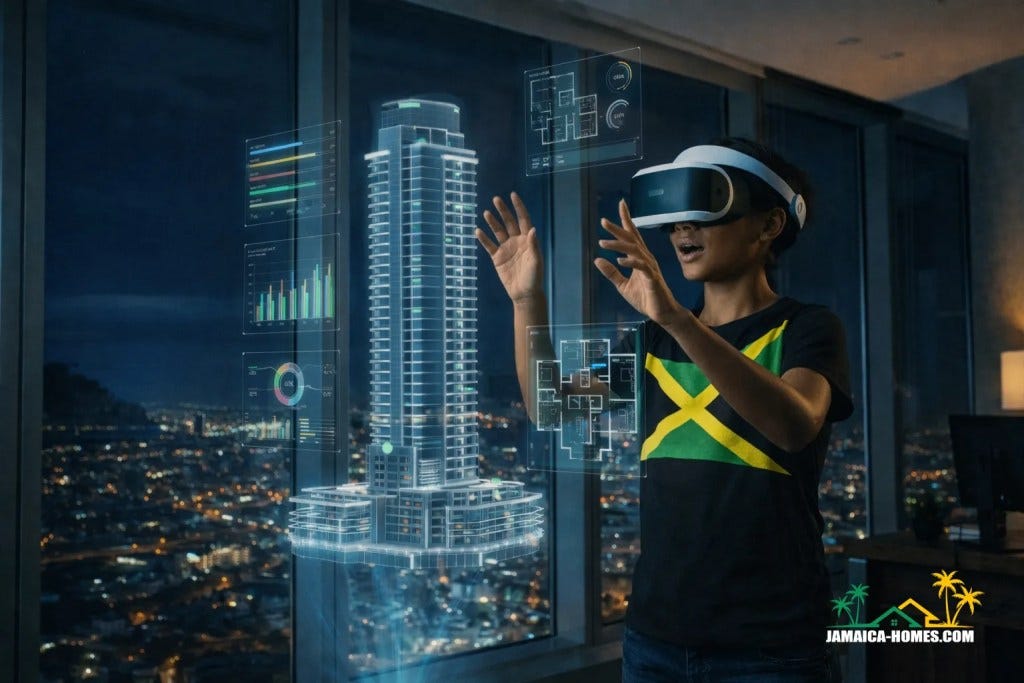
When Jamaicans hear “digital real estate,” the mind often goes to online listings, WhatsApp videos, drone shots, and virtual walkthroughs for overseas buyers. Those tools have become invaluable, particularly for the diaspora. They allow a house in St Ann or a development in Montego Bay to be marketed globally with relative ease.
But those tools are still largely visual. They show what a building looks like.
Digital twin technology does something fundamentally different. It shows how a building works.
A digital twin is a living digital representation of a physical structure. It reflects not just layout and dimensions, but materials, systems, maintenance history, and performance over time. It can be updated as changes occur — renovations, repairs, system upgrades, even damage.
In practical Jamaican terms, this means a property can have a clear digital record of:
Structural elements and materials
Plumbing and electrical layouts
Roof type, age, and maintenance history
Drainage paths and water exposure
Modifications and extensions over time
In a country where informal alterations are common and documentation is often fragmented or missing, that level of clarity is quietly revolutionary.
As Dean Jones, Founder of Jamaica Homes, puts it:
“A building doesn’t forget what you’ve done to it — people do. Digital records protect the truth of a property long after memory fades.”
Why This Conversation Matters Now — Especially Now
This is not an abstract or future-facing discussion. Timing matters.
Jamaica has just endured Hurricane Melissa, and for many families, the priority is not innovation but recovery — repairing roofs, restoring power, salvaging belongings, and getting back to some sense of normality. Writing about technology in this moment requires humility.
But it also requires honesty.
Each storm exposes the same vulnerabilities: undocumented construction, unknown structural weaknesses, aging infrastructure, and uncertainty around what was built, how it was altered, and whether it was ever designed for current conditions.
Digital tools do not prevent hurricanes. But they change how well we understand what survives them.
In the aftermath of extreme weather, questions come quickly:
Why did one roof fail while another held?
Where did water enter first?
Which materials deteriorated fastest?
What repairs were temporary, and which were structural?
Without reliable records, answers are speculative. With digital building data, they become measurable.
This is not about pushing technology during recovery. It is about learning from recovery so that rebuilding is smarter, not just faster.
Not Just for Developers: Why Everyday Owners Should Care
There is a common misconception that advanced property technology only benefits large developers or luxury projects. In Jamaica, that assumption does not hold.
Digital building records matter because they influence three things that affect everyone:
insurance, financing, and resale.
Insurance providers are already becoming more cautious. Premiums are rising, exclusions are increasing, and underwriting is more detailed than it was even five years ago. Properties that can clearly demonstrate how they were built, maintained, and repaired are easier to insure — and often on better terms.
Similarly, lenders prefer certainty. A property with documented systems, maintenance history, and clear records presents less risk than one where key details are unknown or unverifiable.
And when it comes time to sell, transparency builds confidence. Buyers — especially overseas buyers — are no longer satisfied with assurances alone. They want evidence.
As Dean Jones observes:
“Trust in real estate is built fastest when you don’t have to ask someone to take your word for it.”
Maintenance in a Jamaican Reality: From Reaction to Prevention
Building maintenance in Jamaica has traditionally been reactive. Something breaks, then it is fixed — often quickly, sometimes creatively, and not always with long-term documentation. This approach is understandable in a context where resources can be stretched and urgency is real.
But reactive maintenance is expensive.
Digital building models allow for a shift toward preventive care. Systems can be monitored over time. Patterns emerge. Early signs of deterioration can be identified before they become emergencies.
For apartment complexes, commercial buildings, and multi-family developments, this is particularly important. A single unresolved issue can escalate into widespread damage — and major cost.
In a country where skilled labour may not always be immediately available and material costs continue to rise, avoiding unnecessary damage is not a luxury. It is sound economics.
And yes, sometimes Jamaican ingenuity has a way of keeping things going far longer than originally intended — but even the most heroic temporary fix eventually sends an invoice.
Climate Risk Is Already Priced In — Even If We Pretend Otherwise
Whether explicitly stated or not, climate risk already influences property values in Jamaica.
Coastal exposure, flood history, heat retention, drainage, and wind resilience all affect how a property performs — and how it is perceived. Digital building models allow these factors to be tested, simulated, and understood rather than guessed.
A building can be assessed for:
Heat response and ventilation efficiency
Water flow and pooling during heavy rainfall
Structural stress under high wind conditions
System vulnerabilities during power outages
These insights are not theoretical. They inform design decisions, maintenance planning, and long-term budgeting.
Properties that cannot provide this level of insight will increasingly be treated as higher risk — even if no one says so outright.
As Dean Jones reflects:
“In today’s market, uncertainty is a hidden cost. The less we know about a building, the more expensive it becomes to own.”
Valuation, Evidence, and a More Honest Market
Valuation in Jamaica has always depended on professional expertise, comparable sales, and physical inspection. That will never change. But evidence strengthens judgment.
When valuers, lenders, and buyers can access clear building records — what was installed, when it was serviced, how systems have performed — valuation becomes less speculative and more precise.
This benefits responsible owners. It rewards proper maintenance. And it quietly discourages neglect.
Over time, a more evidence-based property market reduces disputes, speeds up transactions, and improves confidence. That matters in a sector where delays and uncertainty can derail deals entirely.
Transparency does not weaken the market. It matures it.
Technology Will Not Replace People — But It Will Expose Gaps
Surveyors, valuers, engineers, agents, and inspectors remain central to Jamaican real estate. Digital systems do not replace their expertise. They amplify it.
Professionals who understand both buildings and data will be better equipped to advise clients, assess risk, and protect value. Those who resist change may find themselves relying on assumptions in a market that increasingly expects documentation.
As Dean Jones notes:
“Technology doesn’t make professionals obsolete — it makes guesswork obsolete.”
That distinction matters.
A Gradual Shift, Not an Overnight Leap
Jamaica does not need to — and should not — attempt to replicate large international developments wholesale. Adoption will be gradual. Larger projects will lead. Smaller owners will follow where benefits are clear.
But within the next decade, it will be normal for well-managed developments to maintain detailed digital records of their buildings. Buyers, insurers, and lenders will come to expect it.
Properties without that transparency will still exist. They just may not compete as well.
The choice facing the sector is not whether change is coming, but whether we shape it thoughtfully or respond to it reactively.
Building Forward While Rebuilding
Jamaica is resilient. We rebuild. We adapt. We move forward — often under pressure, often with limited resources, but always with determination.
Digital tools alone will not solve the challenges facing Jamaican real estate. But better information leads to better decisions. And better decisions protect homes, livelihoods, and long-term wealth.
As concrete meets code, the future of Jamaican property will still be physical, still personal, still deeply human. But it will also be documented, measured, and understood in ways that help us build — and rebuild — smarter.
In a country where every structure carries a story, preserving that story accurately may be one of the most powerful tools we have.