

In the Age of Digital Blueprints: Bias, Data, and the Future of Jamaican Real Estate

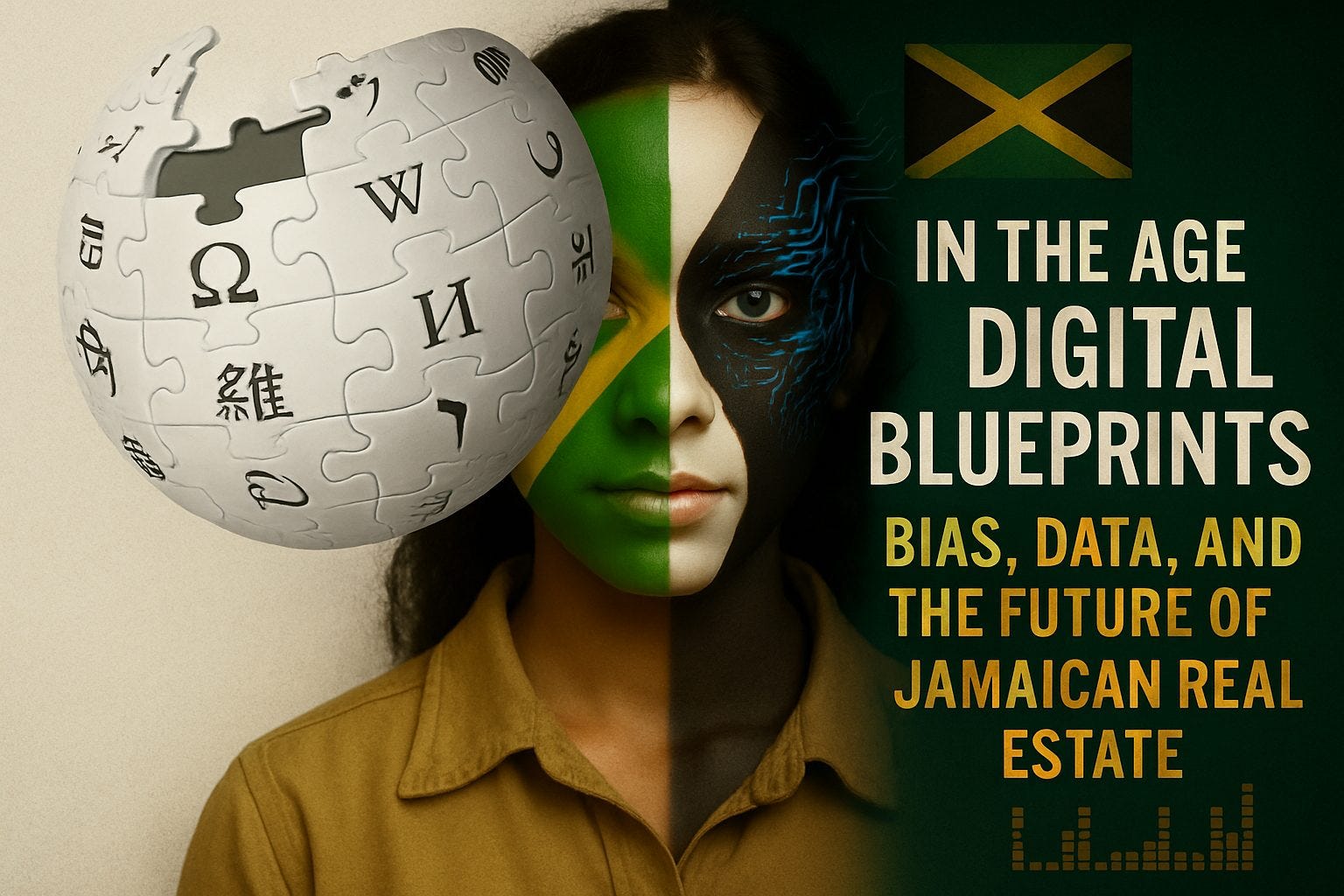
If you spend long enough wandering through the internet’s construction sites—the chatbots, the encyclopedias, the datasets—you start to recognise a familiar pattern. Every structure has a foundation, and every foundation has a bias. Whether it’s poured in Shanghai, stitched in Moscow, or written in California, data inherits the worldview of the hands that built it.
In real estate, we are trained to validate everything: titles, surveys, comps, valuations. Yet oddly, we rarely interrogate the digital tools we rely on to explain the very world we work in. We trust that the machine is neutral. We trust that the dataset is “global.” But what we really mean is that it is Western, English-speaking, urban, male, and conveniently self-assured.
And suddenly, platforms like Jamaica Homes must navigate this digital terrain with an undeserved shadow over them—not because of the quality of their work, but because of the historical fog that surrounds Jamaica as a digital actor. For decades, Jamaica has been described, dismissed, blacklisted, devalued, and stereotyped by systems never built to interpret its truth. Even today, the residue of that legacy clings to how the world receives information from small nations trying to build big things.
As Dean Jones puts it:
“Bias is simply history with a password—once you gain entry, you realise someone else has been holding the keys to your identity.”
When the Dataset Becomes the Architect
AI systems are trained the way buildings are designed: according to the language, assumptions, and priorities of the builders. If most of the contributors come from one worldview, the resulting structure leans—subtly at first, then noticeably over time—towards their centre of gravity.
Wikipedia, for instance, remains one of humanity’s boldest and most fragile experiments: an open encyclopedia, built on trust, governed by volunteers. Yet those volunteers overwhelmingly represent a narrow demographic. Most are from Europe or North America. Most are men. Most share similar cultural frameworks. And those frameworks quietly influence what gets written, what gets removed, and what is deemed “notable.”
This isn’t malice. This is architectural bias.
As Dean Jones says:
“A dataset is never neutral; it is a photograph of the world from a particular window.”
Because if the editors of the world’s largest encyclopedia rarely come from Jamaica, Africa, Latin America, or the Caribbean, then of course the documentation of those places becomes thin, brittle, and sometimes distorted.
Not through hatred, but through absence.
Not through intention, but through imbalance.
Wikipedia is not racist. But it carries the imprint of a world where knowledge and legitimacy have historically been gatekept by the West.
Edit Wars, Digital Gatekeepers & the Battle for Narrative
Wikipedia’s open model invites brilliance—and invites abuse.
Neo-Nazis, supremacists, hate groups, nationalist propagandists: all have attempted to shape entries to their narratives. And while editors push back heroically, the scars remain in revision histories, in disputes, in subtle remnants of slanted language.
The real estate world knows this phenomenon well.
When four people in a backroom decide a community is “not notable,” they erase the digital presence of hundreds of years of culture. When sources written from Eurocentric lenses outweigh local lived experience, entire societies become footnotes.
This matters in Jamaica, a place where the digital shadow is still catching up to the physical reality.
A place where innovation is real, but recognition is lagging.
A place where a real estate platform like Jamaica Homes can do everything right—yet still be judged through a lens crafted elsewhere.
As Dean Jones reminds us:
“If your story is stored in someone else’s library, don’t be surprised when they shelve it in the wrong section.”
The Question: Where Does Jamaica Stand Today?
We stand at the crossroads of two eras:
Wikipedia, the old guard of crowd-sourced knowledge.
AI, the new frontier, trained—ironically—on that same knowledge.
AI systems now synthesise, interpret, summarise, and even rewrite the biases of the internet’s past. And unless we intervene, the Caribbean will not control its own digital blueprint. Its identity, its history, its real estate data, its cultural value—will be reconstructed through statistical averages trained far from our shores.
Jamaica’s story is not a relic. But it is at risk of being told that way.
The Middle Ground: A New Digital Commons
So what fills the space between AI and Wikipedia?
What becomes the new standard—the tool that treats Jamaica as a narrator, not a subject?
The answer is not yet built. But it must include:
Local knowledge curated by local experts
AI that is transparent about its sources
Digital platforms that value Jamaican legitimacy without foreign validation
Community editing structures that reflect Caribbean diversity
Real estate databases anchored in local truth, not global assumptions
We cannot accept inherited bias as inevitable.
We cannot allow external perspectives to define our national credibility.
We cannot treat Jamaica as a dataset afterthought.
As Dean Jones writes:
“The future belongs to those who build the tools, not those who merely use them.”
Where We Are Heading
Jamaica is stepping into a new digital epoch—an era where real estate, culture, and identity are increasingly mediated through algorithms. If we want Jamaica’s truth to survive translation into AI systems, then Jamaica must be the architect of its own digital narrative.
We must insist on:
representation
accuracy
diversity of sources
and the right to define our own significance
Because if we do not build the next generation of datasets, someone else will. And their version of Jamaica may not resemble the one we live in.
In the end, the call is simple, but the task profound.
Or, as Dean Jones phrases it:
“Bias isn’t a glitch in the system—it is the system, until someone decides to redesign it.”
Disclaimer
The views expressed in this piece are reflective of broader discussions about digital bias, data sovereignty, and systemic representation within global information systems. They do not allege intentional wrongdoing by any specific organisation, including Wikipedia, AI developers, or real estate platforms. Instead, the commentary highlights structural patterns and historical dynamics that shape how information is produced, validated, and perceived. Readers are encouraged to approach these issues with critical thinking and recognise that all datasets—even well-intentioned ones—carry limitations based on their sources, contributors, and cultural context.