


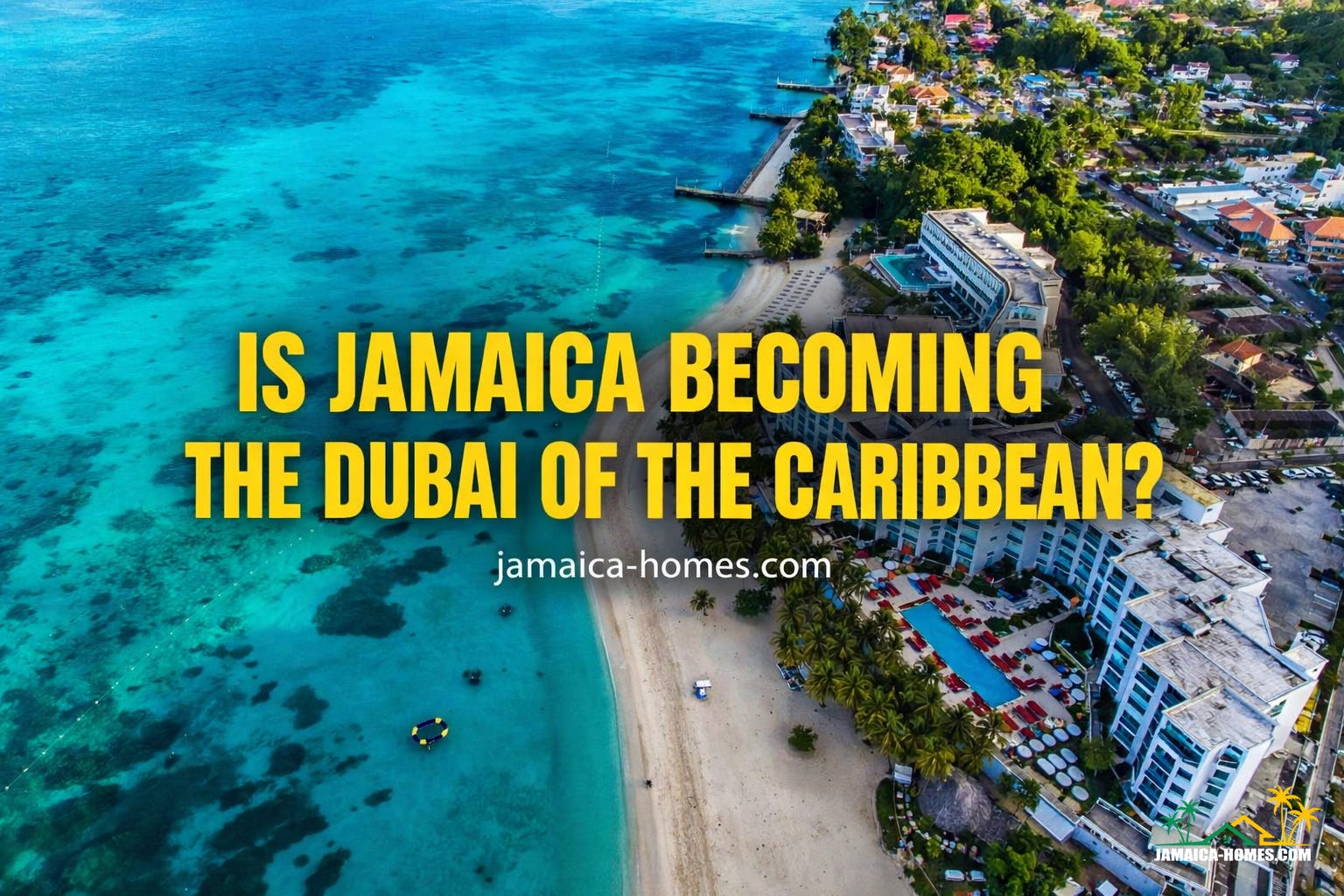
Or Is the Question Missing the Point Entirely?
Every few years, a country on the rise gets handed a borrowed identity.
Singapore becomes “the Switzerland of Asia.”
Rwanda becomes “the Singapore of Africa.”
And now, increasingly, Jamaica is being labelled “the Dubai of the Caribbean.”
At first glance, the comparison feels flattering. Dubai is sleek, ambitious, technically advanced, unapologetically extravagant. It is a city that arrived late to the global party and somehow still managed to take centre stage. Who doesn’t like going to Dubai? Indoor ski slopes in the desert. Palm-shaped islands visible from space. Architecture that looks like it was designed by science fiction writers with unlimited budgets.
So when Jamaica is spoken about in the same breath, it sounds like progress. Momentum. Arrival.
But scratch beneath the surface and the comparison starts to wobble — not because Jamaica lacks ambition, but because Dubai and Jamaica are fundamentally different things. And that difference matters.
Dubai is a city.
Jamaica is a country — and a culture.
And that distinction changes everything.
“Comparisons are usually a shortcut people take when they sense momentum but don’t yet have the language to describe it properly.”
— Dean Jones
Dubai: A New City Built at Speed

Dubai is, in many ways, the newest major city on Earth.
Yes, all cities are technically man-made. But Dubai is different. It is intentionally new, deliberately assembled, consciously designed to project power, wealth, and modernity in record time. It did not grow slowly around old streets or inherited institutions. It was engineered.
It borrowed ideas freely — architecture from Europe, retail concepts from North America, labour from South Asia, branding from everywhere. It curated the best (and sometimes the most extreme) elements of global capitalism and fused them into something visually astonishing.
And it worked.
Dubai is slick. High-spec. Immaculate.
It is controlled, polished, efficient — sometimes to the point of sterility.
What you won’t find there, though, is rawness.
There is very little that is unplanned. Very little that feels untried. Very little that surprises in a messy, organic way.
That’s not a criticism. It’s simply the nature of a city built fast, with purpose, and with money.
Jamaica: Not New — Just Uncontainable
Jamaica sits at the opposite end of the spectrum.
It is not new. It is not curated. It is not controlled.
What Jamaica has — and what Dubai fundamentally cannot manufacture — is depth.
Raw beauty, yes.
But also raw history. Raw struggle. Raw creativity.
Jamaica doesn’t yet have rows of glass skyscrapers piercing the clouds. Those are coming, slowly, unevenly, and in a very Jamaican way. But what it already has is something far harder to replicate:
Oceans that haven’t been over-engineered
Beaches that still feel alive rather than staged
Mountains that cut across the island like a backbone
Rivers, forests, wildlife, and pockets of near-jungle
A climate that shapes lifestyle, not just architecture
And then there’s the culture.
Not a manufactured culture. Not a lifestyle brand.
A lived culture.
Reggae that came out of struggle, not studios.
Faith that grew in the cracks of hardship.
Language shaped by resistance and survival.
Traditions that weren’t designed to impress anyone — they were designed to endure.
“You can build a skyline in ten years. You cannot compress centuries of cultural formation into concrete and glass.”
— Dean Jones
This is why Jamaica resonates globally in a way that far exceeds its size. It’s not because of GDP or infrastructure rankings. It’s because the country carries emotional weight.
People don’t just visit Jamaica. They feel Jamaica.
Why the Comparison Keeps Coming Back
So if the comparison doesn’t quite fit, why does it keep surfacing?
Because Jamaica is leading — whether it’s comfortable admitting that or not.
In the Caribbean context, Jamaica has long functioned as a cultural, economic, and psychological anchor. Music. Sport. Language. Diaspora influence. International recognition. When the Caribbean has a voice on the world stage, it often sounds Jamaican.
That leadership is now beginning to show up more visibly in development conversations.
Increased foreign investment
Large-scale tourism and hospitality projects
Infrastructure upgrades
A growing skyline
Ambitions around logistics, connectivity, and global relevance
At the time of writing, Jamaica hosts the tallest building in the English-speaking Caribbean — a title it may not hold forever, but one that symbolises momentum rather than dominance.
And momentum attracts labels.
Calling Jamaica “the Dubai of the Caribbean” is less about accuracy and more about signal. It signals that people sense Jamaica is changing. Moving. Positioning itself differently.
But the risk is this: borrowed identities often erase the very thing that made a place valuable in the first place.
The Danger of Wanting to Be Someone Else
Dubai’s success came from knowing exactly what it wanted to be — not from copying another country wholesale.
Jamaica doesn’t need to become Dubai.
It doesn’t need to out-glass Dubai.
It doesn’t need to out-luxury Dubai.
What it needs to do is develop without sanding down its edges.
There is a version of progress that sterilises.
And there is a version that deepens.
Jamaica’s opportunity lies in the second path.
“Development that ignores culture doesn’t fail immediately — it fails quietly, by hollowing out what made the place worth developing in the first place.”
— Dean Jones
This is where the debate becomes urgent and timely.
Across the world, there is growing scepticism about copy-and-paste development models. The ultra-slick, hyper-luxury formula is starting to feel dated in a world grappling with climate anxiety, identity loss, and cultural fatigue.
People are looking for places that still feel real.
Jamaica has that — in abundance.
Jamaica as the Jewel, Not the Imitation
If you look at global regions honestly, there is usually a gravitational centre.
In Europe, it shifts between a few heavyweights.
In the Americas, the United States dominates influence.
In the Caribbean, Jamaica has long held that role — not by force, but by presence.
Music alone has done more for Jamaica’s global footprint than entire marketing budgets elsewhere. Add sport, faith, diaspora networks, and cultural exports, and you start to see why Jamaica occupies such a large space in the global imagination.
This is why the more accurate framing isn’t “Is Jamaica becoming Dubai?”
The better question is:
How does Jamaica lead without losing itself?
Leadership doesn’t require uniformity. It requires confidence.
And confidence comes from knowing that what you offer cannot be replicated elsewhere.
“Jamaica’s power has never been in looking like the world’s idea of success. It has been in making the world adjust its idea of what success looks like.”
— Dean Jones
So, Will Jamaica Become the Dubai of the Caribbean?
No. And that’s not a failure.
Dubai is a masterclass in speed, spectacle, and strategic ambition. Jamaica is something else entirely — slower, deeper, messier, more human.
Where Dubai dazzles, Jamaica endures.
Where Dubai curates, Jamaica creates.
Where Dubai assembles, Jamaica evolves.
The future of Jamaica doesn’t lie in borrowed metaphors. It lies in developing a model that respects its land, its people, its culture, and its contradictions.
If the Caribbean has a jewel, it isn’t defined by how closely it resembles a desert city half a world away.
It’s defined by how boldly it remains itself — while still moving forward.
And on that measure, Jamaica isn’t chasing anyone.
It’s already leading.