


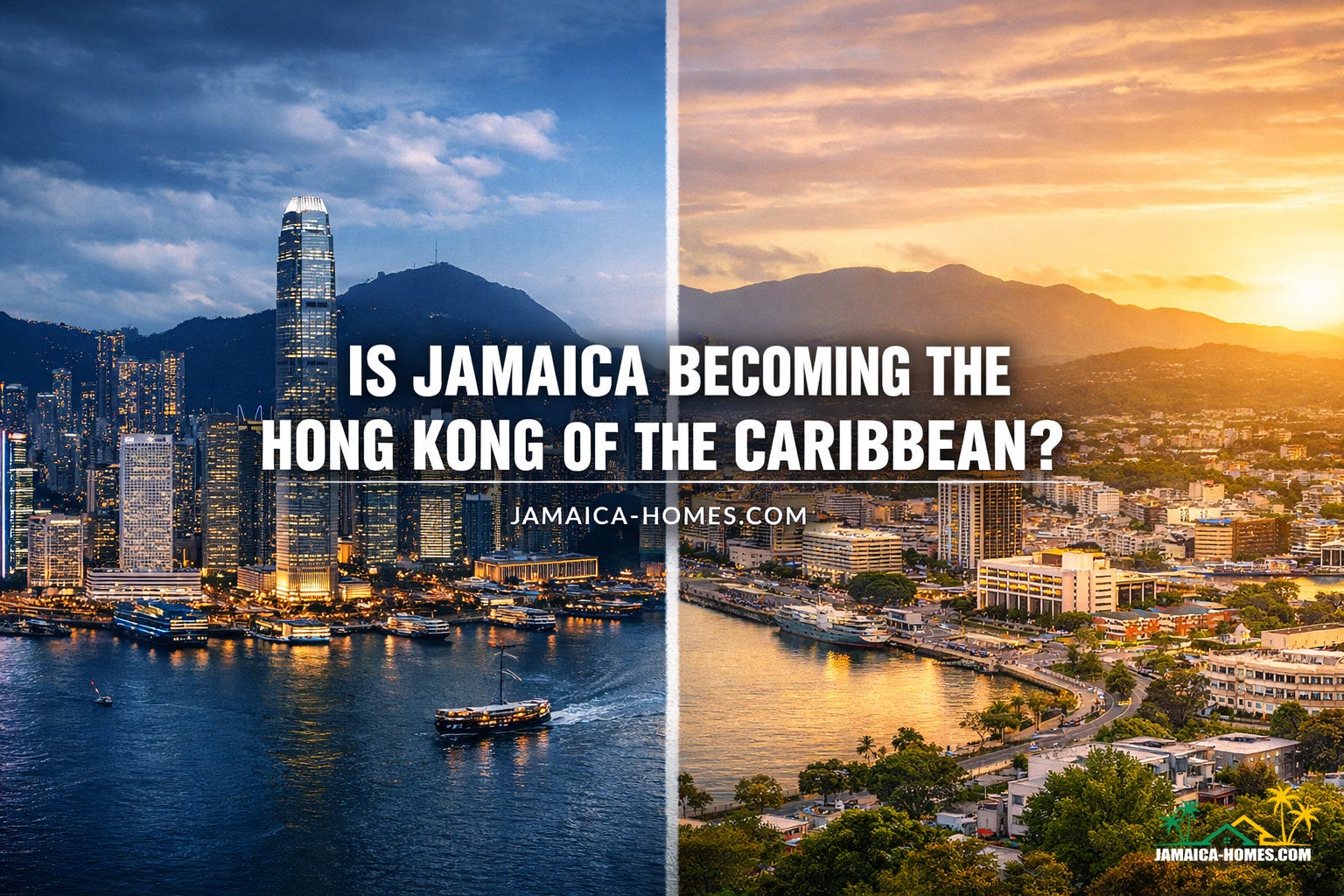
Trade, Talent, Capital and the Quiet Repositioning of an Island Nation
For the past few years, Jamaica has been compared — often lazily — to Dubai.
The phrase “the Dubai of the Caribbean” resurfaces whenever a new hotel breaks ground, a luxury development is announced, or international investors begin paying attention again. It is meant as praise. Dubai symbolises speed, ambition, global relevance, and capital on the move.
But the comparison has always been slightly off.
Dubai is a city built around spectacle. Jamaica is a country built around connection.
And if we are serious about understanding Jamaica’s emerging role in the Caribbean and the wider global economy, a more interesting — and far more accurate — question is beginning to emerge:
Is Jamaica quietly positioning itself as the Hong Kong of the Caribbean?
Not in architecture. Not in skyline.
But in function, influence, and flow.
Why the Dubai Comparison Falls Short
Dubai’s rise is rooted in a very specific model:
centralised authority, rapid execution, large-scale capital deployment, and a deliberate creation of a global business hub almost from scratch.
It is a city designed to attract wealth.
Jamaica, by contrast, is not trying to manufacture relevance overnight. Its value is not engineered; it is accumulated — historically, culturally, economically, and relationally.
Where Dubai builds visibility, Jamaica facilitates movement.
That difference matters.
Because Jamaica’s emerging strength is not about becoming louder or flashier — it is about becoming more strategically indispensable.
Hong Kong as a Better Lens
Hong Kong was never just a skyline.
At its height, Hong Kong functioned as:
a gateway economy
a financial and legal bridge
a logistics and trade hub
a cultural intermediary
a place where East met West, capital met credibility, and global systems intersected
Its power came from position, not scale.
That is the lens through which Jamaica’s current trajectory makes sense.
Jamaica’s Strategic Geography: Underestimated, Again
Geography has always been Jamaica’s quiet advantage.
Sitting at the crossroads of:
North America
Latin America
the Caribbean
major Atlantic shipping routes
Jamaica is positioned not as an endpoint, but as a connector.
Kingston, in particular, has long been underutilised in global narratives. Yet its port infrastructure, proximity to Panama, and time-zone alignment with the US make it uniquely suited for logistics, trade, and services in a way few Caribbean capitals can match.
This is not new.
What is new is the way global systems are shifting back toward nearshoring, regionalisation, and trusted jurisdictions.
And Jamaica fits that moment far better than it did a decade ago.
Capital Is Moving — Quietly, Strategically
The post-pandemic world has changed how capital behaves.
Wealth is no longer just chasing returns; it is chasing:
stability
regulatory clarity
cultural familiarity
geopolitical neutrality
lifestyle without isolation
Jamaica is increasingly appearing on that radar — not as a tax haven, but as a substantive jurisdiction.
Diaspora capital continues to play a major role, but it is now being joined by:
regional investors
North American professionals
Caribbean-based funds
international buyers seeking long-term positioning rather than speculation
This is not speculative money.
It is patient money.
And patient capital behaves very differently from the kind that fuels skyline booms.
A Legal and Institutional Advantage Few Talk About
One of Hong Kong’s historic strengths was trust.
Trust in:
contract enforcement
courts
commercial norms
professional services
Jamaica quietly shares more of that DNA than many realise.
Its legal system, rooted in common law, is deeply familiar to international investors. English remains the language of business and law. Professional services — from surveying and valuation to legal practice and banking — operate within recognisable global frameworks.
In a region where legal uncertainty can be a barrier to serious investment, Jamaica often feels legible, navigable, and dependable.
That matters more than glossy marketing ever will.
Crime, Perception, and the Shifting Narrative
For years, perception lagged reality.
But recent reductions in violent crime — continuing into early 2026 — have begun to materially change how Jamaica is discussed internationally. While no one is pretending challenges have vanished, the trend itself has altered investor psychology.
Capital does not require perfection.
It requires direction.
And Jamaica’s trajectory — combined with improved enforcement, targeted policing, and institutional focus — is beginning to register beyond the region.
This mirrors Hong Kong’s historical arc more than Dubai’s: credibility earned gradually, not declared loudly.
Culture as Economic Infrastructure
This is where the comparison becomes most compelling.
Hong Kong’s cultural hybridity — its ability to operate fluently between worlds — was central to its success.
Jamaica has always done this instinctively.
Few countries of Jamaica’s size exert such disproportionate cultural influence:
music
language
sport
religion
diaspora networks spanning multiple continents
This is not “soft power” in the abstract. It is economic infrastructure.
Diaspora Jamaicans are not tourists. They are connectors — linking capital, talent, markets, and opportunity across borders.
In a global economy increasingly driven by networks rather than nations, Jamaica’s extended global family is one of its greatest, least measured assets.
Real Estate as Signal, Not Spectacle
Luxury development often grabs headlines, but Jamaica’s real estate story is subtler.
Rather than hyper-concentrated mega-projects, growth is happening through:
mixed-use developments
urban regeneration
diaspora-led residential investment
incremental densification
professionalisation of the property market
This looks far more like Hong Kong’s organic layering than Dubai’s master-planned approach.
Importantly, real estate here is not just about lifestyle — it is about positioning.
Who buys, where they buy, and why they buy tells a deeper story than marketing brochures ever will.
The Risk: Mistaking Attention for Direction
None of this is guaranteed.
Hong Kong’s success was built on clarity of purpose. Jamaica’s biggest risk is not foreign influence — it is strategic drift.
If the country chases spectacle instead of systems…
If development prioritises short-term visibility over long-term resilience…
If affordability, access, and local participation are sidelined…
Then the opportunity narrows.
The lesson from Hong Kong is not blind imitation. It is intentional positioning.
Jamaica’s Emerging Role in the Caribbean
Within the region, Jamaica already functions as:
a cultural anchor
a diplomatic voice
a migration hub
a reference point for identity and credibility
What is changing is the economic layer beneath that influence.
Jamaica is not trying to outbuild its neighbours.
It is quietly out-connecting them.
In that sense, the country is not becoming a replica of anything.
It is becoming a node.
So… Is Jamaica Becoming the Hong Kong of the Caribbean?
Not in form.
Not in density.
Not in skyline.
But in function, the comparison is increasingly hard to ignore.
A place where:
capital passes through
trust accumulates
culture travels outward
systems align across borders
Jamaica is not reinventing itself.
It is finally being understood on its own terms.
And that may be the most powerful shift of all.
Final Thought
Borrowed metaphors are always temporary.
But the question itself — asked seriously — signals something important:
The world is no longer asking if Jamaica matters.
It is asking what kind of place Jamaica is becoming.
And that is a far more interesting conversation than skylines will ever be.