

Jamaica Diaspora: A Global Nation Called Home
As Prime Minister Andrew Holness turns to New York, the numbers reveal a deeper truth: Jamaica’s recovery is inseparable from a diaspora now measured in millions across the world.

As Prime Minister Andrew Holness turns to New York, the numbers reveal a deeper truth: Jamaica’s recovery is inseparable from a diaspora now measured in millions across the world.
Prime Minister, Dr. the Most Hon. Andrew Holness, arrived in New York on April 16 for a three day programme of high level engagements aimed at placing Jamaica’s post Hurricane Melissa recovery agenda before one of the island’s most influential diaspora communities.
He was received by Jamaica’s Ambassador to the United States, His Excellency Major General (Ret’d) Antony Anderson, and Ambassador to the United Nations, Brian Wallace, a signal that Jamaica’s full diplomatic weight in the United States is being mobilised behind the visit.
At the centre of the programme is the Recover Better Conference, a one day, action driven forum designed to mobilise diaspora expertise, investment, and advocacy in support of national reconstruction. The conference is anchored by the National Reconstruction and Resilience Authority, which is leading Jamaica’s hurricane recovery framework, and brings together government ministers, institutional leaders, and diaspora representatives across agriculture, education, and engagement.
The premise is simple, but profound: Jamaica’s recovery cannot be domestic alone.
It must be global.
A diaspora measured in millions
The Government often speaks of a diaspora of approximately four million Jamaicans worldwide. That figure captures not just those born on the island, but generations of descendants spread across continents.
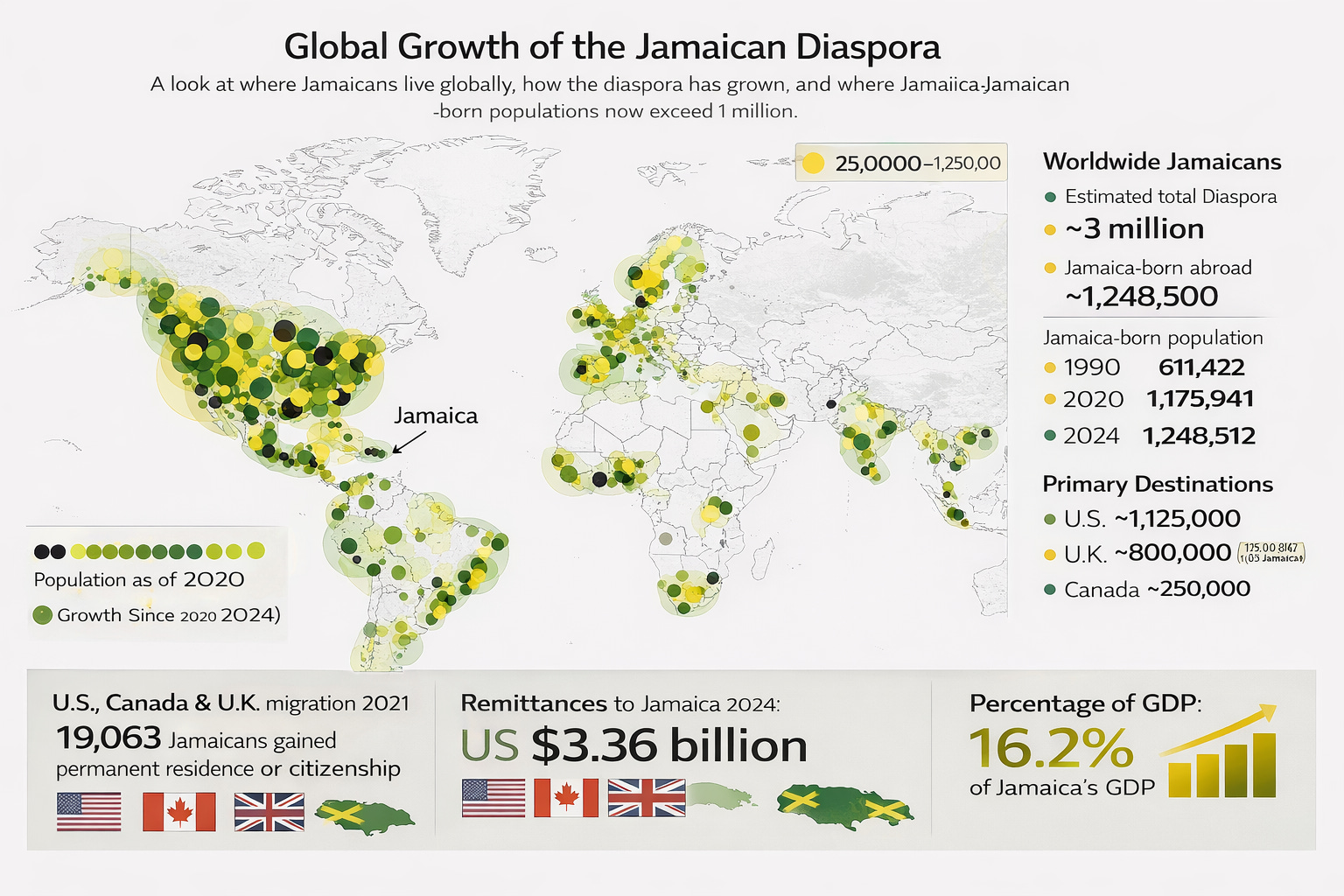
Official policy documents provide a more granular picture. Jamaica’s diaspora policy estimates around three million people globally, including descendants, with roughly 1.6 million first generation Jamaicans living abroad based on selected country data.
A stricter measure, counting only Jamaica born individuals overseas, is lower. Using United Nations derived estimates, Jamaica’s emigrant stock stood at 611,422 in 1990, rising to 1,175,941 in 2020, and reaching approximately 1,248,512 by 2024. These figures reflect only those born in Jamaica, excluding the wider diaspora of second and third generation nationals.
The difference between these numbers is not statistical confusion. It is the story itself.
“Jamaica is one of the few countries where the idea of nation stretches far beyond geography,” said Dean Jones, founder of Jamaica Homes. “If you only count those born on the island, you miss the real force. The diaspora is not just people who left. It is generations who carry Jamaica forward, economically, culturally, and politically.”
There is no single global dataset capturing the full Jamaican diaspora, with figures varying depending on whether they measure Jamaica-born populations or include later generations.
From Windrush to Wall Street
The Jamaican diaspora did not emerge overnight. Its modern shape was forged in waves.
In the 1950s and early 1960s, migration was dominated by the United Kingdom, driven by post war labour shortages. That era, often associated with the Windrush generation, established large Jamaican communities in London and other British cities.
By the late 1960s and into the 1970s, the centre of gravity shifted. Changes in United States immigration law opened new pathways, and migration increasingly moved westward, particularly among skilled workers such as nurses and professionals.
By the numbers, the shift is unmistakable.
Between 1970 and 1979, Jamaica recorded 327,779 migrants to its three main destinations. Of these, 256,984 went to the United States, 56,964 to Canada, and just 13,831 to the United Kingdom.
In the 1980s, migration totalled 239,207, with 201,177 to the United States, 33,973 to Canada, and 4,057 to the United Kingdom.
The pattern continued through the 1990s, when 212,892 Jamaicans migrated, including 170,291 to the United States, 39,443 to Canada, and 3,158 to the United Kingdom.
From 2000 to 2006, migration stood at 135,493, with 117,205 heading to the United States, 15,374 to Canada, and 2,914 to the United Kingdom.
More recent data from 2010 to 2015 shows continued dominance of the United States, with approximately 177,000 Jamaicans migrating there, compared to 39,000 to Canada and 6,000 to the United Kingdom.
Where Jamaicans live today
The result of that history is a diaspora concentrated but globally dispersed.
In the United States, Jamaica’s largest overseas population, the diaspora was estimated at 1,124,120 people based on American Community Survey data. The 2020 U.S. Census reported roughly one million Jamaicans when measured across racial and ethnic identification categories. The largest clusters are in the New York metropolitan area, followed by Florida cities such as Miami, Orlando, and Tampa, with growing communities in Atlanta and Houston.
In Canada, the 2021 census recorded 249,070 people of Jamaican ancestry, including 101,965 first generation, 104,730 second generation, and 42,380 third generation. Earlier figures based on broader ethnic identification placed the number as high as 309,485 in 2016. Between 2016 and 2021, just over 15,000 Jamaicans migrated to Canada.
In the United Kingdom, census data shows 145,871 Jamaica born residents in 2001, rising to 160,095 in 2011, before declining slightly to 142,155 in 2021. Yet when descendants are included, estimates place the wider Jamaican diaspora in the UK at close to 800,000 people.
Across the Caribbean, Jamaican communities remain deeply embedded. Official counts include 17,456 in the Cayman Islands, 16,000 in Antigua and Barbuda, 8,000 in Trinidad and Tobago, and 5,572 in The Bahamas, alongside smaller populations throughout the region.
In Europe outside the UK, the numbers are smaller but significant, with over 3,500 Jamaican nationals, including 1,275 in the Netherlands, 511 in France, 232 in Belgium, and smaller counts in countries such as Luxembourg and Hungary.
In Asia and Australasia, the diaspora totals approximately 2,394, with 1,022 in Australia, 895 in Japan, 387 in New Zealand, and 59 in South Korea, alongside very small populations in Southeast Asia.
In Africa and the Middle East, data remains less complete, though official estimates point to over 1,000 Jamaicans in the Middle East, primarily in the United Arab Emirates, with smaller communities across the Gulf. Jamaican presence in parts of West Africa is acknowledged, though still under research.
A modern migration economy
Migration has not slowed. In 2021 alone, 19,063 Jamaicans were granted permanent residence or citizenship in the United States, Canada, and the United Kingdom combined. Canada received 4,045 Jamaicans that year, its highest intake in a decade.
What follows migration is money.
In 2024, remittances to Jamaica reached US$3.357 billion, representing approximately 16.2 percent of GDP. The United States accounted for roughly two thirds of those flows, with the United Kingdom, Canada, and the Cayman Islands also contributing significantly.
“Remittances are the visible layer,” said Jones. “What is less visible is the structural dependency. Entire communities in Jamaica are sustained by decisions made in New York, Toronto, and London. That changes how you think about national recovery. It is no longer local. It is distributed.”
Recovery, redefined
It is against this backdrop that Prime Minister Holness’s visit takes on deeper meaning.
The Recover Better Conference is not simply about rebuilding after Hurricane Melissa. It is about redefining who is responsible for that rebuilding.
On Friday, the Prime Minister will be honoured at the American Foundation for the University of the West Indies 29th annual ‘The Legacy Continues’ Awards Gala, where he will receive the Legacy Award in recognition of his leadership in education and economic resilience. The event will raise funds for scholarships supporting Caribbean students at UWI, linking diaspora capital directly to human development.
He is also scheduled to address students and faculty at New York University’s STEM School of Business, framing Jamaica’s recovery within a broader push toward knowledge based economic resilience.
That framing reflects a shift in policy thinking.
Jamaica is no longer approaching its diaspora as a distant community. It is treating it as an extension of the state.
“Jamaica’s future is being shaped in multiple time zones,” Jones said. “You cannot rebuild the island without engaging the people who left, because in many ways, they never really left at all.”
The unfinished picture
Despite the scale, one reality remains.
There is still no single, complete dataset capturing the full Jamaican diaspora across all countries and generations from 1950 to today. Even official policy acknowledges that the exact size of the diaspora remains undetermined and that better global data collection is needed.
What exists instead is a mosaic.
But even in fragments, the picture is clear.
Jamaica is not a small island with a large diaspora.
It is a global nation, anchored in the Caribbean, but lived far beyond it.