

Jamaica Is Being Asked to Choose Between Poverty and Principle. That Is the Wrong Question.


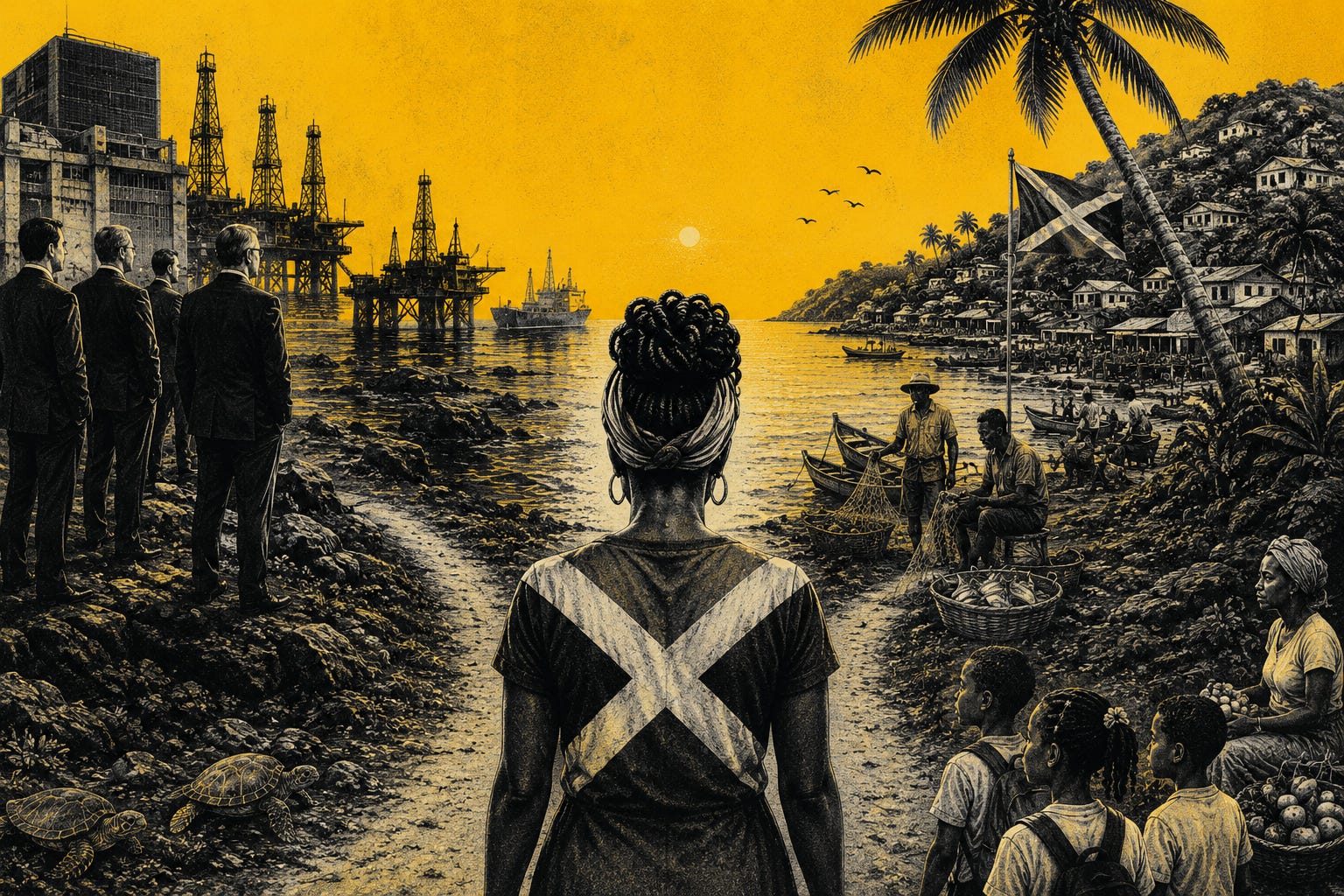
Every few years, a familiar conversation returns to the Caribbean.
A report is published. An international organisation issues a warning. Experts from thousands of miles away explain the risks of development, extraction or industrialisation. Headlines follow. Campaigns begin. The world watches.
Now Jamaica finds itself at the centre of another version of that debate.
A new report has raised concerns about the environmental risks associated with potential offshore oil and gas exploration in the Walton-Morant Basin off Jamaica’s south coast. The warnings are serious. Coral reefs, fishing grounds, protected areas and coastal communities could all face consequences if exploration were eventually to lead to extraction and if environmental safeguards were inadequate.
These concerns deserve attention.
But so does another question that is rarely asked with equal force.
Who gets to decide Jamaica’s future?
The answer should be obvious.
Jamaicans do.
Not foreign governments. Not international campaign groups. Not multinational corporations. Not financial institutions in distant capitals.
The people of Jamaica.
That principle sounds uncontroversial. Yet history suggests otherwise.
For centuries, decisions about Jamaica’s resources were made by others. Wealth flowed outward while ordinary people saw little benefit. Sugar built fortunes. Bauxite generated billions. Land changed hands. Labour was extracted. Communities endured.
The names and industries changed, but the pattern often remained remarkably similar.
The island produced value. Someone else captured much of it.
That history matters because it shapes how many Jamaicans view today’s debates about development.
When wealthy countries lecture poorer nations about what they should not do, many people hear an uncomfortable contradiction.
The industrialised world did not become wealthy through restraint.
Britain did not build its prosperity by leaving coal underground.
Norway did not become one of the richest countries on earth by refusing to develop North Sea oil.
The United States did not become an economic superpower by declining to exploit its energy resources.
These countries extracted. They industrialised. They consumed. They emitted carbon on a scale unimaginable to most developing nations.
Today, many of those same countries urge others to choose a different path.
Some of those arguments are sincere and grounded in genuine concern for the planet. Climate change is real. Biodiversity loss is real. Environmental degradation is real.
But sincerity does not erase inequality.
Jamaica’s contribution to global emissions is tiny compared with that of major industrial economies. Yet Jamaicans are frequently asked to bear the economic cost of decisions made elsewhere.
That is not a climate argument. It is a fairness argument.
And fairness matters.
The reality is that Jamaica faces challenges that environmental reports often mention only in passing.
There are communities where young people struggle to find stable employment.
There are families choosing between paying utility bills and buying groceries.
There are pensioners surviving on incomes that barely stretch to the end of the month.
There are talented graduates leaving because opportunities are limited.
There are returning residents who discover that the dream of coming home is more complicated and expensive than they imagined.
There are hardworking people doing everything right and still finding themselves one unexpected expense away from crisis.
These realities are not theoretical.
They are lived daily.
When people in such circumstances hear that potential economic opportunities should be abandoned in the name of a greater global good, they naturally ask a difficult question:
Who exactly is being asked to sacrifice?
The answer is rarely those already living comfortably.
It is almost always those who have the least.
That does not mean Jamaica should rush into offshore drilling.
Far from it.
Blind development can be as dangerous as blind opposition.
The country’s marine ecosystems are among its greatest assets. Tourism supports livelihoods across the island. Fisheries sustain communities. Coral reefs protect coastlines. Mangroves serve as natural defences against storms and erosion.
A major environmental disaster would carry enormous consequences.
Any discussion about offshore resources must begin with these realities.
Environmental protection is not anti-development.
It is a form of development.
Destroying the natural assets that support jobs and economic activity would be self-defeating.
Yet protecting those assets and exploring economic opportunities are not necessarily mutually exclusive goals.
The real issue is governance.
Can Jamaica create a framework that protects its environment, safeguards public interests and ensures that citizens benefit if resources are developed?
That is the debate worth having.
Because history teaches another lesson.
The greatest threat to resource-rich countries is often not the resource itself.
It is what happens after discovery.
Around the world, oil wealth has produced dramatically different outcomes.
Some nations transformed resource revenue into education, infrastructure and sovereign wealth.
Others became trapped by corruption, dependency and inequality.
The difference was not geology.
The difference was governance.
If commercially viable reserves were ever discovered offshore Jamaica, the question should not simply be whether extraction occurs.
The question should be who benefits.
Would revenues fund schools?
Would they strengthen healthcare?
Would they support housing programmes?
Would they improve roads, water systems and public services?
Would future generations receive a share through a sovereign wealth fund?
Or would the benefits disappear into the same black hole that has swallowed so many opportunities throughout history?
These questions deserve answers long before any production begins.
Indeed, they deserve answers before Jamaicans are asked to support or oppose any project.
Too often, debates become polarised.
One side portrays development as economic salvation.
The other portrays it as environmental catastrophe.
Reality is usually more complicated.
A mature democracy should be capable of discussing both possibilities simultaneously.
Jamaicans should not be forced into a false choice between prosperity and protection.
Nor should they be forced to accept narratives crafted entirely by external interests.
The island’s future should not be written exclusively in corporate boardrooms.
Neither should it be written exclusively in international conference halls.
It should be written in Jamaica.
By Jamaicans.
For Jamaicans.
That principle extends beyond oil and gas.
It applies to tourism.
It applies to mining.
It applies to agriculture.
It applies to housing.
It applies to renewable energy.
It applies to every major decision affecting the country’s future.
Development cannot simply mean extracting value from a place.
It must mean improving the lives of the people who live there.
That sounds obvious, yet history shows how often this principle has been ignored.
The Caribbean knows what it means to watch wealth leave its shores.
It knows what it means to be told that sacrifices are necessary while others enjoy the rewards.
It knows what it means to hear promises that never quite reach ordinary citizens.
Perhaps that is why debates like this provoke such strong emotions.
They are not only about environmental risk.
They are about trust.
Trust that institutions will act in the public interest.
Trust that benefits will be shared fairly.
Trust that decisions will not once again enrich a few while leaving many behind.
Before Jamaica decides whether offshore oil exploration represents an opportunity or a threat, it must first answer a more fundamental question.
Can the country finally create a system in which national resources genuinely serve the national interest?
Because if the answer is no, then neither environmental protection nor resource extraction will deliver justice.
But if the answer is yes, then the conversation becomes far more interesting.
The issue is not whether Jamaica should be told what to do.
The issue is whether Jamaica can decide for itself what kind of future it wants.
That right belongs to no organisation, no corporation and no foreign government.
It belongs to the Jamaican people.
And it always should.