

Jamaica: The Mountain Beneath the Sea
Long before roads and settlements, Jamaica emerged as the peak of a submerged mountain — a geological story that still shapes how the island lives and builds today.

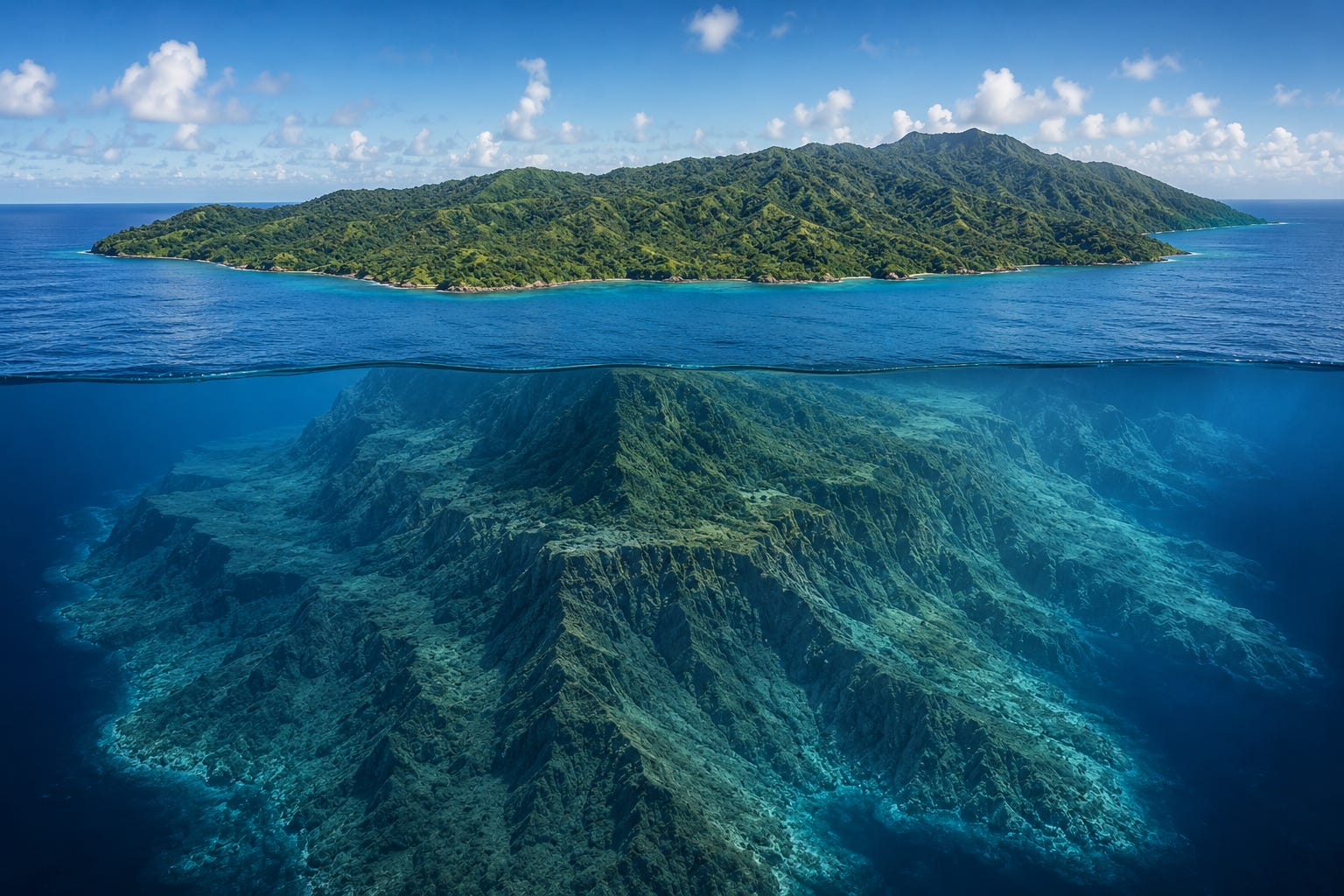
Most Jamaicans grow up hearing that the island is mountainous. But few fully realise just how literal that truth is.
Jamaica is not simply an island sitting in the Caribbean Sea. Geologically, it is the exposed summit of a massive underwater mountain system known as the Jamaica Ridge, a submerged formation that rises dramatically from the ocean floor between the Cayman Basin and the Colombian Basin. The land people know today, Kingston, MoBay, Portland, Clarendon, the Blue Mountains, is only the visible crest of something far larger hidden beneath the sea.
It is a powerful image when you think about it carefully: Jamaica itself is the top of a mountain.
The island’s formation began roughly 25 million years ago through tectonic movement between the North American and Caribbean plates. Over immense stretches of time, pressure, uplift, volcanic activity, and limestone formation shaped the rugged terrain that now defines the country. Unlike flatter islands elsewhere in the region, Jamaica emerged steep, folded, elevated, and geologically restless.
Even today, nearly half the island sits more than 1,000 feet above sea level. The terrain rises quickly and often unexpectedly, from coastal plains into hills, then mountains, then mist-covered interior valleys. In places like St. Andrew, Portland, St. Thomas, and St. Mary, the landscape can shift dramatically within minutes of driving.
The Blue Mountains remain the island’s most iconic expression of this geology. Rising to approximately 7,402 feet at Blue Mountain Peak, they stand among the Caribbean’s highest elevations, often appearing cinematic in the early morning haze. But those visible peaks are only the continuation of the much larger submerged ridge beneath the sea.
In many ways, Jamaica’s physical geography explains much about Jamaican life itself.
Land here has never been simple. Roads curve because mountains demand it. Communities settle in pockets shaped by valleys and ridges. Farming traditions developed around slopes, rainfall patterns, and elevation. Even architecture evolved in response to terrain, from raised foundations and hillside retaining walls to deep verandahs designed for airflow in elevated districts.
The island’s geology also quietly shapes the property market in ways many overseas buyers do not initially understand.
Building in Jamaica is often less about square footage and more about topography, drainage, access, retaining structures, soil conditions, and elevation. Two parcels of land with identical acreage may carry vastly different development costs depending on slope stability, marl access, road frontage, or proximity to limestone formations.
This is especially true in hillside communities across Kingston, St. Andrew, St. Ann, and Portland, where dramatic views can come with equally dramatic engineering realities. A beautiful mountainside lot may require significant excavation, drainage systems, and structural reinforcement before a single block is laid.
At the same time, elevation has always carried emotional and social meaning in Jamaica. Historically, the hills often represented refuge, status, cool climate, agricultural opportunity, or escape from the heat and density of coastal towns. Today, many of the island’s most desired residential areas, from Cherry Gardens and Jack’s Hill to parts of Irish Town and Smokey Vale, continue that relationship between height, breeze, privacy, and prestige.
There is also something symbolic in the idea that Jamaica rises from beneath the sea.
For generations, Jamaicans have built lives on difficult terrain, physically, economically, and historically. The island itself reflects that resilience. What appears small on a map is connected to something much deeper and larger underneath. The visible Jamaica is only part of the story.
And perhaps that is why land ownership remains so emotionally significant across the country. Whether it is family land in rural parishes, a small lot in a housing scheme, a returning resident building in the hills, or generations fighting to preserve ancestral property, land in Jamaica is rarely viewed as merely transactional. It represents permanence in a place shaped by movement, migration, hardship, and endurance.
The mountain beneath the sea still shapes the island above it.
Every cut stone road winding into the hills. Every house balanced against a slope. Every coffee farm hidden in mist. Every community carved into valleys and ridgelines. Jamaica’s geography is not background scenery, it is the foundation of the nation’s identity itself.
From the ocean floor to the Blue Mountains, the island continues to rise.