A reflection by Dean Jones — Founder, Jamaica Homes
When Hurricane Gilbert hit Jamaica in September 1988, I was here. I remember the sound first — the roar that seemed to come from everywhere at once. It was devastating, yes, but also unforgettable. Back then, our homes were mostly wooden. Light frames, zinc roofs, the smell of pine and paint — that was the Jamaica I partly grew up knowing. The storm tore through those homes like paper, reminding us how fragile we were.
And yet, even amid the chaos, there was community. People checked on each other. We cooked together, shared what we had — a car load of plantin’ from Guys Hill, St Mary, and tins of bully beef — and laughed nervously at the gusts that rattled what was left of the wooden window slats. In the days that followed, Jamaica turned tragedy into humour, into song — Wild Gilbert, by Lovindeer.
“Wild, wild, wild, wild Gilbert,” the chorus went — a cheeky anthem that turned loss into laughter. The zinc roofs that flew off, the pots that boiled outdoors, the children who sang while rain poured through the rafters — it all became part of the story.
As a child, I didn’t feel only fear. There was something else too — excitement, a sense of belonging, of being part of something the whole island was experiencing together. The rain was endless, the wind ferocious, but we were together.
From Wood to Stone — Jamaica’s Transformation
Since Gilbert, Jamaica has come a long way. The island that once leaned on timber and tin has embraced concrete, steel, and reinforced block. Building standards have evolved; construction practices have matured.
You can see it in the skyline: the sturdy homes on the hillsides, the apartment complexes rising in Kingston and Montego Bay, the modern developments that blend resilience with design. Today’s Jamaica is built differently — not invincible, but stronger, wiser.
In many ways, Gilbert forced us to grow up. It taught us that beauty means nothing without strength, that a home is more than four walls — it’s a promise of safety.
A History Written in Storms
Jamaica has always been in the path of hurricanes, but not always in their grip. History records them all — Hurricane Charlie in 1951, Flora in 1963, Allen in 1980, Gilbert in 1988, Ivan in 2004, Dean in 2007, Sandy in 2012, and most recently Beryl in 2024.
Each storm told its own story.
Some brought destruction, others passed us by, and a few — by grace or geography — turned away entirely.
Some say it’s the contours of our island that steer them off course. Others say it’s a blessing. I believe it’s both — science and spirit, logic and grace working in unison.
Still, blessing doesn’t mean we should relax. It means we should be grateful and prepared.
Preparing for the Next One — Like Hurricane Melissa
As I write, meteorologists are watching another system — a storm they’re calling Melissa. Whether it turns away or touches down, we prepare the same way. Because preparedness isn’t panic; it’s wisdom.
Just the other day, at a car wash in Ocho Rios, I overheard a debate about it. One of the guys said, “You notice how them name it Melissa? That sound like a soft storm — not like Gilbert. Gilbert was a man name, and you see what him do!” We all laughed. It was that typical Jamaican humour — turning worry into wit, faith wrapped in laughter. Because even when we talk about hurricanes, we do it with a smile and a prayer.
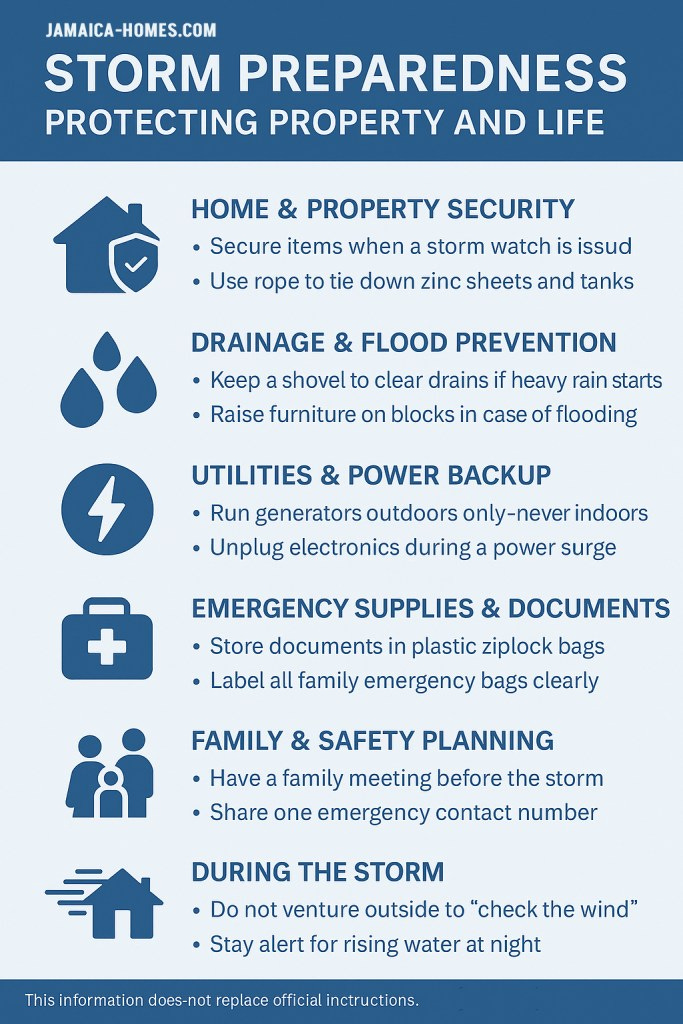
Here are twenty ways — drawn from experience — to protect your family, your home, and your peace of mind.
Affordable Steps — What Everyone Can Do
Choose your safe room. Find an interior space with no windows — somewhere you can shelter safely.
Create a family plan. Know where to go, who to call, and who checks on whom. Include local relatives — especially if you live abroad.
Prepare an emergency kit. Flashlight, batteries, tinned food, water, medication, first aid, cash.
Secure outdoor items. Bring in plant pots, chairs, tools, and tarps that could become projectiles.
Clean drains and gutters. Most damage in Jamaica comes not from wind — but from water.
Photograph your home and contents. Store digital copies for insurance or documentation.
Ask a local relative or neighbour to check your property. Many Jamaicans live abroad; a trusted person on the ground can make all the difference.
Keep printed emergency numbers. Power and phone lines go down — paper doesn’t.
Stock up early. Don’t wait for the rush. Batteries, water, fuel, medication — buy before the warning.
Stay informed. Follow the Meteorological Service of Jamaica and trusted radio updates.
Medium-Cost Measures — Invest in Security
Install shutters or pre-cut plywood. Have fixings ready so you’re not scrambling last minute.
Elevate valuables and electronics. Floods ruin faster than wind destroys.
Buy a small generator or battery system. Keep lights and fridge running when the grid fails.
Inspect and reinforce your roof. Replace weak fasteners, add hurricane straps, check overhangs.
Trim trees and secure branches. Nature’s beauty can become nature’s weapon.
Higher-Investment Resilience — Building for the Future
Hurricane-rated doors and windows. They’re costly, but they protect everything inside.
Raise utilities and structures. Build slightly higher, install back-flow valves, and protect water pumps.
Use hurricane clips and reinforced roof systems. Tie the roof to the walls, and the walls to the foundation — a chain of strength.
Install solar or generator backup. Resilience isn’t only about walls; it’s about continuity.
Review your insurance. Make sure wind, rain, and flood are covered — especially if you’re renting or hosting guests.
Looking Ahead — Designing for Resilience
Jamaica’s future depends on learning from its past. Build homes that stand firm and look beautiful. Use proper drainage, elevate structures in flood-prone areas, choose materials that can dry, not rot.
Plan your landscape like an ally — let it guide water away, not trap it. Plant deep-rooted trees at a distance. And, most importantly, nurture your community. Neighbours, relatives, friends — these are your real defences.
Faith, Science, and the Jamaican Spirit
I believe Jamaica is a blessed island. Again and again, storms have turned away. Some say it’s geography; I call it grace. But grace, as every builder knows, doesn’t replace preparation — it rewards it.
“Jamaica stands firm when the hurricane winds howl — not because the storm forgot us, but because we have built with purpose.”
— Dean Jones
“A turned-away hurricane is not a reason to relax, but a reminder to remain thankful — and ready.”
— Dean Jones
Of course, there were the opportunists too. You see, when the storm was at its worst, some people came out — not to help — but to see what they could take from the houses others had to leave behind. Looking back, it sounds almost unbelievable. Some still joke about it today, but really, it was dangerous — both for the people doing it and for those already in distress. Still, even that became part of the folklore of Gilbert: the madness, the mischief, the mayhem — and somehow, the laughter that followed.
When I think back to Wild Gilbert, I think of zinc roofs flying, laughter in the rain, neighbours cooking outdoors, children singing. It was terrifying, yes. But it was also — in its own strange way — beautiful. Because from it came a stronger, wiser Jamaica.
And that’s the point. Storms test us, but they also shape us. We have learned to build not just for shelter, but for strength. To value both our homes and our humanity.
So whether Hurricane Melissa turns away or touches down — we’ll prepare, we’ll pray, and, as always, we’ll endure.
Because this is Jamaica — wild sometimes, yes — but never weak.