

Jamaica’s Mental Health Crisis May Be Far Bigger Than We Admit
The Caribbean’s mental health crisis may run deeper than official statistics reveal, shaped by trauma, stigma, economic pressure, violence, and generations of unresolved emotional strain.


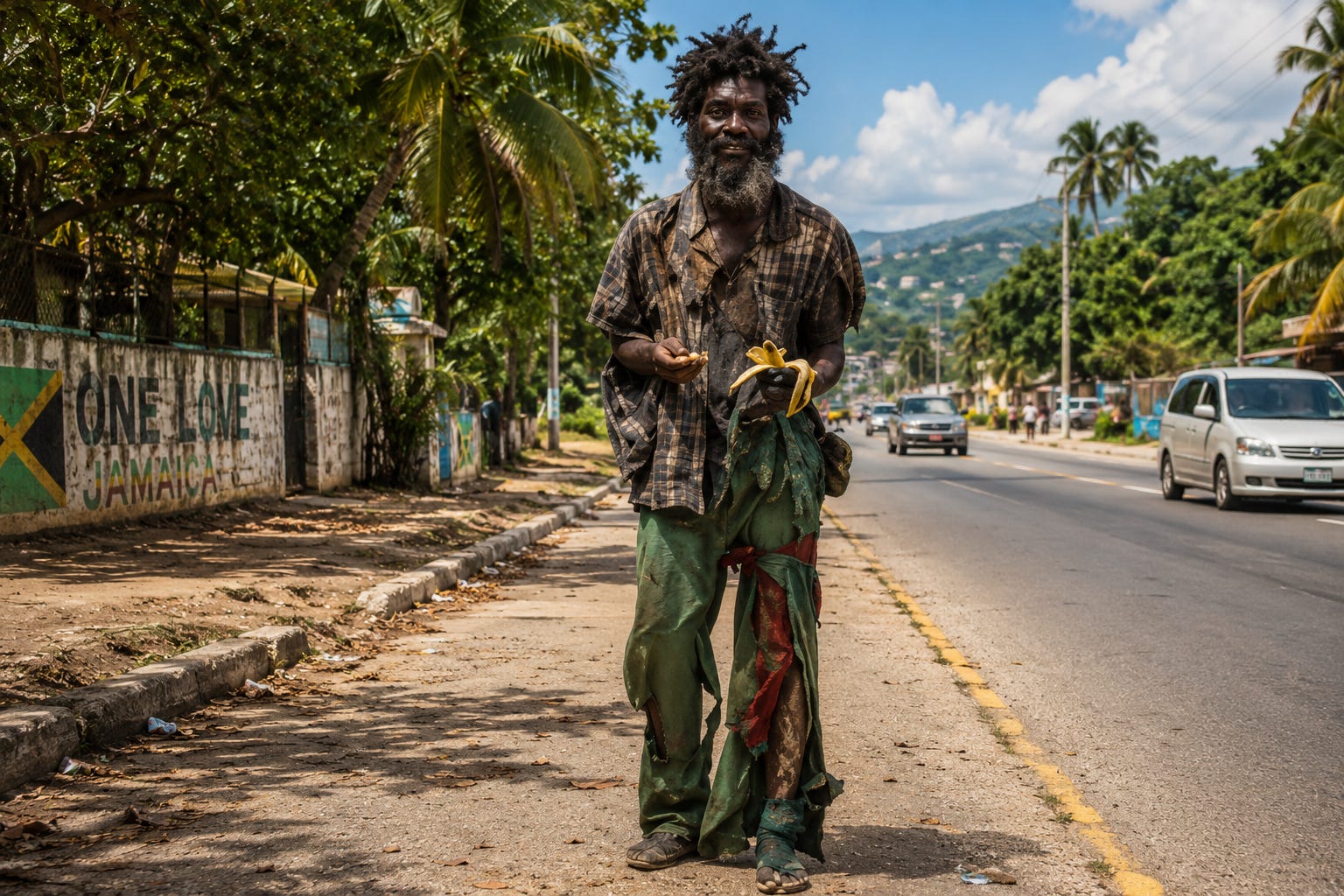
There are moments during Mental Health Awareness Month, driving across Jamaica, when the country feels breathtakingly alive. The mountains rise out of nowhere. The sea appears around corners like a painting. Children laugh at bus stops. Vendors sell fruit under zinc roofs while dancehall leaks from passing cars.
Then there are other moments.
Moments where you watch three vehicles overtaking each other simultaneously on a blind corner at high speed. Moments where motorcyclists fly past in slippers and shorts with no protective gear. Moments where someone wanders into traffic screaming at invisible threats. Moments where you hear another story about somebody in the community who “not all there” hurting themselves or somebody else after years of obvious deterioration that everybody saw coming but nobody properly addressed.
Eventually a difficult question begins to form.
Is Jamaica, and perhaps the wider Caribbean, dealing with a mental health crisis far larger than official figures truly capture?
Recent regional reporting revealed that approximately 77 per cent of people living with mental health conditions across Latin America and the Caribbean reportedly do not receive the care they need. The statistic is staggering, but what may be even more alarming is the possibility that many people living with mental health challenges are never formally identified at all.
Some struggle silently. Some are dismissed as troublesome. Some become jokes. Some become feared. Some self-medicate. Some are simply absorbed into the landscape of daily Caribbean life until abnormality begins to feel normal.
Travelling across Jamaica regularly through the work of Jamaica Homes, certain patterns become difficult to ignore. The levels of visible emotional distress, aggression, recklessness, paranoia, impulsiveness, hopelessness, and instability seen in sections of society feel increasingly difficult to separate from broader conversations about mental health.
That does not mean everyone driving dangerously has a mental illness. It does not mean every eccentric person is psychologically unwell. It certainly does not mean Jamaica is uniquely broken. But it does raise serious questions about whether the Caribbean has underestimated the scale of psychological strain carried by its people for generations.
One of the most disturbing experiences affecting my own family involved an elderly relative, almost one hundred years old, who was severely assaulted by a man reportedly known within the community to suffer from mental illness. The allegations surrounding the individual’s prior behaviour were deeply troubling and had apparently been known before the incident occurred.
That experience changes how these conversations are seen. Mental health stops being an abstract policy issue and becomes frighteningly real.
Across Jamaica, stories like these exist quietly inside families and communities. Many people can point to someone they know who deteriorated mentally over time but never received sustained intervention, treatment, supervision, or support. Others can identify family members battling depression, alcoholism, addiction, anxiety, unresolved trauma, or emotional instability that has simply become normalised over decades.
The Caribbean has historically carried a culture of survival. People “push through.” People “manage.” People “hold strain.” People “tek it and gwaan.” But survival and healing are not the same thing.
The region’s history may also matter more than many are comfortable admitting. Slavery was not only physical brutality. It was psychological destruction on an industrial scale. Families were separated. Identity was stripped. Language was erased. People were commodified, bred, beaten, raped, traded, and psychologically terrorised for generations. Entire systems were built around fear, punishment, humiliation, and control.
No serious society can honestly believe that centuries of such conditions leave no long-term psychological imprint on populations.
Trauma does not always disappear because time passes. Sometimes trauma changes shape. Sometimes it becomes violence. Sometimes addiction. Sometimes emotional detachment. Sometimes hyper aggression. Sometimes reckless behaviour. Sometimes cycles of abandonment. Sometimes silence. And sometimes it becomes so embedded into a culture that people no longer recognise it as trauma at all.
Even today, many Caribbean societies continue to carry enormous social pressures. Financial hardship remains intense for many households. Crime and fear affect communities. Migration separates families across countries. Social media intensifies comparison and insecurity. Young men often grow up emotionally unsupported. Women frequently carry overwhelming burdens while being expected to remain endlessly resilient. Children are exposed early to stress, instability, and violence.
Meanwhile, mental health services across much of the region remain underfunded and overstretched. Regional health organisations have already warned that mental health spending in many Caribbean and Latin American countries remains critically low compared to need.
Yet the issue stretches beyond severe psychiatric illness alone. There are broader neurological, developmental, educational, and behavioural challenges that societies often fail to fully identify or support. Conditions such as dyslexia, dyspraxia, ADHD, autism spectrum disorders, trauma-related conditions, anxiety disorders, and depression may remain undiagnosed for years, especially among poorer populations or older generations who grew up without access to assessment.
Many people were simply labelled “slow,” “bad,” “aggressive,” “lazy,” or “mad.” Others learned to mask their struggles entirely. The result may be generations of people functioning below their full potential while carrying invisible burdens nobody properly addressed.
There is also a dangerous stigma surrounding mental illness across parts of the Caribbean. People fear embarrassment. Families hide relatives. Therapy is sometimes mocked. Men especially are often taught that vulnerability equals weakness. Even seeking counselling can still carry social judgement in some circles.
Yet the irony is that many Caribbean people openly acknowledge the symptoms every day. They speak about stress. Pressure. Burnout. Sleeplessness. “Dark thoughts.” Panic. Anger. Exhaustion. Hopelessness. But often without connecting these experiences to mental health itself.
One of the greatest tragedies may be that some people only receive attention after violence, breakdown, addiction, homelessness, imprisonment, or tragedy occurs. By then the damage can already be immense.
There is also a growing concern surrounding road behaviour in Jamaica.
The level of risk-taking witnessed daily on some roads feels extraordinary. Dangerous overtaking on blind corners, excessive speeding, reckless weaving through traffic, aggressive confrontation, and impulsive decision-making create an atmosphere where survival can sometimes feel partly dependent on luck.
Road safety experts may point to infrastructure, enforcement, driver training, culture, or economics, all of which matter greatly. But it is also fair to ask whether chronic stress, emotional instability, unresolved trauma, impulsiveness, or untreated psychological conditions may contribute more to public behaviour than societies currently acknowledge. Healthy societies do not usually normalise constant chaos.
At the same time, compassion is essential in these conversations. Mental illness is not moral failure. People suffering psychologically are not automatically dangerous. Most individuals living with mental health conditions are not violent. Many are deeply vulnerable themselves.
The answer cannot simply be punishment, ridicule, or abandonment. It requires serious investment. Better diagnosis. More school support systems. Affordable counselling. Community intervention programmes. Trauma-informed education. Support for families. Public awareness campaigns. Safer housing. Reduced stigma. And far greater political seriousness about emotional well-being.
Housing itself also forms part of the conversation. Stable housing environments can affect stress levels, family relationships, child development, safety, sleep quality, and emotional well-being. Overcrowding, instability, violence within communities, and poor living conditions can intensify emotional strain over time. Real estate is not only about buildings and transactions. It is also about the environments people return to every night and the psychological effect those spaces have on human beings.
The Caribbean often speaks proudly about resilience, and rightly so. The region has survived colonisation, slavery, poverty, natural disasters, migration, violence, and economic instability while still producing extraordinary culture, music, faith, creativity, intellect, and joy.
But resilience should not become an excuse to ignore suffering.
Strong people still break.
And sometimes societies become so accustomed to dysfunction that they stop recognising warning signs altogether.
The statistic that 77 per cent of Caribbean people with mental health conditions reportedly receive no care should not merely trigger sympathy. It should trigger urgency.
Because behind those numbers are real people. People driving taxis. Teaching classrooms. Walking streets. Working construction sites. Selling produce. Raising children. Searching for housing. Trying to hold families together. Trying to survive emotionally while societies continue moving around them.
And many may be suffering invisibly in ways the Caribbean still does not fully understand.