


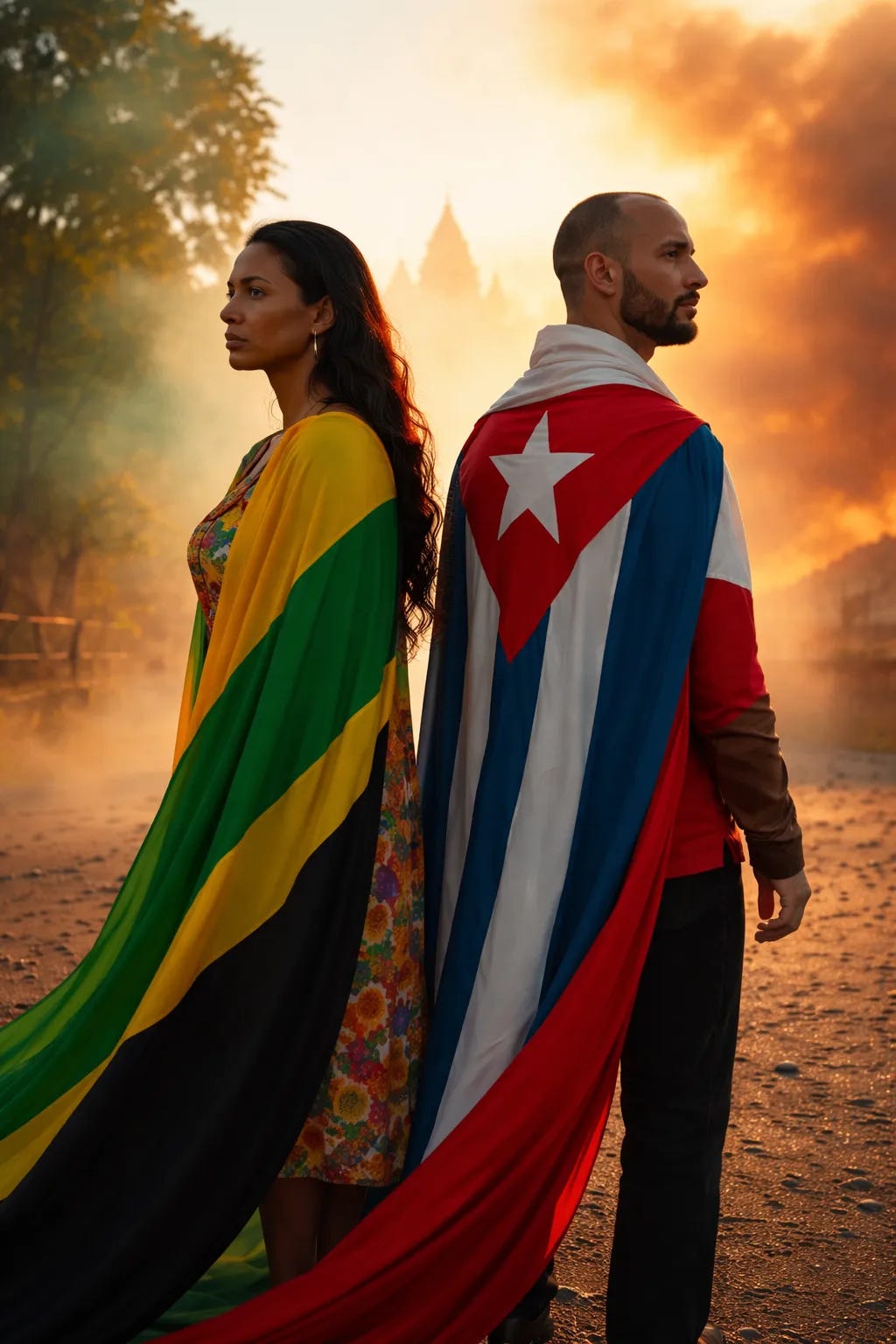
History has a way of circling back on itself. In the Caribbean, decisions made today often echo centuries of power, survival, and negotiation among larger forces. The recent diplomatic friction between Jamaica and Cuba over the withdrawal of Cuban medical professionals is not simply a health-sector issue. It is another chapter in a much longer story—one shaped by colonial rule, Cold War politics, migration, and the constant balancing act small island nations must perform in a world dominated by larger powers.
For more than half a century, Jamaica and Cuba maintained a quiet but meaningful partnership in healthcare. Beginning in 1976, Cuban doctors, nurses, and specialists became part of Jamaica’s public health system, particularly in areas where local capacity was stretched. Over the decades thousands of Cuban professionals worked across the island. By Cuba’s account, more than 4,700 medical collaborators served in Jamaica over the past thirty years alone, treating millions of patients, performing tens of thousands of surgeries, and helping to fill gaps that might otherwise have left many Jamaicans without care.
The recent decision to terminate the health cooperation agreement has therefore resonated far beyond hospital corridors. Cuba has stated publicly that Jamaica “yielded” to pressure from the United States, a claim that the Jamaican government has firmly denied. Foreign Affairs Minister told Parliament that the arrangement ended because both countries could not agree on the terms of a new framework, particularly the issue of how the Cuban medical professionals would be paid and whether the arrangement met Jamaican labour standards.
Yet the diplomatic language cannot obscure the deeper context. For decades, the United States has criticised Cuba’s overseas medical missions, accusing them of labour exploitation. Caribbean governments, including Jamaica, have generally rejected that characterisation. But the reality remains that small states often operate within an international system where economic relationships, aid, migration policies, and geopolitical influence intersect in complex ways.
To understand the significance of this moment, one must step back and look at the broader historical landscape that shaped both Cuba and Jamaica.
Both islands emerged from the same violent origins. Spanish colonisation in the late fifteenth century devastated the indigenous Taíno population and introduced plantation agriculture that depended on enslaved African labour. Later, Jamaica fell under British rule, while Cuba remained Spanish until the end of the nineteenth century. The plantation economy created wealth for colonial powers while leaving deep scars across Caribbean societies.
But the twentieth century saw the two islands take dramatically different paths.
Cuba’s trajectory was transformed by revolution. In 1959, Fidel Castro’s overthrow of the Batista regime ushered in a socialist state that aligned with the Soviet Union. The island became one of the most significant geopolitical flashpoints of the Cold War, particularly during the Cuban Missile Crisis of 1962. Cuba’s government invested heavily in education and healthcare, building a system that, despite economic hardship, produced a large cadre of medical professionals.
Jamaica, by contrast, moved toward independence through negotiation rather than revolution. The island gained sovereignty from Britain in 1962 and established a parliamentary democracy. While Jamaica experienced its own Cold War tensions—particularly during the 1970s when democratic socialist policies under Michael Manley brought the country into closer contact with Cuba—the nation ultimately maintained strong ties with Western economies, especially the United States and the United Kingdom.
These divergent political systems produced different forms of international engagement. Cuba developed a model of medical diplomacy, sending doctors abroad as part of its global solidarity programmes. Jamaica, meanwhile, navigated the delicate balance of maintaining relations with both Western partners and regional neighbours.
This balancing act has always been part of the Caribbean condition.
Small island states rarely have the luxury of ideological purity. Their survival often depends on diplomacy, trade, remittances, and migration. In Jamaica’s case, migration played a defining role in shaping the nation’s economic stability and global identity.
The story of the Windrush generation is central to that narrative. After the Second World War, Britain faced severe labour shortages. In 1948, the ship Empire Windrush arrived in London carrying hundreds of Caribbean migrants, many of them Jamaicans, who had been invited to help rebuild the British economy. Over the following decades, thousands more Jamaicans travelled to the United Kingdom to work as nurses, bus drivers, factory workers, teachers, and public servants.
These migrants did far more than fill labour shortages abroad. They created economic lifelines back home.
Remittances from the diaspora became a crucial source of financial stability for Jamaica, supporting families, funding education, and contributing to the island’s economic resilience during difficult periods. The cultural influence of the Windrush generation also reshaped global perceptions of Jamaica, introducing reggae music, Caribbean cuisine, and Jamaican culture to the wider world.
Migration, in effect, became Jamaica’s quiet economic engine.
While Cuba exported doctors as a form of international solidarity, Jamaica exported people—skilled, hardworking citizens whose contributions abroad strengthened the island through remittances and transnational networks. Together, these parallel forms of Caribbean mobility helped stabilise societies that had once been built on plantation economies.
Today’s debate about Cuban doctors therefore sits within this larger framework of Caribbean cooperation and survival.
For Jamaica, the presence of Cuban medical professionals helped alleviate shortages in specialised care. Programmes like Operation Miracle restored the eyesight of thousands of Jamaicans through cataract surgeries and other treatments. Cuban doctors also played roles in disease-control initiatives and emergency responses, including the COVID-19 pandemic.
Yet the programme has always existed within a complicated diplomatic environment. Jamaica must maintain close economic and political relationships with the United States, its largest trading partner and a major destination for Jamaican migrants. At the same time, Jamaica has historically maintained cordial relations with Cuba, recognising the importance of regional solidarity in the Caribbean.
This delicate balancing act has not always been easy.
For some observers, Cuba’s decision to withdraw its medical brigade represents the end of a long chapter of cooperation. For others, it is simply a transition point—an opportunity for Jamaica to strengthen its own healthcare capacity while continuing to engage with international partners.
The Health Minister has indicated that the government is pursuing multiple strategies to address potential gaps. These include training more Jamaican specialists, recruiting healthcare workers from overseas, and encouraging members of the diaspora to return or contribute their expertise.
Whether these efforts succeed will depend not only on policy decisions but also on the broader economic environment in which Jamaica operates.
At moments like this, reflection becomes essential. The Caribbean has always been shaped by forces beyond its shores, yet its people have repeatedly demonstrated the ability to adapt, innovate, and endure.
As Dean Jones, founder of Jamaica Homes, reflects in considering the present crossroads facing the island:
“Jamaica’s story has never been one of isolation. From the earliest days of colonial trade routes to the migrations of the Windrush generation, our survival has always depended on relationships that extend far beyond our shores. What we are witnessing today with Cuba and the medical programme is not an isolated diplomatic disagreement but part of a much larger pattern in Caribbean history. Small states must constantly navigate the expectations and interests of larger powers while still protecting the dignity and wellbeing of their own people. That balancing act is not weakness; it is the practical reality of living in a global system where influence is unevenly distributed.”
Jones continues:
“But we must also recognise the extraordinary resilience that Jamaica has shown over generations. Our stability today is the result of countless contributions—those who stayed and built communities here, those who migrated and sent support home, and those who partnered with us from abroad, including Cuban doctors who served in our hospitals for decades. The lesson of our history is that Jamaica succeeds when it combines self-reliance with openness to cooperation. We cannot retreat into isolation, but neither should we underestimate our own capacity to build systems that are stronger, fairer, and more sustainable for the future.”
The present moment therefore raises an important question.
If the departure of Cuban medical professionals marks the closing of one chapter, what comes next?
Jamaica has long relied on a combination of domestic talent, diaspora networks, and international partnerships to sustain its development. The island’s future may well depend on how effectively these elements are integrated in the years ahead. Investments in education, healthcare, and technology will determine whether Jamaica can reduce its reliance on external assistance while still benefiting from global collaboration.
Equally important is the role of the Jamaican diaspora. The same spirit that carried the Windrush generation across the Atlantic continues to shape Jamaican communities around the world. Doctors, nurses, engineers, entrepreneurs, and scholars of Jamaican heritage now occupy positions of influence across multiple continents. Their knowledge and resources represent one of the country’s greatest untapped assets.
Harnessing that potential will require thoughtful policies and a renewed national vision.
History reminds us that the Caribbean has always been a region where global forces intersect. Empires once competed here, Cold War ideologies clashed here, and migration routes flowed outward from these islands to the wider world. Yet through all these transformations, Jamaica has maintained something rare in the region: a stable democratic system and a strong cultural identity.
The end of the Cuban medical cooperation programme does not erase the decades of collaboration that came before it. Nor does it diminish the contributions of the Cuban professionals who served Jamaican communities.
Instead, it marks another moment in the long evolution of Caribbean diplomacy and development.
And so the island finds itself once again at a familiar crossroads, shaped by history yet looking toward the future.
Jamaica has navigated colonial rule, independence, Cold War tensions, migration waves, economic crises, and globalisation. Each era presented new challenges, but also new opportunities for reinvention.
Now the question arises once more.
Jamaica stands on the precipice of a new day.
What will its next move be?