

Land, Power, and Belonging: What the Histories of Saudi Arabia, Dubai, and Jamaica Teach Us About Property

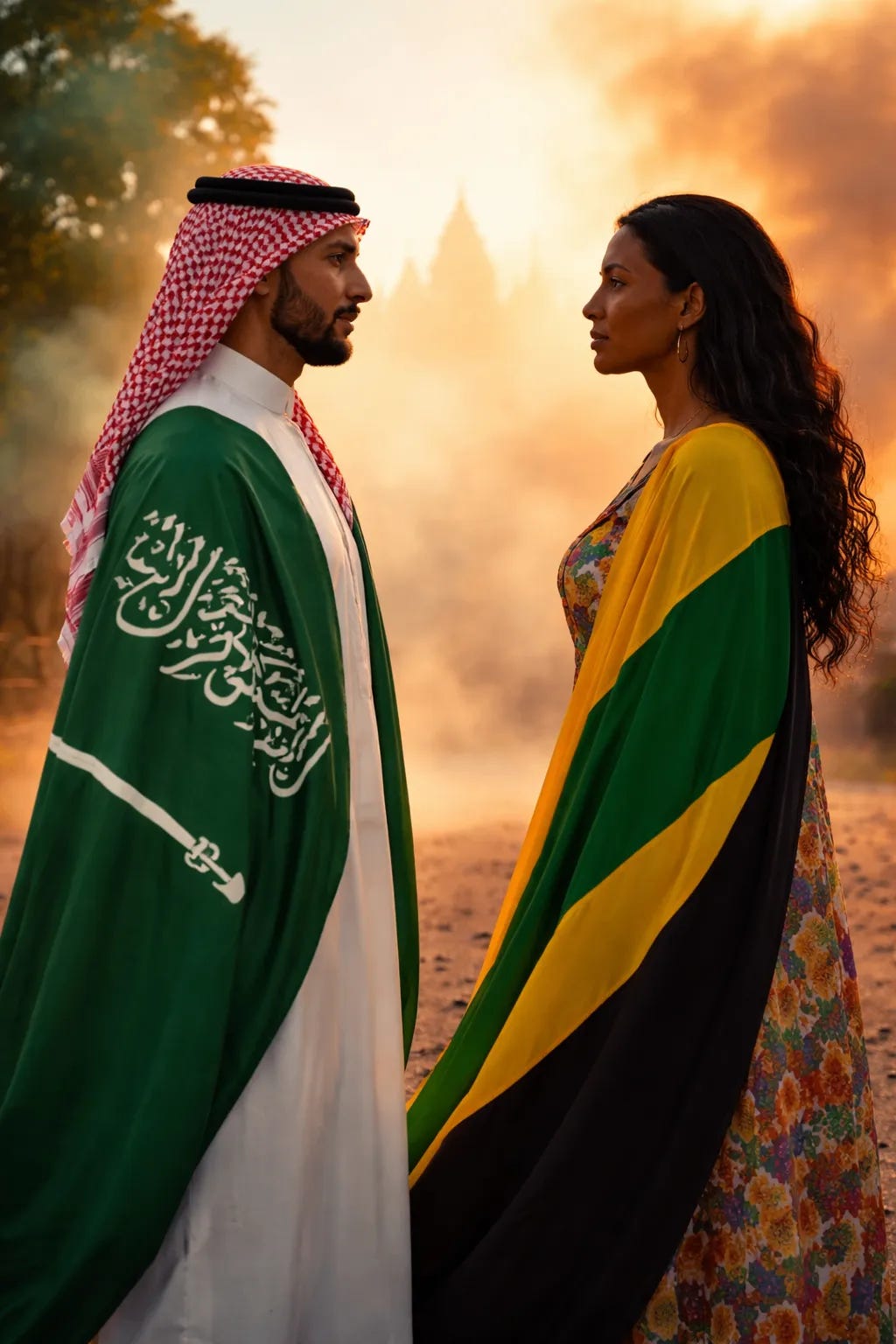
Across the world, land tells stories. Long before governments issue titles, before surveyors draw boundaries, before lawyers debate ownership, land exists as something deeper: territory, survival, identity, and power. If you trace the histories of Saudi Arabia, Dubai, and Jamaica from their earliest beginnings to the modern era, a fascinating pattern emerges. Each place reveals that real estate is never simply about buildings or transactions. It is about civilisation itself—about who controls land, who belongs to it, and who benefits from it.
The modern language of real estate—titles, deeds, mortgages, development—sits on top of thousands of years of human struggle over territory. In these three places, separated by oceans and cultures, the same underlying truth appears again and again: land is destiny.
Arabia: Land Before Oil
Long before Saudi Arabia became synonymous with oil wealth and gleaming modern cities, the Arabian Peninsula was a vast landscape of movement, trade, and survival. Archaeological evidence suggests humans passed through Arabia hundreds of thousands of years ago, during periods when the climate was greener and the desert was dotted with lakes and grasslands.
Ancient Arabia was not a single political unit. It was a mosaic of tribes, oasis settlements, caravan towns, and coastal trading communities. Land was rarely owned in the modern sense. Instead, territory was tied to tribal identity. A tribe did not simply occupy land—it belonged to it, protected it, and drew its livelihood from it.
In the south of Arabia, kingdoms such as Saba and Himyar grew wealthy through the trade of incense and spices, commodities once as valuable as precious metals. In the north and west, caravan routes connected Arabia to the Roman and Persian worlds. These trade networks created early forms of urban property and commercial centres, including settlements such as Hegra and other oasis towns that functioned as logistical hubs along desert routes.
Even then, the value of land lay not merely in its physical surface but in its strategic position. A water source, a trade crossroads, or a pilgrimage route could transform a remote desert settlement into a thriving centre of commerce.
The Sacred Geography of Islam
The rise of Islam in the seventh century dramatically reshaped Arabia’s relationship with land. When the Prophet Muhammad began preaching in Mecca in the early 600s, the city was already a religious and commercial hub. After the migration to Medina in 622—an event marking the beginning of the Islamic calendar—the Arabian Peninsula began to unify under a new religious and political framework.
Two cities became permanently embedded in the global consciousness: Mecca and Medina. Their significance created something unique in the history of land. These places were not merely urban centres but sacred geography. Ownership, governance, and stewardship of these cities carried immense spiritual authority.
In real estate terms, these locations became some of the most valuable land on Earth—not because of natural resources, but because of belief. Millions of people continue to travel to Mecca each year for pilgrimage, demonstrating that land can derive extraordinary value from culture, religion, and collective meaning.
The Long Fragmentation of Arabia
For centuries after the early Islamic period, Arabia remained politically fragmented. While great Islamic empires governed from capitals like Damascus and Baghdad, much of Arabia remained under local control. Tribal systems continued to shape land use, especially in the interior regions.
The Ottoman Empire eventually exercised influence over parts of Arabia, particularly the Hijaz where the holy cities are located. Yet even then, central Arabia remained largely autonomous.
In many ways, the peninsula functioned like a vast network of territories rather than a single nation. Property rights were fluid, often governed by tribal customs rather than codified law. The concept of modern land registration was largely absent.
The Saudi State and the Oil Transformation
The foundation of modern Saudi Arabia began in the eighteenth century when a local ruler, Muhammad ibn Saud, formed a political and religious alliance with reformer Muhammad ibn Abd al-Wahhab. Their movement gradually expanded across central Arabia, establishing what historians call the First Saudi State.
Although that early state collapsed, the Saudi family re-emerged in the twentieth century under Abdulaziz Ibn Saud. By 1932, he had unified much of the Arabian Peninsula into the Kingdom of Saudi Arabia.
Then came the discovery that would transform everything: oil.
In 1938, commercial oil was discovered in Saudi Arabia. What had once been a relatively poor desert kingdom rapidly became one of the most economically powerful nations in the world. Cities expanded, infrastructure multiplied, and vast urban developments emerged.
The transformation of Saudi Arabia demonstrates how natural resources can redefine land value. Desert territory that once seemed economically marginal suddenly became the foundation of immense national wealth.
Dubai: From Creek to Global Skyline
While Saudi Arabia’s modern rise was tied to oil, the story of Dubai follows a slightly different path. The land that forms the modern United Arab Emirates has been inhabited for thousands of years. Archaeological sites reveal ancient coastal communities that traded with Mesopotamia, Persia, and the Indus Valley.
For centuries, the Gulf region functioned as a maritime trading network. Communities survived through fishing, pearl diving, and commerce. Land near the sea held strategic importance, especially natural harbours and inlets.
Dubai itself developed around such a geographic feature: Dubai Creek. In 1833, the Al Maktoum family established political control over the settlement, creating the emirate that continues to exist today.
At the time, Dubai was a modest port town. Its prosperity depended heavily on the pearl trade, which dominated the Gulf economy. Pearl divers risked their lives in the waters of the Arabian Gulf, retrieving natural pearls that were sold across Asia and Europe.
In modern real estate language, Dubai Creek functioned as prime waterfront property. Its natural harbour allowed trade to flourish and merchants to settle nearby. Land along the creek quickly became the economic heart of the settlement.
Reinventing Land Value
The collapse of the pearl industry in the early twentieth century devastated many Gulf communities. However, Dubai’s leadership responded with a remarkable strategy: openness to trade.
Merchants from Persia and India were welcomed. Taxes were low, and commerce was encouraged. The emirate developed a reputation as a free trading port.
Oil was eventually discovered in Dubai during the 1960s, but its reserves were far smaller than those of neighbouring Abu Dhabi. Rather than rely entirely on oil, Dubai’s rulers invested in infrastructure, aviation, logistics, and real estate development.
When the United Arab Emirates was formed in 1971, Dubai became one of its seven emirates. Over the next few decades, the city undertook one of the most ambitious urban transformations in modern history.
Artificial islands, luxury towers, massive shopping centres, and global transport hubs emerged where desert once dominated. Dubai effectively turned land development into a national strategy.
Its success demonstrates a powerful lesson: real estate can itself become an economic engine. Through strategic planning, branding, and infrastructure investment, Dubai converted geography into global influence.
Jamaica: Land, Colonialism, and Identity
The story of Jamaica introduces a very different dimension of land history. Before European arrival, the island was inhabited by the Taíno people, who called it Xaymaca, often interpreted as “land of wood and water.” Their communities practiced agriculture, fishing, and regional trade across the Caribbean.
In 1494, Christopher Columbus arrived on the island, claiming it for Spain. Within decades, the Taíno population collapsed under the weight of disease, forced labour, and colonial disruption.
Spain introduced African slavery to Jamaica, but it was the English conquest in 1655 that transformed the island into one of the British Empire’s most profitable plantation colonies. Sugar plantations spread across the landscape, worked by enslaved Africans under brutal conditions.
Here, land became a tool of economic extraction. Large estates were carved out of the island, concentrating wealth in the hands of plantation owners while enslaved people were denied any legal claim to land.
Yet even under these oppressive conditions, resistance flourished. Escaped enslaved Africans formed independent communities in the mountainous interior. These groups became known as the Maroons.
The Maroons defended their territory fiercely, eventually forcing the British into treaties during the eighteenth century. In doing so, they created one of the earliest examples in the Caribbean of Black territorial autonomy.
The Fight for Land After Emancipation
When slavery was abolished in the British Empire in 1834, followed by full emancipation in 1838, freedom did not automatically translate into land ownership.
Many formerly enslaved people struggled to access land, as plantations remained concentrated in the hands of colonial elites. However, small farming communities gradually emerged, forming the foundation of Jamaica’s rural society.
Land became a symbol of independence and dignity. Owning a small plot meant escaping plantation labour and building a life outside colonial control.
This struggle for land access continues to shape Jamaica today. Issues of property rights, land titling, housing development, and inheritance remain central to the island’s social and economic landscape.
Land as Power
When we examine the histories of Saudi Arabia, Dubai, and Jamaica side by side, a powerful pattern becomes visible.
In Arabia, land gained value through religion and natural resources. In Dubai, it gained value through trade and visionary development. In Jamaica, it became a battleground for freedom, identity, and economic justice.
Despite their differences, these places share a common truth: land is never neutral. It reflects the political systems, economic priorities, and social struggles of the people who inhabit it.
Real estate professionals sometimes view property as numbers, transactions, and development opportunities. But behind every title deed lies a deeper story.
Land carries memory.
A desert oasis that once sustained caravans becomes a modern metropolis. A creekside trading port becomes a global skyline. A plantation island becomes a cultural powerhouse that influences music, language, and identity across the world.
The lesson is clear. Real estate is not just about structures or square footage. It is about the long human story of territory, belonging, and transformation.
And if history teaches us anything, it is this: the most valuable land is not always the land with the most resources. Sometimes it is the land where people decide to build a future.
Disclaimer
This article is written for general informational and educational purposes only. It offers a broad historical and interpretive overview of Saudi Arabia, Dubai and the wider Gulf region, and Jamaica, with commentary on how land, property, and development have influenced their historical trajectories. While reasonable efforts have been made to present accurate historical information, the discussion is necessarily simplified and interpretive in nature and should not be treated as a definitive academic account of the histories of these places.
The references to land, ownership, development, and real estate are intended to provide a conceptual perspective on how territory and property have shaped societies over time. They should not be interpreted as legal, financial, investment, surveying, or real estate advice. Readers seeking professional guidance regarding property transactions, land ownership, development, or legal rights should consult qualified professionals such as attorneys, licensed real estate practitioners, surveyors, or financial advisors in the relevant jurisdiction.
Historical interpretations, dates, and cultural descriptions may vary among historians, scholars, and sources. The author acknowledges that the histories of these regions are complex and continue to be researched and debated within academic and historical communities.
Any views expressed in the article represent general commentary and analysis and do not necessarily reflect the official positions of any government, institution, organisation, or professional body.
Readers are encouraged to consult multiple scholarly sources and historical records when conducting research or forming conclusions about the historical development of any country or region discussed.