

Land tussle
The dispute may start with a fence, a house, a burial, or an inheritance. But beneath almost every family land conflict lies a much deeper story about history, memory, migration, and time.

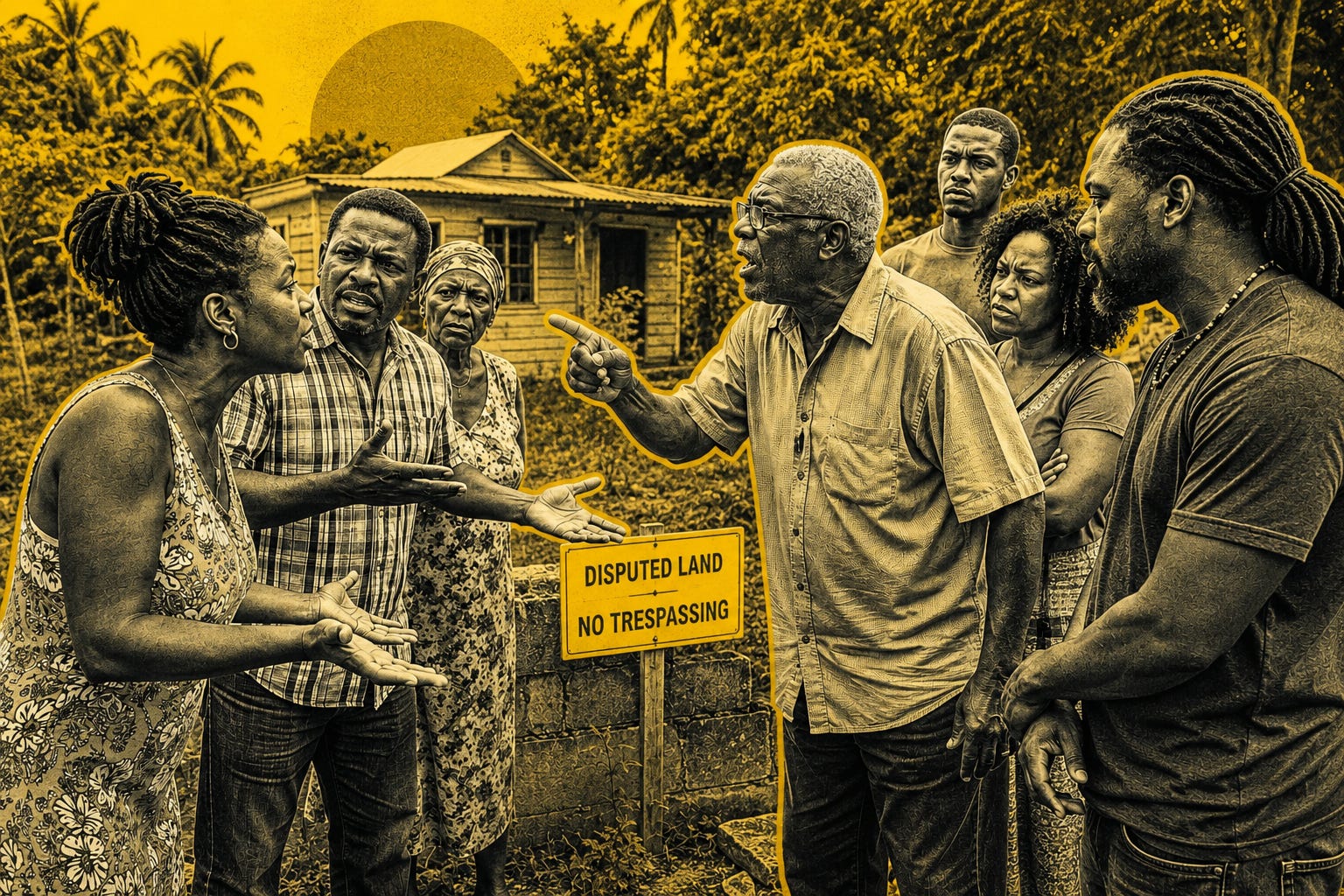
There are few subjects in Jamaica more capable of dividing an otherwise loving family than land.
It is a phenomenon so common that it has become part of the national conversation. Mention family land in almost any district and someone will have a story. A brother who stopped speaking to a sister. Cousins locked in court proceedings. A house that nobody can sell. A farm abandoned because nobody can agree who owns it.
Yet the disputes themselves are often only the visible part of a much larger problem.
Across Jamaica and the wider Caribbean, recent cases suggest that family land conflicts are not isolated incidents. They are the predictable outcome of a system that has been building pressure for generations.
The question is not why families fight over land.
The question may be why they are almost destined to.
The Legacy of Family Land
To understand modern disputes, it is necessary to understand family land itself.
Family land emerged after emancipation when formerly enslaved Jamaicans acquired small parcels of land and passed them to future generations. The system was designed to ensure that descendants would always have somewhere to live, farm, and build a future.
For many families, it worked.
For decades.
Sometimes for more than a century.
The challenge is that family land was often passed down through understanding rather than documentation. A son built a house. A daughter cultivated a field. Grandchildren moved onto different sections. Relatives migrated overseas while others remained behind.
Each generation added another layer to the story.
What began as one owner eventually became ten descendants, then twenty, then fifty, and sometimes hundreds of people with a potential interest in the same property.
The land remained.
The paperwork often did not.
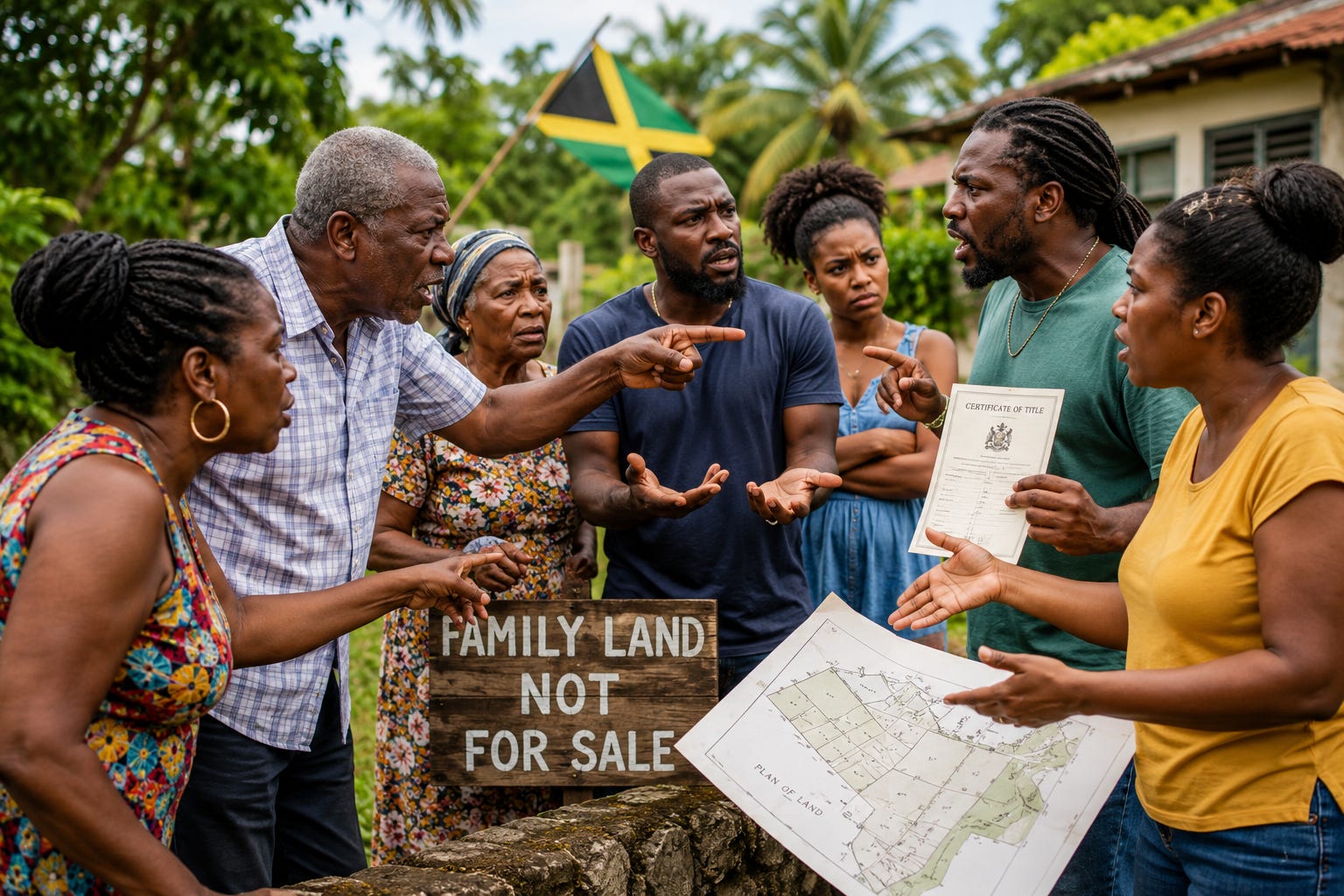
Land Never Forgets
Unlike money, land does not disappear when it is spent.
A bank account can be exhausted. A vehicle can be sold. A business can fail.
Land stays exactly where it is.
And because it stays, it accumulates history.
A plot that nobody cared about in 1980 may suddenly become valuable because a highway was built nearby, a tourism development arrived, or a growing town expanded in its direction.
The moment value increases, old questions reappear.
Who owns it?
Who inherited it?
Who maintained it?
Who should benefit from it?
In many cases, relatives who showed little interest for years suddenly become interested when the property acquires significant value.
What appears to be greed is often something more complicated.
People are not merely claiming land.
They are claiming a place in family history.
The Diaspora Effect
No discussion of Jamaican land disputes is complete without considering migration.
For generations, Jamaicans left for Britain, Canada, the United States, and elsewhere in search of opportunity.
Many sent money home.
Many expected to return.
Some never did.
Meanwhile, relatives who remained on the island continued paying taxes, repairing structures, clearing bush, and protecting family property.
When ownership questions eventually arise, two competing narratives often emerge.
The relative overseas argues that inheritance rights do not disappear simply because they migrated.
The relative at home argues that they carried the burden of maintaining the property when nobody else would.
Both positions frequently contain elements of truth.
The result is a dispute that is rarely about law alone.
It is about contribution, sacrifice, and belonging.
When Difficult Conversations Never Happen
Another recurring feature of land disputes is silence.
Many parents avoid discussing inheritance.
Some believe there will always be time later.
Others fear creating conflict among their children.
Some simply assume everyone knows what they intended.
But intentions are not legal documents.
When a parent dies without a will, surviving relatives are often left attempting to interpret years of conversations, promises, assumptions, and memories.
Earlier this year, Jamaica’s Justice Minister warned that too many Jamaicans continue to die intestate, leaving families locked in disputes over houses, land, and inherited assets. He noted that more than J$50 billion in estates and assets remain tied up in unresolved estate matters.
The consequences can last for decades.
When Land Disputes Become Personal
What makes Jamaican land conflicts different from ordinary property disputes is how deeply personal they become.
One sibling may have built a house.
Another may have funded improvements from overseas.
A third may have lived on the property for thirty years.
A fourth may possess legal documentation.
By the time the dispute reaches lawyers or courts, nobody believes they are simply arguing about land.
They believe they are defending their parents’ wishes, protecting their children’s future, or preserving decades of personal sacrifice.
That emotional dimension explains why these conflicts can become so bitter.
The legal position and the emotional position are often two very different things.
Recent Cases Show the Pattern
Recent events across Jamaica illustrate how frequently these issues surface.
In St Ann earlier this year, a dispute involving burial rights drew national attention after ownership questions reportedly complicated efforts to bury a deceased family member. Municipal authorities acknowledged that land ownership disputes were contributing to delays in burials across parts of the parish.
The dispute was not really about a burial.
It was about ownership.
The burial simply exposed a conflict that had already existed beneath the surface.
A separate dispute in Clapham, St Ann, involved a property owner who had reportedly been attempting to remove occupants from land for years before the matter escalated into public controversy. Long occupation, competing claims, family ties, and unclear arrangements combined to create a conflict with no quick resolution.
Meanwhile, in Kettering, Trelawny, a dispute involving residents who had occupied land for more than three decades highlighted another uniquely Caribbean tension: the clash between legal ownership and emotional ownership. Occupants argued that decades of living on the land had created a legitimate connection to it. Legal owners disagreed.
Across Jamaica, similar stories repeat themselves.
“My father lived here.”
“My grandmother planted these trees.”
“I have been here longer than the paper owner.”
The language is rarely legal.
It is familial.
Hurricane Melissa Exposed Hidden Problems
Sometimes disputes remain invisible until a crisis occurs.
Hurricane Melissa provided a stark reminder of this reality.
Following the storm, some families reportedly encountered challenges accessing assistance, rebuilding, or securing financing because ownership documentation was unclear.
For years, the arrangements had seemed sufficient.
Then disaster struck.
Suddenly ownership mattered.
The same pattern appears repeatedly throughout the Caribbean.
Everything functions normally until:
Someone dies.
A developer arrives.
A highway is built.
Government compensation becomes available.
A natural disaster occurs.
Then the question everyone avoided becomes unavoidable.
Who actually owns the land?
A Caribbean Problem, Not Just a Jamaican One
Although Jamaica’s family land tradition is unique in its scale, the wider Caribbean faces many of the same challenges.
In Barbados, policymakers have recently pointed to inheritance disputes as barriers to economic development and wealth creation. Families remain unable to utilise property effectively because ownership remains unresolved.
In Guyana, one of the Caribbean’s longest-running land battles finally reached its conclusion this year after more than three decades of litigation. The Vigilance family spent 31 years attempting to recover land through multiple levels of the court system before ultimately losing their final appeal.
Three decades.
Multiple generations.
Multiple courts.
The dispute outlived many of the people who originally started it.
That may be the most powerful lesson of all.
Land disputes often survive longer than the individuals involved.
Why Governments Keep Pushing Land Titling
Jamaica’s renewed emphasis on land titling is about far more than paperwork.
At its core, it is an attempt to prevent future family wars.
Officials repeatedly return to the same challenges:
Family land.
Missing documents.
Informal inheritance.
Long-term occupation.
Absent owners.
Competing claims.
Behind each category lies a potential dispute waiting to happen.
The reality is that thousands of Caribbean families continue to occupy land that has never been fully regularised. Some inherited it. Some purchased it decades ago with little more than handwritten receipts. Some remain on ancestral property while relatives overseas retain legal interests.
Every one of those situations contains the seeds of tomorrow’s conflict.
Time Is the Real Culprit
It is tempting to blame greed.
Sometimes greed is involved.
But the deeper explanation is usually time.
Every generation adds another descendant.
Another verbal promise.
Another house.
Another fence.
Another memory.
Eventually the land becomes less a record of ownership and more a record of family history.
And family history is rarely simple.
Jamaica’s greatest land disputes are seldom created in courtrooms. They are created slowly, over decades, through conversations never held, wills never written, documents never updated, and assumptions never challenged.
By the time lawyers become involved, the dispute is rarely about property alone.
It is about memory.
It is about sacrifice.
It is about belonging.
And that is why, across Jamaica and much of the Caribbean, the most difficult battles over land are often not really battles over land at all.