


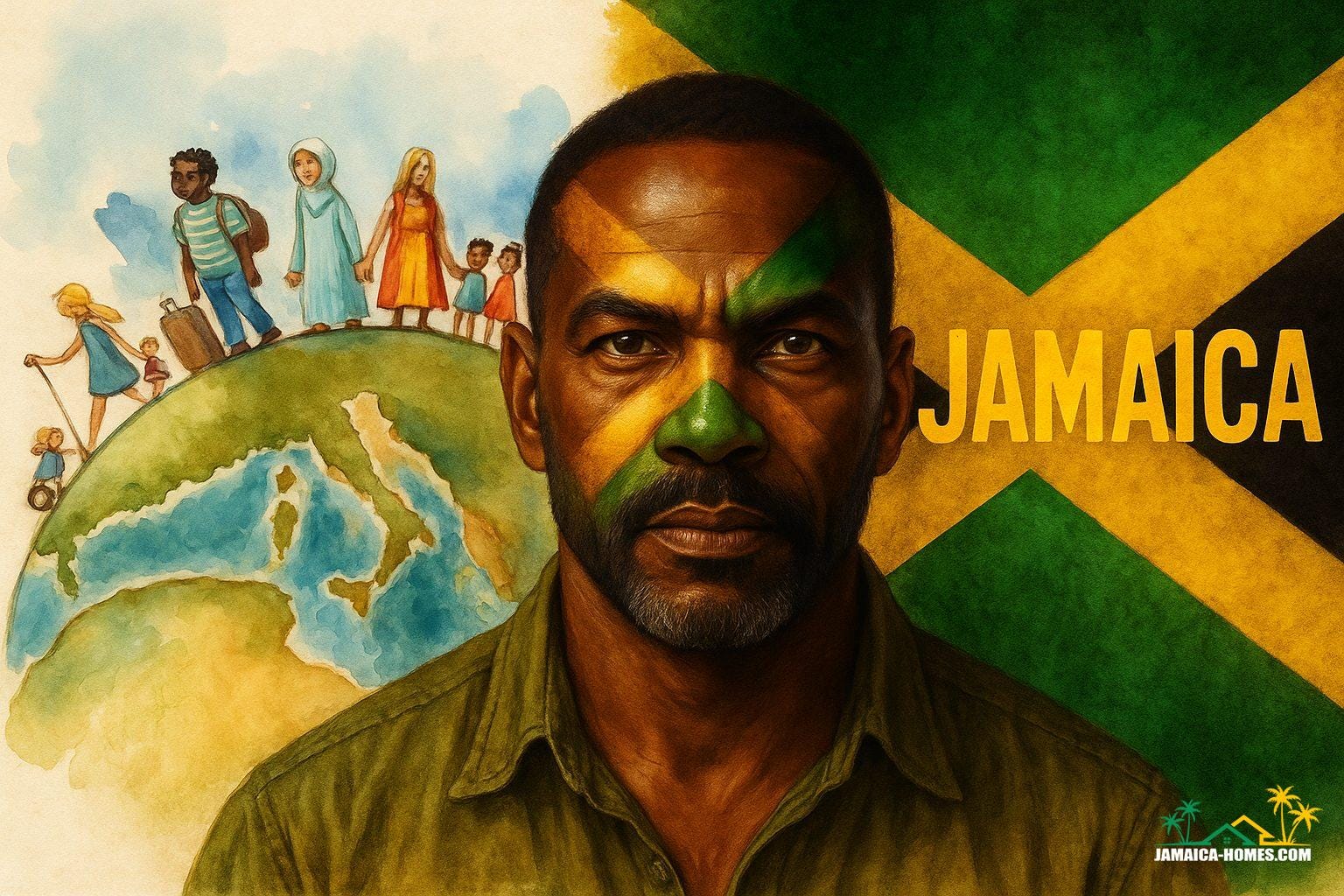
THIS PIECE REFLECTS ON JAMAICA’S RELATIONSHIP WITH LAND AND PROPERTY ACROSS PAST, PRESENT, AND FUTURE, SHAPED BY HISTORY, CLIMATE, AND GLOBAL INFLUENCE.
He stands facing us, eyes steady, unblinking.
Green, gold, and black are not just painted on his face — they are carried in him. Not costume. Not performance. Inheritance. Behind him, the island’s colours refuse to stay flat. They spill into history, into geography, into people moving across a globe that never stops turning.
This is not a portrait of a man.
It is a portrait of land.
Jamaica has always been more than soil and survey lines. From the first moment land here was mapped, it was contested — named, renamed, taken, divided, promised, broken apart, stitched back together in unequal ways. Real estate in Jamaica has never been neutral. It has always been political. Always emotional. Always tied to power.
The land remembers, even when we pretend not to.
The Past: When Land Was Not Ours
Jamaican real estate begins with loss. That is the uncomfortable truth beneath the brochures and beachfront listings.
Indigenous land was erased before it was ever registered. Then came plantations, where land was not owned so much as enforced — carved into sugar fields by enslaved labour, wealth exported, ownership concentrated far away. The land worked, but it did not belong to those who lived on it.
After emancipation, freedom did not come with acreage. Formerly enslaved people were left to negotiate small plots, hill land, marginal spaces. That legacy still shapes Jamaica’s property map today — fragmented titles, family land passed by memory rather than deed, boundaries marked by stories instead of pegs.
Even now, many Jamaicans live on land their families have occupied for generations, yet do not “own” in the way banks and registries demand. The past did not disappear. It hardened into systems.
And yet, despite everything, Jamaicans stayed. Built. Claimed. Held on.
The Present: A Small Island in a Big World
Today, Jamaica’s real estate market sits at a crossroads of global forces. The island is no longer isolated — if it ever truly was. Capital moves faster than hurricanes now.
The West looks at Jamaica and sees lifestyle.
The United States sees proximity and return on investment.
China sees infrastructure, leverage, long-term positioning.
Diaspora Jamaicans see home — emotional, complicated, unfinished.
Every influence arrives with its own language: yield, development, partnership, opportunity. And none of these words are wrong. But none are neutral either.
Luxury developments rise beside communities still waiting on proper drainage. Gated enclaves promise safety while informal settlements absorb the overflow of those priced out. Beachfront becomes asset class. Inland becomes afterthought.
The land itself hasn’t changed — but who can afford to touch it has.
Hurricane, Climate, and the Truth Beneath the Concrete
Then the wind comes.
A hurricane doesn’t care about zoning approvals or foreign direct investment. It does not respect concrete more than wood, wealth more than want. It exposes everything we tried to cover.
Climate change is no longer theoretical in Jamaica. It is visible in floodplains turned into housing schemes, in coastal erosion eating into hotel boundaries, in insurance premiums that quietly push locals out of the market altogether.
Real estate here is now inseparable from resilience. From drainage. From slope stability. From materials. From planning — real planning, not paper exercises.
Land is not just something to buy anymore. It is something to defend.
The Human Layer: Families, Memory, and Migration
Look again at the figures in the background of the image. People walking across the world, carrying bags, children, hopes. This is Jamaica too.
Migration has always shaped our property story. People leave, but they do not sever ties to land. They send money to build houses they may only visit once a year. They invest emotionally in plots they inherited but never occupied.
Diaspora money has kept many families afloat. It has also driven prices beyond the reach of those who never left.
This tension is rarely discussed honestly. But it must be.
Owning land in Jamaica is not just about wealth — it is about belonging. And when belonging becomes transactional, something fragile begins to crack.
Influence Without Illusion
The United States brings financing models, branding, scale.
China brings speed, infrastructure, long timelines.
Europe brings planning frameworks and environmental language.
Jamaica absorbs all of it — selectively, unevenly, sometimes clumsily. The danger is not foreign influence itself. The danger is forgetting whose future is being built.
Real estate is where sovereignty quietly erodes if vigilance fades. Not through flags or armies, but through contracts, incentives, and planning permissions.
None of this requires paranoia. It requires clarity.
The Future: What We Choose to Build
The future of Jamaican real estate will not be decided by investors alone. It will be decided by policy, by enforcement, by courage, and by whether we are honest about what land is for.
Is it only for profit?
Or is it also for shelter, dignity, continuity?
The next chapter must grapple with family land reform, affordable housing that is actually affordable, climate-resilient construction, and planning systems that serve people before speculation.
This is not anti-development. It is pro-Jamaica.
Because land outlives markets. It outlives governments. It outlives us.
The Very Real Ending
At the end of the day, Jamaican real estate is not poetry.
It is contracts signed in rooms without air-conditioning.
It is families arguing over inherited plots.
It is banks deciding who qualifies and who doesn’t.
It is a storm that doesn’t care how much you paid per square foot.
It is a finite island in an infinite global economy.
The question is no longer whether Jamaica will change. It already has.
The question is who the land will remember when the paint fades, the brochures yellow, and the wind returns.
That answer is still being written — plot by plot, title by title, choice by choice.
And it is not too late to write it well.
Disclaimer:
The author has chosen to remain anonymous. This piece is written as a reflection on land, memory, and change in Jamaica. Any interpretations offered are personal and intended to provoke thought rather than prescribe policy.