


“To father a child is divine. But to father a nation—that is destiny.” – Dean Jones, Founder of Jamaica Homes
Father’s Day is more than a day on the calendar. It is a call to honour not just the men who nurture children in their homes, but the visionaries who fathered a dream for this island, who tilled the land for freedom, who built homes for generations, who led movements for justice, and whose love stretched beyond bloodlines and borders.
While many countries trace the origins of Father’s Day to early 20th-century America, in Jamaica, the celebration took on its own cultural tone by the mid-to-late 20th century. It was never just about giving neckties or colognes—it became a time of reflection, gratitude, and reverence. And in our unique Jamaican way, we expanded the meaning of “father” to honour both the literal and symbolic.
Our Founding Fathers: The Pillars of Nationhood
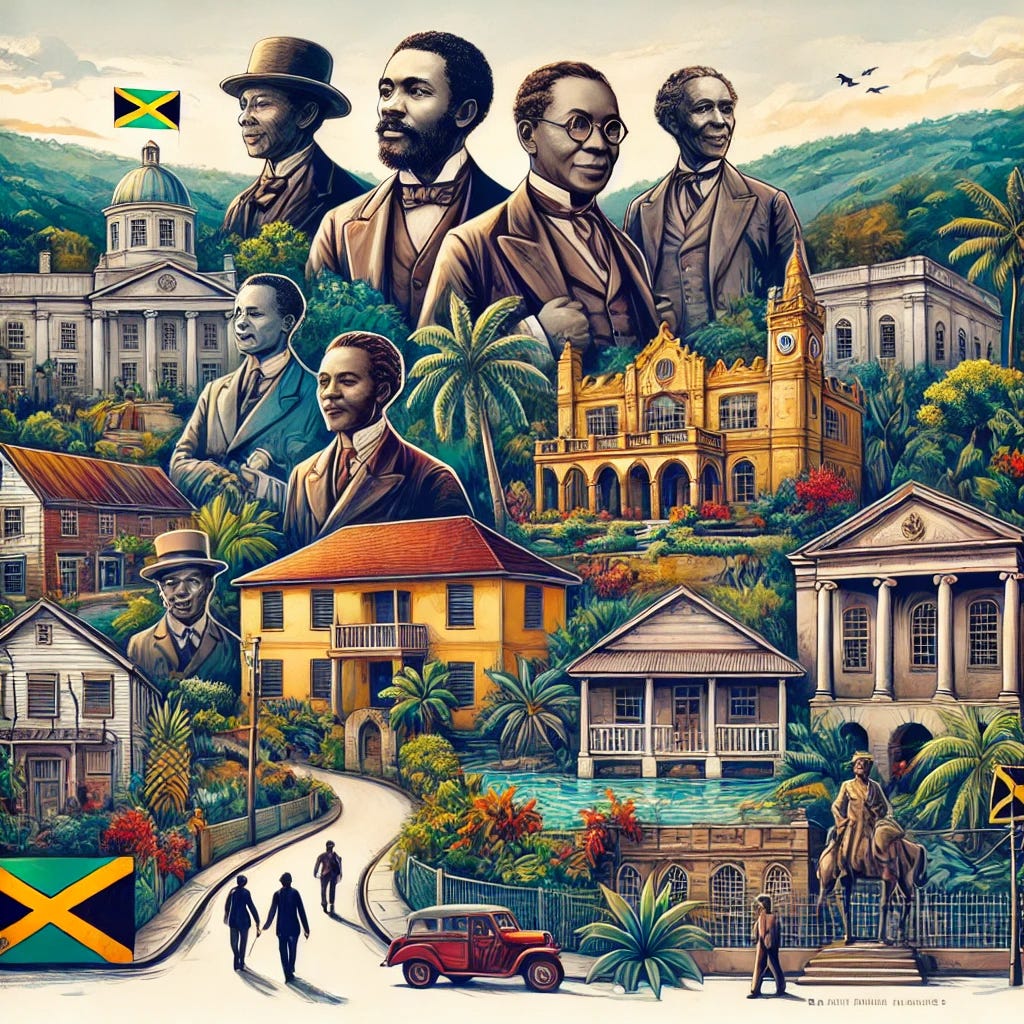
In the story of Jamaica’s rise, our seven National Heroes stand tall as founding fathers of freedom and identity.
Marcus Mosiah Garvey, often called the “Father of Pan-Africanism,” envisioned not just a free Jamaica, but a free and unified Black world. He inspired millions with his voice of empowerment, famously saying, “A people without the knowledge of their past history, origin and culture is like a tree without roots.”
Garvey didn’t raise only biological children—he raised nations to stand with dignity. His teachings on economic independence echo today in our dreams of homeownership, community building, and land development. “A house is more than shelter. It is a revolution. It is ownership. It is power,” says Dean Jones, founder of Jamaica Homes. In Garvey’s footsteps, many Jamaican fathers are still fighting to put their family’s names on a title deed.
Paul Bogle walked from Stony Gut to Spanish Town to demand justice—walking for his people like a father would walk miles for his children. His fight for land rights and equity was not for glory, but for dignity. In many ways, Bogle’s vision lives on in how modern Jamaicans struggle for fair land access, housing schemes, and equal development.
George William Gordon, a father of justice, gave voice to the voiceless. Despite being born into privilege, he used his position to lift the oppressed. He reminds us that fatherhood is not about status but service.
Sam Sharpe, preacher and leader of the Christmas Rebellion of 1831, sacrificed his life to end slavery. His last words were, “I would rather die upon yonder gallows than live in slavery.” His spirit fathers our Emancipation Day, reminding every Jamaican father that freedom is the inheritance they give their children.
Sir Alexander Bustamante, the first Prime Minister, was known as the “Father of the Nation.” He not only fathered the labour movement, he fathered Independence in 1962. Together with Norman Manley, a brilliant advocate and father of political reform, they birthed modern Jamaica.
These men carried a nation like a father carries a child on his shoulders. They bore the burdens of freedom, justice, land, and nation-building. Jamaica is what it is today because these men chose to father more than homes—they fathered a people.
The Jamaican Dream: From Struggles to Real Estate
In the post-Independence era, the Jamaican father became a new kind of visionary. The struggles shifted from chains to concrete, from fields to factories, from protest to prosperity.
Land ownership became the new frontier. To own land was to declare that one had overcome. The house a father builds became a monument of love, a beacon of stability in an unstable world. “In every zinc fence and every gated scheme, there is a man who once dared to dream,” says Dean Jones.
From inner-city fathers building from scrap materials, to rural men growing crops to fund their children’s schooling, to diaspora dads wiring money every month to finish a foundation—these are the unsung fathers of the Jamaican Dream.
Today, Jamaican fathers are still fighting for that dream. Some are taxi men with three jobs, some are construction workers finishing homes they may never live in. Some are abroad—fathers in Toronto, New York, London, the Cayman Islands—sending barrels and blessings. They may be far in body, but close in sacrifice.
Bob Marley: A Father of Sound and Spirit
Though not declared a national hero (yet), Bob Marley was, undeniably, a father to a generation. He fathered not only a tribe of children but also a movement. He gave voice to the ghetto, melody to resistance, and rhythm to our soul.
In Redemption Song, he cries, “Emancipate yourselves from mental slavery; none but ourselves can free our minds.” These were not just lyrics—they were a charge to the nation. Marley was a man who took fatherhood seriously, not just biologically but philosophically.
He left behind a legacy of culture, business (Tuff Gong), and real estate that now serves as a pilgrimage site. Marley understood, just as today’s fathers must, that legacy is land, language, and love.
Modern Fathers: Still Building, Still Holding Up the Sky
We must remember the everyday fathers—the ones who walk their children to school, who stand in visa lines, who take a bush for high blood pressure but still show up to work. The fathers who may be silent, but never absent in spirit.
“Society may not always applaud the hands that build. But homes remember. Children remember. History remembers,” says Dean Jones.
Yes, women have borne much. But the burdens society places on men—the expectation to never cry, to never falter, to never fail—often go unseen. Father’s Day should not just be a call to duty; it should be a celebration of resilience.
Fatherhood in All Its Forms
Let’s not forget the uncles, the godfathers, the teachers, the pastors, the community elders who step in where fathers cannot. In Jamaica, we say, “It tek a village fi raise a child,” and many of those villagers are men who father not with blood, but with presence.
Fathers of Jamaica don’t all wear ties. Some wear uniforms. Some wear rags. Some hold a Bible, a trowel, a hammer, or a chalkboard. They all hold us up.
A Tribute Across the Timeline
From slavery to Emancipation, from Crown lands to Strata Titles, from Marcus Garvey to Marley, from cane cutters to code developers, Jamaican fathers have evolved—but never disappeared.
Today, we walk in a diverse Jamaica, with fathers of every stripe and story. Some are in Parliament, some are in prison. All deserve to be seen—not just for what they’ve done, but for what they’ve tried to do in the face of impossible odds.
As Dean Jones reflects, “To build a house is to believe in tomorrow. Jamaican fathers have been building even when the storms come.”
Lift Them Up
So today, we lift them up.
The fathers who stayed. The fathers who returned. The fathers who couldn’t, but still tried. The fathers who fathered not just a child, but a community, a business, a cause, a country.
We salute the farmers in St. Elizabeth, the fishermen in Port Royal, the teachers in Clarendon, the nurses in the diaspora, the developers in Montego Bay, the builders in Kingston, the fathers in exile, and the fathers at home.
“Jamaican fathers are not just men. They are movements. They are monuments.” – Dean Jones
Let us honour them, not just on Father’s Day, but in every deed, every development, every title handed down, every future imagined.
For in honouring our fathers, we honour Jamaica.