

London’s Tax Reset, Jamaica’s Property Pull: Rethinking the “Millionaire Exodus”

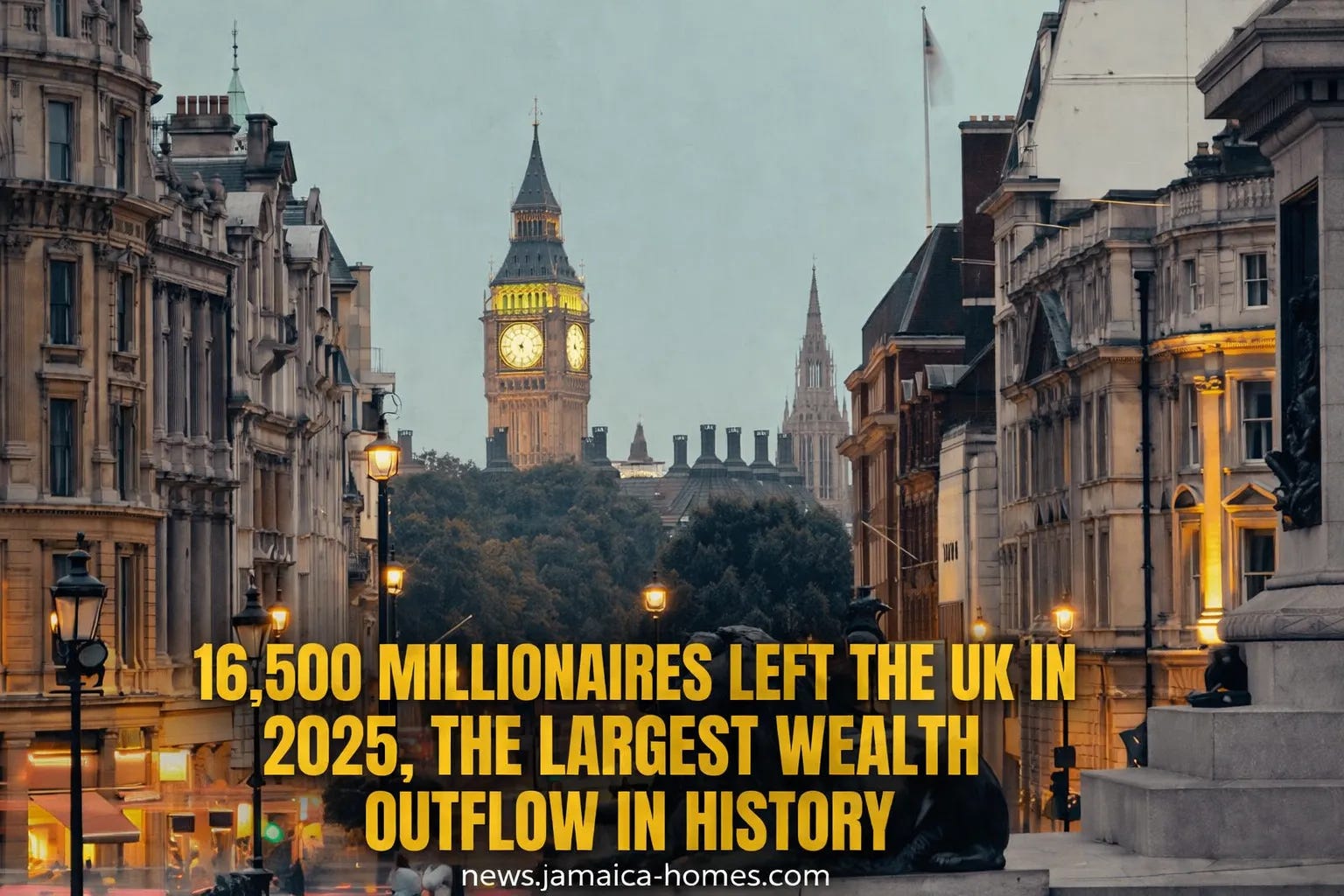
In recent years—and especially through 2024 into 2025—the idea that wealthy individuals are “leaving the UK” has hardened into a media shorthand. It is often described as a millionaire exodus: a flow of mobile wealth responding to tax reform, political signals, and a shifting sense of certainty about where capital is best anchored.
The truth, as ever, is more nuanced. The most widely quoted figures come from Henley & Partners, whose Private Wealth Migration Report 2025 forecasts a net outflow of around 16,500 high-net-worth individuals from the UK. The number is model-based, contested, and frequently misunderstood—but it captures something real: globally mobile wealth is reassessing where it lives, invests, and buys property.
Against that backdrop, Jamaica has quietly entered the conversation. Not as a replacement for London, and not as a tax haven, but as a real estate market where lifestyle, tourism demand, and long-term land value intersect. For certain investors—particularly those already thinking internationally—the island offers a different proposition at a moment when the UK’s rules have become less predictable.
This article sets the two stories side by side: why parts of UK wealth are repositioning, and why Jamaica’s property market is attracting attention without pretending to be something it is not.
What the UK “millionaire exodus” narrative really means
The UK does not publish official statistics tracking the emigration of millionaires. The figures dominating headlines are forecasts, not counts. Henley & Partners’ work—often cited by outlets such as the Financial Times and Business Insider—focuses on individuals with at least US$1 million in investable (liquid) wealth, a group that is by definition more mobile than homeowners whose wealth is tied up in property.
At the same time, critics—including tax justice researchers—have argued that the word exodus overstates the scale of movement and ignores how small these flows are relative to the UK’s total wealthy population. What is harder to dispute is the context in which these forecasts appear.
Policy change, not panic
The decisive shift came with the UK government’s decision to abolish the long-standing non-domiciled (“non-dom”) tax regime and replace it with a residence-based system from April 2025. Under the new framework, foreign income and gains are treated very differently from the past, and inheritance tax exposure is expected to widen for internationally connected families.
Alongside this, the UK signalled a tougher approach to capital taxation more generally, including increases to capital gains tax on many assets. Whether or not these changes ultimately raise more revenue, they altered something intangible but powerful: expectations of stability.
For wealthy households used to planning decades ahead, sudden rewrites matter. And when people reassess where they spend time, raise children, or base family offices, property decisions often follow.
Why property sits at the centre of wealth mobility
For global investors, real estate is rarely just an asset class. A home anchors residency, schooling, healthcare access, social networks, and identity. That is why reporting on the UK’s tax changes often references prime London property—not only as a store of value, but as a symbol of belonging.
When policy shifts introduce uncertainty, some investors respond by trimming exposure rather than exiting entirely. This might mean:
Selling or downsizing a UK home
Reducing days spent in the UK
Redirecting new property investment elsewhere
In that sense, the UK story is not about abandonment; it is about rebalancing.
Jamaica’s property market: not a substitute, but an alternative
Jamaica does not compete with London on scale, liquidity, or global financial infrastructure. Where it competes is on use-value: the ability for property to function simultaneously as a personal retreat, a diaspora connection, and—under the right conditions—a revenue-generating asset.
Several structural features explain why Jamaica appears in conversations among internationally mobile investors.
1. Tourism as an economic backbone
Tourism remains one of Jamaica’s most reliable demand drivers. Visitor arrivals underpin a large ecosystem of hotels, attractions, and increasingly, short-term rental accommodation. In locations such as Montego Bay, Negril, Ocho Rios, and parts of Kingston, this has created sustained demand for well-located, well-managed residential units.
Unlike purely speculative markets, Jamaica’s tourism-linked property demand is tied to actual footfall. This does not guarantee returns—but it creates a logic that investors can analyse and stress-test.
2. The diaspora effect
Jamaica’s global diaspora plays a role that is often underestimated. Many buyers are not anonymous foreign investors, but people with family, cultural, or historical ties to the island. That connection changes behaviour: properties are held longer, upgraded more carefully, and sometimes passed between generations.
This matters for price resilience. Markets supported by emotional as well as financial demand tend to behave differently in downturns.
3. Incentives—specific, conditional, and often misunderstood
Jamaica actively encourages foreign investment, and in some cases offers tax incentives, particularly through Special Economic Zones (SEZs) and approved tourism developments. These incentives are not universal and are not designed for casual buyers, but for structured projects that meet regulatory thresholds.
The key point is credibility: incentives exist, but only within clear frameworks. Serious investors treat them as a bonus, not the foundation of the deal.
A grounded comparison: UK versus Jamaica through a real estate lens
In the UK, property—especially in London—has traditionally served as a global anchor. Legal certainty, deep capital markets, and international prestige supported this role. Recent tax reforms did not remove those strengths, but they did change the cost-benefit equation for some internationally mobile households.
In Jamaica, property is more explicitly hybrid. A beachfront apartment or hillside villa may be used personally, rented seasonally, or held as a long-term land investment. Returns depend heavily on location, build quality, insurance, and management—but the asset is tangible, usable, and tied to a visible economic engine.
This difference matters. For investors reassessing concentration risk in a single jurisdiction, Jamaica offers diversification of place, not merely diversification of assets.
A practitioner’s perspective from the ground
From the perspective of Jamaica Homes, the interest Jamaica is receiving is best understood as selective rather than speculative.
Dean Jones, founder of Jamaica Homes and Realtor Associate, has consistently argued that Jamaica rewards clarity and discipline, not hype. In his view, internationally mobile buyers are not chasing quick wins but looking for assets that align with how they actually live.
He has pointed out that Jamaica’s strongest real estate propositions combine three elements: genuine demand drivers (such as tourism or professional hubs), proper legal and title due diligence, and realistic assumptions about operating costs and seasonality. Where those elements are present, property can function as both a lifestyle asset and a long-term store of value.
Jones has also cautioned against simplistic comparisons with the UK. Jamaica, he notes, is not a place to park capital blindly. It is a market where local knowledge, professional advice, and patience determine outcomes—especially for higher-value properties exposed to climate, insurance, and management variables.
The risks that must be acknowledged
Any credible comparison must be honest about trade-offs.
Climate exposure is real. Insurance availability, building standards, and resilience planning are central to value preservation.
Currency dynamics can amplify or erode returns depending on cost structures.
Operational intensity is higher for short-term rentals than for long-term lets or owner-occupation.
These are not reasons to avoid Jamaica—but reasons to approach it with professionalism rather than romanticism.
Why this matters now
The UK’s tax reset has forced a conversation about what makes a country attractive to global wealth. Stability, predictability, and quality of life matter as much as headline rates. Jamaica enters this conversation not because it is perfect, but because it offers something distinct at a time when many investors are consciously spreading risk across jurisdictions.
For Jamaica, the implication is equally important. Attracting high-quality investment depends on maintaining credibility: clear rules, enforceable contracts, transparent processes, and honest market commentary. The goal is not volume at any cost, but sustainable participation.
Conclusion: repositioning, not replacement
The story of UK wealth mobility is not a story of flight so much as repositioning. Some investors stay. Some leave. Many adjust. In that adjustment, property decisions play a central role.
Jamaica’s real estate market benefits when it is understood on its own terms: as a tourism-linked, diaspora-supported, lifestyle-inflected market that can reward long-term thinking. For certain investors responding to change in the UK, that combination is compelling—not because it is easier, but because it is different.