



Practical, Technical Guidance for Jamaican Households Repairing, Rebuilding, and Preparing Smarter
Jamaica is likkle, but we are talwah. The saying reflects generations of endurance, rebuilding, and resilience. But toughness alone does not stop a hurricane. What reduces damage is preparation, sound judgment, and careful use of limited resources.
When the wind dies down and the rain eases, people step outside in silence. Roofs are counted. Cracks in walls are traced. Waterlines on paintwork mark decisions made long before the storm arrived.
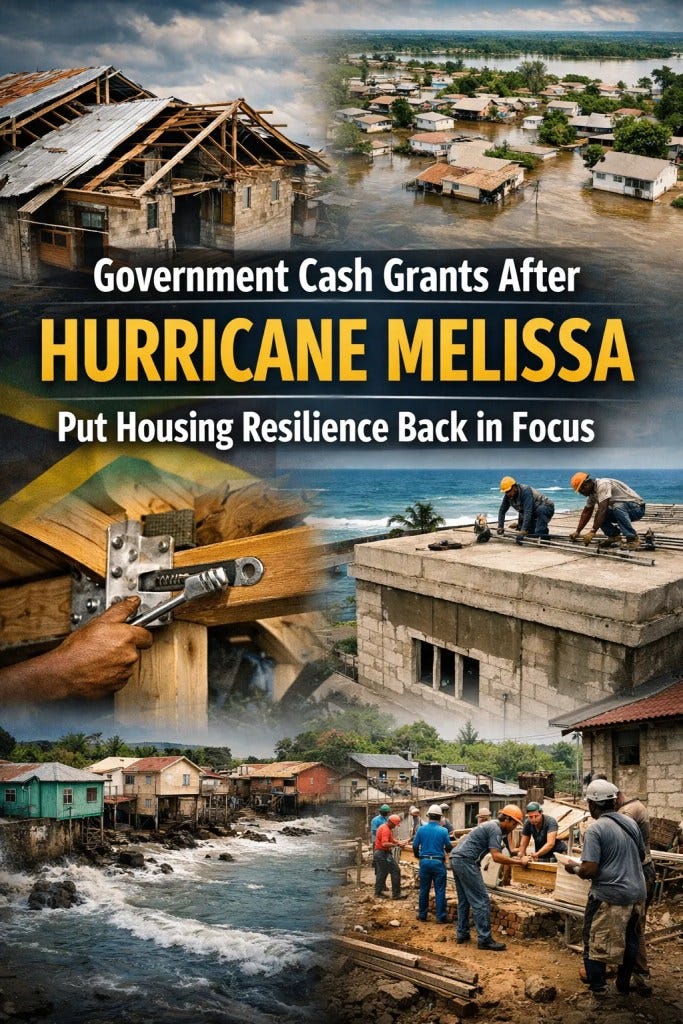
Hurricane Melissa did not simply damage houses. It revealed choices — some well-made, others rushed or inherited from a time when the climate behaved differently. As Jamaica moves into a new year, with another hurricane season already approaching, the central question is no longer what was lost.
It is what will be rebuilt, and how wisely.
The Government’s decision to support recovery through direct cash assistance reflects a practical approach. It recognises dignity and places trust in households to prioritise their needs. But with that trust comes responsibility. When resources are limited, every dollar must carry weight.
This is the point at which the conversation must become grounded, technical, and honest.
The Reality We Must Face: Climate Is No Longer Theoretical
Jamaica has always lived with hurricanes. But what has changed is frequency, intensity, and unpredictability.
In recent years, storms have become wetter, slower-moving, and more destructive. Rainfall volumes that once fell over days now fall in hours. Wind fields are wider. Flooding reaches places that never flooded before. Entire communities that believed they were “safe” have learned otherwise.
This is not fear-mongering. It is observation.
Climate scientists have been clear that warmer oceans fuel stronger storms. Jamaica sits directly in that warming belt. Whether a storm makes landfall or skirts the island, the impacts are now more severe. This is why repairing to yesterday’s standards leaves us vulnerable tomorrow.
Start With What Fails First: Roofs
If there is one truth every hurricane in Jamaica has taught us, it is this:
When the roof goes, everything else follows.
Rain damage, wall failure, electrical loss, mould, and displacement often begin with roof failure. If you are using grant money, the roof should be your first consideration, even if other damage feels more visible.
Practical Roof Guidance (Broad, Technical, and Applicable)
Every roof is different. That is a fact. But the principles of good hurricane performance are consistent.
1. Connections Matter More Than Materials
Many roofs fail not because the zinc, tile, or sheet is weak—but because the connections fail.
Use hurricane straps to tie rafters or trusses to the ring beam
Ensure straps are properly nailed or screwed, not bent loosely
Check that straps are embedded into concrete or secured to timber beams that are themselves anchored
2. Follow the Load Path
Wind uplift must travel safely from:
Roof → rafters/trusses → ring beam → walls → foundation → ground
If any link in that chain is weak, the system fails.
Ensure ring beams are continuous
Bolts or threaded rods should connect ring beam to walls
Walls should be properly tied into foundations
3. Use Proper Fasteners
Roofing screws should be hurricane-rated, with neoprene washers
Avoid nails for sheeting where possible
Screw spacing matters—too far apart invites uplift
4. Reduce Overhangs Where Possible
Large eaves catch wind like a sail. Shorter, tighter overhangs reduce uplift forces.
5. Consider Roofing Type Carefully
Standing seam metal roofs perform better than traditional zinc
In high-risk zones (coastal areas, hilltops, wind tunnels), reinforced concrete roofs offer the highest resilience
Concrete roofs must be professionally designed, reinforced, and cured correctly—shortcuts here are dangerous
“A roof isn’t just something that keeps the rain out. It’s a structural system. If you treat it like decoration, the hurricane will remind you it’s engineering.”
— Dean Jones
Walls, Columns, and Structural Repairs: Know When to Call an Expert
If walls are cracked, displaced, or partially collapsed, do not guess.
Engage a structural engineer or qualified technician
Ensure vertical steel reinforcement continues from foundation to ring beam
Where walls are rebuilt, steel must extend upward to connect with the beam—not stop halfway
Blocking a crack without addressing its cause only delays failure.
Windows and Doors: Weak Points That Multiply Damage
Broken windows are not cosmetic damage—they are pressure points.
When wind enters a house:
Internal pressure increases
Roof uplift doubles
Structural failure accelerates
Practical options include:
Hurricane-rated windows where affordable
Storm shutters
Permanently blocking unnecessary windows in high-risk areas
Reinforcing door frames and using solid-core doors
Sometimes the safest window is no window at all—especially on windward sides.
Flooded Homes: Rebuild With Memory, Not Forgetfulness
If your home flooded during Hurricane Melissa, assume it can flood again.
Practical considerations:
Raise electrical outlets and breaker panels
Use flood-resistant materials at lower levels
Improve drainage paths around the house
Avoid sealing moisture into walls—allow proper drying
Ignoring flood history is one of the costliest mistakes households make.
Make the Money Stretch: Community, Planning, and Timing
Grant money is finite. Needs are many. Stretching funds requires strategy.
Combine jobs with neighbours to negotiate better contractor rates
Get multiple quotes, even if time feels tight
Prioritise structural work over finishes
Know when DIY is appropriate—and when it is dangerous
“There’s dignity in using the money wisely. Every dollar you spend strengthening your house is a dollar you don’t have to beg for later.”
— Dean Jones
Emergency Preparedness: Not Fear, Just Sense
Grant money is for repairs—but preparedness costs little and saves lives.
Every household should aim to have a basic emergency kit:
Torch and spare batteries
Portable radio
Copies of important documents (waterproofed)
Drinking water (minimum two days)
Non-perishable food
Medication
Sanitary items
Whistle
Simple water filter if possible
Store it in a sealed container or barrel, in a known location.
Preparation is not panic. It is maturity.
Humility Is the Missing Ingredient in Building Smarter
One of the most important lessons from Hurricane Melissa is humility.
Jamaica is not flat. Not uniform. Not predictable.
A house in Portmore faces different risks than one in St Mary. Coastal homes behave differently from hillside properties. Wind tunnels exist where people don’t expect them.
There is no universal hurricane-proof design.
There are only:
Principles
Engineering judgment
Local knowledge
Respect for nature
“The storm doesn’t care how long you’ve been building. It only respects physics.”
— Dean Jones
This Is a New Year, and a New Climate Reality
We are not wishing for another storm. But wishing does not prepare us.
The Government’s move toward cash-based recovery is about trust—trusting people to make decisions for their families. That trust works best when households are given clear, honest, technical guidance grounded in Jamaican reality.
This article is not about perfection. It is about reducing risk, stretching resources, and building smarter than before.
Because Jamaica is likkle.
But we are talwah.
And talwah doesn’t mean careless.
It means prepared.
Disclaimer:
This content is provided for general informational purposes only and does not constitute legal, financial, professional, or other advice. While care has been taken to ensure accuracy, no guarantees are made, and readers should seek independent professional advice before making any decisions based on this information.