


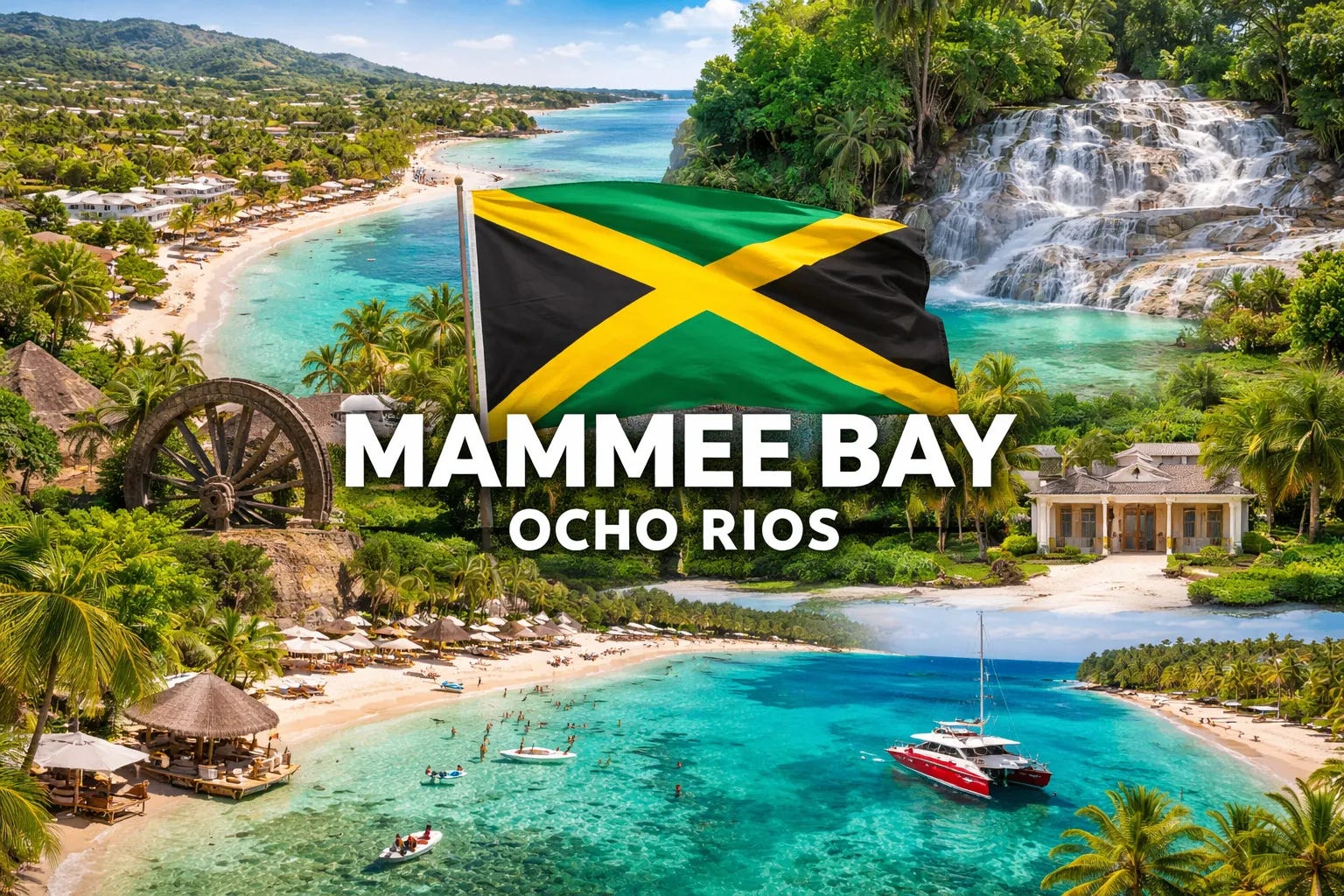
There are places in Jamaica that shout their importance. And then there are places like Mammee Bay — places that whisper, but only if you slow down enough to listen.
At first glance, Mammee Bay is easy to misread. A sweep of north coast shoreline just west of Ocho Rios. Gated communities. A private beach. A highway interchange that funnels traffic efficiently north and south. To the untrained eye, it looks like somewhere that simply arrived fully formed in the modern era.
But Mammee Bay did not arrive.
It accumulated.
Layer by layer, Mammee Bay tells a story that runs far deeper than resorts, far older than roads, and far more complex than property values. It is a story of land and water, of forced labour and engineering ingenuity, of forgotten systems quietly shaping modern Jamaica.
As Dean Jones, founder of Jamaica Homes, puts it:
“If you really want to understand property in Jamaica, you have to understand what the land was used for before it was sold. Nothing here starts with the brochure.”
A Coast Shaped Long Before It Was Named
Mammee Bay sits within St Ann, the parish often described as the birthplace of Jamaica’s colonial story. Long before Mammee Bay had a name, this stretch of coast formed part of a dense Indigenous landscape — settlements connected by water, rivers, and coastal access rather than roads and boundaries.
St Ann’s wider coastline is inseparable from Jamaica’s earliest recorded encounters with Europe. The Spanish settlement of Sevilla la Nueva, near present-day St Ann’s Bay, marked the beginning of a violent reordering of land use — from subsistence and community-based occupation to extraction, export, and control.
Mammee Bay lay just outside the administrative heart of Spanish Jamaica, but not outside its consequences.
By the time the English took control of the island in 1655, this entire coast was already understood not as homeland, but as resource.
From Forest to Factory: The Plantation Logic
The north coast’s geography made it ideal for sugar. Fertile soils. Reliable rainfall. Rivers that could be harnessed. Mammee Bay, like much of St Ann, was absorbed into the plantation system that reshaped Jamaica’s physical and human landscape.
Sugar estates did not simply grow cane. They engineered environments.
Water was diverted. Channels were cut. Wheels were built. Labour was coerced.
One of the most tangible remnants of this era still stands today: the Mammee Bay waterwheel, tied historically to the wider Drax Hall plantation complex.
This was not decorative infrastructure. It was industrial machinery — part of a system designed to extract maximum value from land and people alike.
“That waterwheel isn’t a ruin,” Dean Jones notes.
“It’s a record. It tells you exactly how organised, how deliberate, and how brutal the plantation economy really was.”
The wheel once powered sugar rollers, turning harvested cane into exportable wealth. Enslaved Africans built it, operated it, and paid for it with their bodies.
Mammee Bay was not a backdrop to this system. It was part of its engine room.
Emancipation Did Not End Control of the Land
When slavery ended in 1838, the land did not suddenly become free.
Across St Ann, large estates fragmented slowly or changed hands without fundamentally changing purpose. Some lands shifted from sugar to cattle. Others were leased, neglected, or consolidated. But the basic pattern — large tracts held by the few, worked by the many — remained stubbornly intact.
Mammee Bay followed this quiet trajectory. It did not become a free village. It did not emerge as a town. It remained estate land — valuable, coastal, and strategically positioned.
That liminal status would later make it perfect for something else.
Ocho Rios Changes Everything
The mid-20th century transformed Jamaica’s north coast. When Ocho Rios was deliberately developed as a tourism hub in the 1950s and 60s, land values along the surrounding coastline shifted almost overnight.
Suddenly, proximity mattered.
Mammee Bay sat just west of Ocho Rios — close enough to benefit, far enough to remain controlled. The estate model that once served sugar now served privacy, exclusivity, and access.
Beaches were no longer workspaces. They became amenities.
“This is where you see the handover from plantation logic to resort logic,” says Jones.
“Different industry, same obsession with control.”
Gated access replaced overseers. Security posts replaced estate boundaries. But the land was still doing what it had always done: generating wealth for those who owned it, not those who lived around it.
The Quiet Power of Infrastructure
For decades, Mammee Bay remained relatively understated — known locally, but not nationally significant. That changed with the arrival of Highway 2000’s North–South Link.
Infrastructure does not just connect places. It reorders importance.
When the highway terminated at Mammee Bay, the area was no longer just near Ocho Rios. It became a gateway. A hinge point between Kingston and the north coast.
Travel times collapsed. Development pressure intensified.
Suddenly, Mammee Bay was not just desirable. It was strategic.
“Roads decide the future faster than planners do,” Jones observes.
“Once the highway reached Mammee Bay, the question was never if it would change — only how fast.”
Residential developments expanded. Land values surged. What had once been quietly held estate land became some of the most sought-after coastal real estate in the parish.
Heritage Re-emerges, Carefully Curated
In 2023, the Mammee Bay waterwheel was formally restored and reopened as a heritage attraction. On the surface, this was a victory for preservation — long-overdue recognition of a historic structure.
But heritage, like land, is never neutral.
The waterwheel now exists within a carefully managed narrative: restored, signposted, contextualised. It is presented as history — safely distant, safely concluded.
Yet its presence raises uncomfortable questions.
Who built it?
Who benefited from it?
And who benefits now from the land it once powered?
“Heritage can’t just be about aesthetics,” Jones argues.
“If we preserve the structure but ignore the system behind it, we’re only telling half the story.”
Mammee Bay’s past is not something that can be tidied away with landscaping and plaques. It lives on in land patterns, access rules, and ownership structures that still shape daily life.
Mammee Bay Today: Ordered, Valuable, Unequal
Today, Mammee Bay presents itself as calm, exclusive, and well-managed. Private beaches. Controlled entry. Carefully designed residential spaces.
It is, by many measures, successful.
But success raises its own questions.
Who gets to live here?
Who passes through?
Who works here — and who owns it?
Mammee Bay is not unique in this. It reflects a wider Jamaican reality where some of the most beautiful, accessible land remains socially distant from the communities around it.
“The danger,” Jones says quietly,
“is pretending that value comes from nowhere. Every high-value property in Jamaica sits on a long history — and that history still matters.”
A Landscape That Still Speaks
Mammee Bay does not announce its story loudly. There are no grand ruins towering above the road. No obvious monuments demanding attention.
Instead, the past reveals itself in fragments:
a waterwheel beside a modern development,
estate boundaries disguised as community planning,
a highway cutting through land once worked by hand.
To understand Mammee Bay is to accept that Jamaica’s most desirable places are often its most complicated.
They are not blank slates.
They are palimpsests.
And if you stand still long enough — if you look beyond the gates and the gloss — Mammee Bay still speaks.
Not of paradise.
But of process.
“Land remembers,” Dean Jones says.
“Whether we choose to listen is the real question.”
Disclaimer
This article is intended for general information and reflective commentary only. It draws on publicly available historical records, heritage sources, and contextual interpretation of land use and development in and around Mammee Bay, St Ann, Jamaica. While care has been taken to ensure accuracy, the article does not claim to be a definitive or exhaustive historical account.
Any quotations attributed to Dean Jones, founder of Jamaica Homes, reflect personal observations and professional perspectives and should not be interpreted as legal, valuation, planning, or investment advice. References to historical land use, estates, infrastructure, or development patterns are provided for educational and contextual purposes only.
Readers are encouraged to consult primary historical sources, qualified professionals, or relevant authorities for specific legal, planning, heritage, or property-related advice. Neither the author nor Jamaica Homes accepts liability for decisions made based on the content of this article.