

Moonlight on Kingston Town: A Love Letter to the Longing of the Windrush Generation

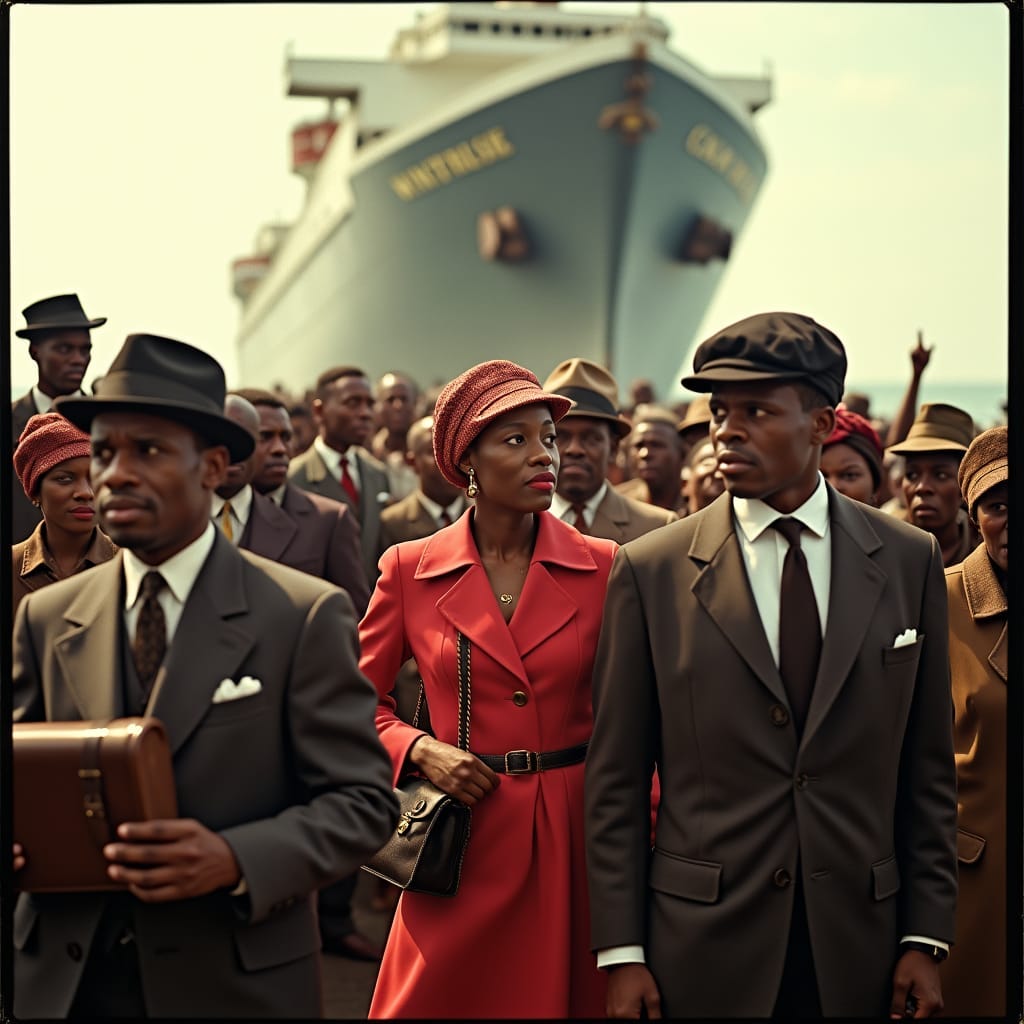
There are nights in Britain—cold, wet, endlessly grey—when the moon hangs low, almost ashamed, as if it knows it cannot shine the way it does over Jamaica. And for thousands of Jamaicans who arrived in the United Kingdom after the Second World War, that dim moonlight was often the first reminder that home was not just miles away, it was a different kind of light entirely.
They stepped off the Empire Windrush and the ships that followed her with battered suitcases, pressed trousers, fresh hairstyles, and hibiscus-bright hopes. They believed—some desperately, some defiantly—that this new land would hold wonders for everyone. A chance. A door cracked open. A place where earnings could stretch farther than sugar cane rows or banana walk wages ever allowed. Britain had called for help, and Jamaica had answered.
But inside them all, sometimes whispered, sometimes blazing, was the pull of another place—Kingston Town, or St. Mary, or Clarendon, or MoBay, or a little district so small the mapmaker would miss it—a place they longed to return to one day. A place they promised themselves they would rebuild, even if time and life and loneliness tried to wear down that promise.
It is this longing—this ache mixed with ambition—that shaped the Windrush journey.
And it is this longing that shaped the real estate dreams so many Jamaicans carried across the Atlantic: to build a house back home. To plant something permanent in the soil that raised them.
The First Winters: Where the Night Seemed to Fade
For many, arrival meant freezing bedsits in Brixton, Tottenham, Peckham, Harlesden, and Stoke Newington—places that would, over time, become the heartbeats of Black Britain. Back then, coal dust coated the windowsills and landlords hung signs reading “No Blacks, No Dogs, No Irish.” Their welcome was not warm. Yet Jamaicans made warmth where they found none.
They shared pots of soup.
They laughed loud on buses.
They dressed sharp—because dignity was armour.
They told stories of sun and sea, even as breath fogged the air.
It was in those small rooms, those shared kitchens, those backbreaking jobs nobody else wanted, that partner thrived. One person contributing each week, until it was their turn to collect the entire pool—a lifeline in a cold place. Partner funded school fees back home. Partner bought plane tickets. Partner built houses—block by block, zinc by zinc—across Jamaica.
And partner did something else:
It kept the dream alive.
Because even as their nights in Britain stretched long, and even as the stars here felt dimmer than the ones “back a yaad,” their vision of home gleamed ever brighter.
Love in a Strange Land: Queens, Kings, and Everything Between
Britain changed them, and they changed Britain.
Among factory floors and hospital wards, among London Transport depots and Bedford’s brickworks, love found people unexpectedly. Some met partners from their own parish; others found themselves drawn to someone whose accent, skin, and upbringing seemed worlds apart.
Interracial love blossomed despite the side-eye, the whispers, the outright hostility.
A Black man walking hand-in-hand with a white woman was, in some areas, an act of rebellion.
A Jamaican woman with an English man was sometimes judged by both communities.
But love is stubborn.
Love, like Kingston, does not yield easily.
Many of these couples built entire families—half Jamaican, half British, fully human—children who would go on to write poetry, run businesses, doctor the sick, and stand on stages telling stories of exactly how complex, messy, and beautiful their parents’ bravery had been.
And yet, no matter how much life unfolded in Britain, the dream of home remained.
Some Windrush elders would say, half-joking, half-serious:
“When mi retire, mi going home fi live like king.”
The song “Kingston Town” captured that dream—the idea that a person who had fought through life abroad could one day return to a Jamaica where they felt royal.
Not royalty made of crowns and sceptres, but royalty made of belonging.
Work: Where Jamaicans Became the Backbone of Britain
They drove the buses that rebuilt London’s pulse.
They scrubbed the hospital floors and lifted patients from trolley to bed.
They sorted letters before dawn and kept the factories humming.
They taught in schools.
They nursed the sick.
They filled gaps in the labour market that Britain preferred not to see.
These jobs were rarely glamorous—often they were dismissed as “unskilled.”
But the Windrush generation carried themselves with skill, pride, and a seriousness about work that generations after still talk about. They sent money home consistently, religiously, even when they had little for themselves.
Every pound saved was another block on a future house.
Another step toward a piece of land.
Another tile on a roof back in the land they dreamed of returning to.
To many, homeownership in Jamaica became a mark of identity, resilience, and dignity.
In a world that often told them they were less than, owning land back home said:
“I come from somewhere.
I belong somewhere.
And one day, I will return.”
Homes Built in Hope—and Sometimes in Heartbreak
For every story of a dream house completed in Jamaica, there is another—quiet, bitter—of money sent home that disappeared. Dishonest builders. Unearned faith in friends. Family disputes. A cousin who promised to “watch the land.” A contractor who cut corners. A sibling who claimed the inheritance for themselves.
Real estate dreams, like love, can break a heart.
Many Windrush elders poured decades of savings into homes they never managed to step foot in. Some returned to Jamaica only to find someone else living on their land. Some never returned at all.
But the longing?
That remained intact.
The longing was incorruptible.
Communities That Held Each Other Together
Areas like Brixton, Peckham, Handsworth, Moss Side, and St. Paul’s became more than postcodes. They were diaspora cities within a city, places where the rhythm of Jamaica lived on.
You could buy yam on a Saturday.
You could fix your hair in a Caribbean salon.
You could hear the bassline of a sound system thundering through the floorboards.
You could find someone frying festival or sharing bun and cheese at Easter.
And beyond the food and music, there was fellowship:
church sisters who prayed for each other,
brethren who lent money,
yardies who knew exactly what “mi soon come” meant.
These communities carried the bittersweet truth that even when you migrate, a piece of you remains rooted in the land you left. That longing was not weakness. It was memory. It was culture. It was Jamaica insisting, softly and consistently:
“Do not forget me.”
The Fire That Never Went Out: Dreams of Returning
Some people made it back, suitcase in hand, standing on Jamaican soil decades older but hearts beating like they were 20 again. They built the home they’d planned since the 1950s. They sat on verandas watching the sun slip behind the hills. They finally lived the dream they had saved for, sacrificed for, endured for.
Others never quite returned permanently—but they visited often.
They brought their children and grandchildren and said:
“This is where your story begins.”
And others could not return at all—age, health, finances, broken ties—yet still, on quiet nights, the memories played like a sweet refrain, echoing the sentiment of the song that captured their yearning:
A place they longed to be.
A place they would give the world just to see again.
What That Longing Means for Jamaica’s Real Estate Today
The Windrush generation didn’t just leave for opportunity—they left with a promise to themselves:
“One day, I will build something back home.”
And those dreams transformed Jamaica’s real estate landscape:
1. Remittance-Funded Construction
Billions of dollars entered Jamaica over decades, shaping communities one house at a time.
2. Multi-storey Family Homes
Many of the “big houses” in parishes—from St. Catherine to Mandeville to Portland—were built not by residents, but by Jamaicans abroad who wanted to return in comfort.
3. Diaspora Demand for Retirement and Investment Property
Even today, Jamaicans in the UK, US, and Canada buy land and homes with that same Windrush desire to reconnect—to own a piece of the island that raised their parents or grandparents.
4. A Spiritual Connection to Land
To the Jamaican heart, land is not just real estate.
It is identity, security, and legacy.
The Windrush generation understood this intimately. They held on to the dream of Kingston—as idea, as metaphor, as melody—even when they stood thousands of miles away.
The Soft Magic of Kingston Town
There is something soft, almost sacred, about the way UB40’s “Kingston Town” captures longing. Not the kind that cripples, but the kind that keeps people moving toward hope.
The imagery of twilight, of a place where the moon glows warmly and dreams feel reachable, mirrors exactly what the Windrush generation carried inside them:
A vision of home where:
the light feels kinder,
the air feels easier,
and the heart feels whole.
When the song speaks of a man imagining himself as king, with a queen waiting for him, it is really speaking of restoration—of finally reaching the place where you feel honoured, cherished, rooted.
So many Jamaicans abroad felt that if they could only make it back home—if they could only stand again in Kingston Town or the district of their birth—they could reclaim the dignity the world sometimes tried to strip away.
It wasn’t fantasy.
It was longing wrapped in possibility.
A Legacy Built on Love, Sacrifice, and Home
Today, when we look at Jamaican communities in Britain, we see the fruits of that longing:
thriving entrepreneurs,
politicians and scholars,
artists and athletes,
nurses and teachers,
children and grandchildren who stand on the shoulders of those who braved the unknown.
But beneath all the success stories lies the quiet truth:
The Windrush journey was never just migration.
It was a love story between Jamaicans and Jamaica—tested by distance, strengthened by hope, immortalised in longing.
The longing to return.
The longing to build.
The longing to belong.
The longing to create a home worthy of sacrifice.
And in that way, every house built in Jamaica by someone abroad—every block, every tile, every paint stroke—is not just construction.
It is a promise fulfilled, a song completed, a lifelong yearning finally anchored in soil.
Final Word: The Song That Knows Our Hearts
When people hear “Kingston Town,” they often think of tourism postcards or sweet nostalgia.
But beneath the melody lies something deeper:
It is the unofficial anthem of every Jamaican who ever packed a suitcase and whispered,
“Mi soon come back.”
The song understands the quiet ache.
It understands the promise of return.
It understands the way home can call to you, even from continents away.
And maybe that is why the Windrush generation loved it—
Because the song carried the same heartbeat they did.
Credit
Inspired by the themes and emotional resonance of “Kingston Town” (1989), written by Kenrick Randolph Patrick and performed by UB40. All rights belong to the original creators.