

NaRRA’s Transformation
What began as a hurricane recovery promise has evolved into one of the most powerful and ambitious state institutions Jamaica has attempted to build in decades


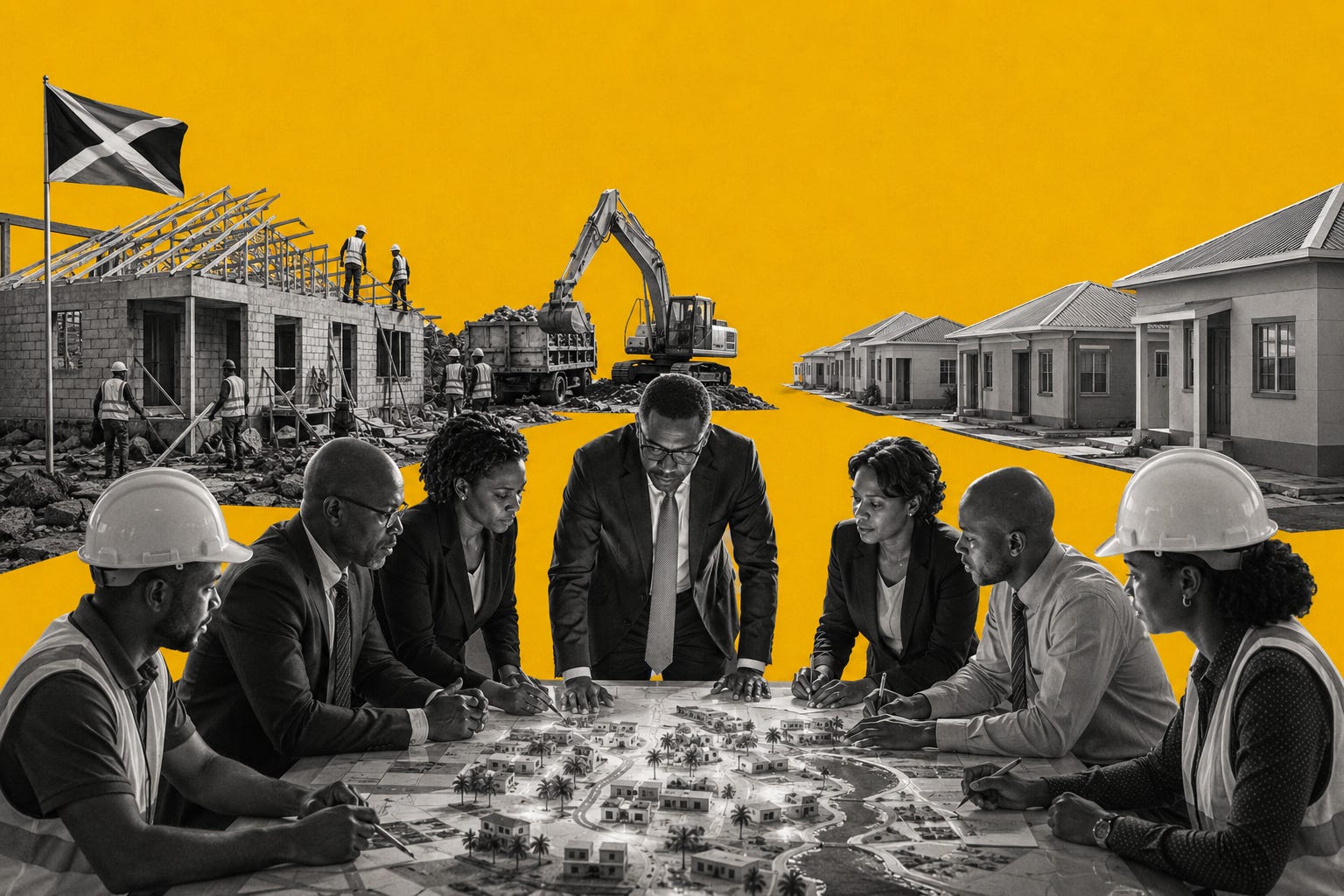
When the Government first announced the National Reconstruction and Resilience Authority in the aftermath of Hurricane Melissa, many Jamaicans imagined something practical, immediate, and deeply human. People expected roofing assistance, rebuilding grants, emergency housing support, debris removal, and faster repairs to damaged roads and bridges. In the minds of many citizens, NaRRA was initially framed as a recovery programme born out of crisis.
But over the months that followed, something changed.
The language changed. The structure changed. The ambition changed. Even the personality of the organisation changed.
Today, NaRRA no longer resembles the narrow emergency recovery body many first imagined. Instead, it has emerged as something far larger, more centralised, and potentially far more influential within the Jamaican state. With the appointment of former Police Commissioner and former Chief of Defence Staff Major General Antony Anderson as Chief Executive Officer effective June 1, alongside the enactment of the NaRRA Act, the authority now appears positioned not simply as a disaster response entity but as a national reconstruction machine with sweeping coordinating powers.
Whether that becomes one of Jamaica’s great modern state reforms or another overly ambitious institution struggling under the weight of expectation may ultimately depend on execution.
From Recovery Programme to National Authority
The earliest public framing of NaRRA was heavily emotional and recovery driven. Jamaica had just endured one of the most destructive storms in modern history. Thousands of homes were damaged or destroyed. Entire communities were shaken. Roads collapsed, coastlines shifted, businesses suffered, and infrastructure vulnerabilities were exposed in uncomfortable detail.
Government officials spoke repeatedly about rebuilding stronger, restoring hope, and helping affected families recover.
At the time, NaRRA appeared to many Jamaicans as a practical response mechanism. A body that would coordinate rebuilding efforts and ensure that recovery funding reached communities quickly.
But as legislation slowly emerged and ministerial statements expanded, NaRRA’s role began to stretch far beyond hurricane repairs.
It became increasingly described as a central coordinating authority with powers to reduce bureaucracy, eliminate fragmentation between ministries, accelerate projects, coordinate reconstruction nationally, oversee resilience planning, and manage large scale delivery systems across government.
That was a major shift.
Some observers began quietly asking whether Jamaica was not simply creating a recovery agency, but building a new layer of state authority somewhere between a reconstruction ministry, infrastructure coordination body, and resilience commission.
For ordinary Jamaicans still waiting on practical rebuilding assistance, that transition was not always fully understood.
The Weight of Expectations
One of the greatest challenges NaRRA now faces is that different parts of government have framed it differently over time.
To some citizens, it still represents help for vulnerable families affected by Hurricane Melissa.
To others, it is a climate resilience authority intended to future proof Jamaica against worsening storms and rising environmental risks.
To international partners and financial institutions, it increasingly appears to function as a project coordination and implementation mechanism capable of managing billions of dollars in reconstruction financing.
To investors and contractors, it may become a fast track infrastructure authority designed to reduce delays and improve execution.
Those are not small differences.
In many ways, NaRRA has inherited almost impossible expectations because it has been asked to symbolise so many things at once. Recovery. Reform. Resilience. Speed. Accountability. National transformation.
And yet Jamaica’s history with ambitious state bodies is complicated.
The island has often produced strong visions, powerful speeches, and major announcements, but implementation has historically been uneven. Projects stall. Procurement slows. Ministries overlap. Responsibilities become blurred. Funding remains unspent while urgent needs continue growing on the ground.
That reality partly explains why some people remain cautious about NaRRA despite broadly supporting its objectives.
Why Antony Anderson Matters
The appointment of Major General Antony Anderson is therefore significant not simply because of his résumé, but because of what his selection signals about the Government’s intentions for NaRRA.
Anderson is not being brought in as a symbolic figurehead. His background in commanding both the Jamaica Defence Force and the Jamaica Constabulary Force points to a preference for disciplined operational management, institutional restructuring, and systems based delivery.
Prime Minister Andrew Holness made clear that this was not a casual appointment. During the announcement, he referenced Anderson’s experience implementing transformational programmes within national institutions, along with his exposure to international financial systems and contracting arrangements.
Perhaps most importantly, Anderson had already been tasked with reviewing aspects of the State’s disaster response mechanisms following Hurricane Beryl, including the performance of ODPEM.
That matters because NaRRA’s success will likely depend less on speeches and more on coordination. Jamaica already has ministries, agencies, and departments responsible for infrastructure, housing, disaster preparedness, roads, planning, and utilities. The challenge is not necessarily the absence of institutions. It is often the fragmentation between them.
NaRRA appears designed specifically to address that fragmentation.
The question is whether it will genuinely improve coordination or simply create another powerful layer within an already complicated state structure.
The Contradictions at the Heart of NaRRA
There is also a deeper contradiction surrounding NaRRA that cannot be ignored.
The authority was born out of a disaster that exposed both Jamaica’s vulnerability and its administrative weaknesses. Yet while the Government increasingly speaks about resilience and acceleration, many reconstruction concerns remain unresolved months later.
Some recovery funds reportedly remain unspent. Communities still feel uncertain about timelines. Questions continue around housing delivery, infrastructure prioritisation, procurement systems, and long term accountability.
This is not unique to Jamaica. Around the world, disaster reconstruction programmes often struggle under the sheer complexity of rebuilding while simultaneously reforming state systems.
But the contradiction remains important because NaRRA’s credibility will ultimately depend on visible outcomes, not institutional language.
Jamaicans are practical people. Citizens may tolerate bureaucracy temporarily during a crisis, but over time they expect roads repaired, homes rebuilt, drainage improved, schools functioning, and projects completed.
The authority therefore faces enormous pressure to move beyond becoming another strategic framework and instead become an institution associated with delivery.
What NaRRA Must Do to Succeed
For NaRRA to succeed, several things are likely essential.
First, transparency must remain central. Reconstruction funding, procurement decisions, project prioritisation, and delivery timelines should be publicly visible wherever possible. Large reconstruction programmes naturally attract scrutiny, and public confidence will depend heavily on accountability.
Second, NaRRA must resist becoming consumed by excessive bureaucracy itself. Ironically, some institutions created to reduce delays eventually become new bottlenecks. If approvals remain slow and coordination remains fragmented, public frustration will grow quickly.
Third, housing recovery cannot become secondary to institutional expansion. Many Jamaicans still associate NaRRA emotionally with helping families recover after Hurricane Melissa. If citizens begin viewing the authority as distant, corporate, or disconnected from ordinary people, it risks losing public legitimacy.
Fourth, Jamaica must avoid allowing resilience to become merely a fashionable policy term. True resilience means stronger infrastructure standards, smarter land use planning, proper drainage systems, coastal protection, reliable utilities, and housing designed for the realities of a changing climate. Those are difficult and expensive decisions requiring long term consistency.
Finally, NaRRA will need measurable wins early. Jamaicans have seen many ambitious agencies announced over the decades. Public trust is built through completed projects, visible improvements, and operational competence.
A Different Jamaica Emerging
What makes NaRRA fascinating is that it quietly reflects a broader transformation taking place within Jamaica itself.
The country is increasingly confronting pressures that older state systems were not designed to handle. Climate risks are intensifying. Infrastructure demands are growing. Urbanisation continues accelerating. Insurance gaps remain dangerous. Informal settlements remain vulnerable. Major storms are becoming economically catastrophic events rather than temporary disruptions.
In that environment, governments across the Caribbean are beginning to build institutions that look less like traditional ministries and more like specialised delivery authorities capable of managing crisis, financing, infrastructure, and resilience simultaneously.
NaRRA appears to be Jamaica’s version of that shift.
Whether the authority eventually becomes admired or criticised will depend on whether it can balance ambition with practicality. It must remain grounded enough to help ordinary citizens while sophisticated enough to coordinate billion dollar reconstruction systems.
That is not an easy balance to achieve.
Still, there is something undeniably significant about this moment.
What started as a promise to rebuild after a hurricane has gradually evolved into an attempt to redesign how Jamaica organises national recovery, infrastructure delivery, and resilience itself.
And perhaps that is the real story of NaRRA.
Not simply what it was first introduced to do, but what it has slowly become.