


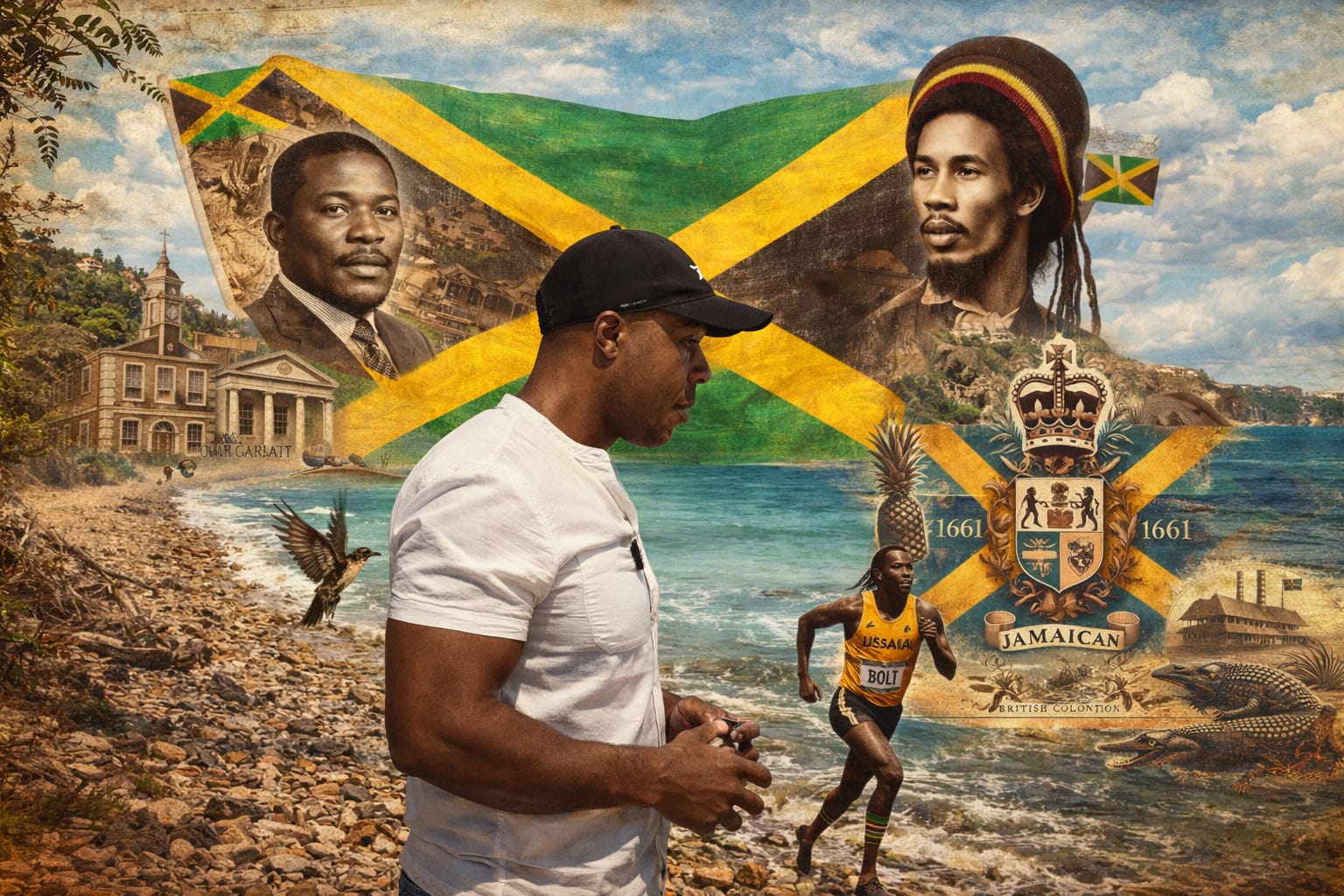
Since childhood, Jamaica has never been just a place to me. It has always been something deeper — a feeling, a rhythm, a memory stitched into the quiet parts of the heart.
I have lived in Jamaica every year of my life, even if some of those years were spent partly overseas. My connection to the island began long before I understood what words like heritage, identity, or nationhood meant. It began with simple moments: walking barefoot along the beach, feeling the warm sand beneath my feet, and looking out toward the endless horizon where the sea meets the sky.
There is something powerful about those early experiences with nature. As a boy, I remember running through the hillsides, playing in forests thick with greenery, hearing the sound of birds and rustling leaves, and encountering the animals that are part of the island’s everyday life. Those moments grounded me in something real — something that cannot be replicated by concrete cities or glass office towers.
Those childhood memories never left me.
They quietly shaped the direction of my life.
As I often say:
“A man may travel the world and achieve success, but the place that shaped his spirit will always whisper his name.” — Dean Jones, Founder of Jamaica Homes
Growing Up Between Two Worlds
Although Jamaica was always home in my heart, I spent much of my upbringing in the United Kingdom. I grew up primarily in Essex and later lived in Islington, London. Those years in the 1980s, and 90s were formative in their own way.
But what made that experience unique was the community.
Many Caribbean families had settled in the UK during the years following the arrival of the Windrush generation. My grandparents were part of that generation — men and women who crossed the Atlantic in search of opportunity but carried their culture, traditions, and ambitions with them.
Life for them was not easy.
They worked jobs that others often overlooked or avoided. Some cleaned hospital wards. Others drove buses. Many laboured in factories. The work was hard, the hours long, and the treatment was sometimes harsh.
Yet despite those challenges, they built something remarkable.
They built stability.
They bought homes. They saved. They invested. They raised families. And quietly, steadily, they created foundations that would benefit generations after them.
But even while they were building new lives in Britain, Jamaica was never far from their minds.
Weekends were often filled with family gatherings. Community centres became places where Caribbean families came together for christenings, weddings, celebrations, and conversations that stretched long into the night. Music was always present.
On Sundays especially, the radio would be playing reggae from pirate stations broadcasting across London. The voices of Dennis Brown, Gregory Isaacs, and other legendary artists filled our homes.
In my own family, that connection ran even deeper. Gregory Isaacs — the legendary reggae singer — was my mother’s first cousin. Music, culture, and Jamaican identity were not abstract ideas in our household. They were living, breathing realities.
Those influences left a permanent imprint.
They reinforced something that many children of Caribbean heritage understand instinctively: even when you live abroad, a part of you belongs somewhere else.
The Dream of Returning Home
Throughout my life, there was always a quiet desire inside me — a sense that one day I would return to Jamaica.
This feeling was not unusual among people of my generation. Many of us grew up hearing our parents and grandparents speak about “back home.” It was part of weekend conversations, part of family plans, and part of long-term dreams.
Many Caribbean families in Britain were investing in land and property back in Jamaica even while they were establishing themselves overseas.
They were building houses, acquiring plots of land, and preparing for a future that included a return.
That mindset influenced me deeply.
But returning home was not something I rushed into. My professional life in the UK developed quickly, and I was fortunate to have opportunities that many people would consider extraordinary.
I worked in senior leadership roles on major national programmes.
At one stage, I was overseeing a £450 million programme for a new university campus and major organisational transformation. My work took me from Cranfield University in Bedfordshire to the Defence Academy of the United Kingdom in Shrivenham.
Before that, I had been involved in delivering programmes within the UK Parliament, working across both the House of Commons and the House of Lords on national security initiatives.
From the outside, everything looked stable and successful.
So people sometimes ask me:
Why leave?
Why walk away from senior positions, major programmes, and a comfortable life in the UK?
Freedom and the Entrepreneurial Spirit
The answer is simple, though not always easy to explain.
Jamaica offers a different kind of life.
In many developed economies, the path is fairly structured. You go through the education system, obtain qualifications, enter the workforce, and build a career within established institutions.
There is nothing wrong with that system.
But it does shape how people think.
It often trains individuals to fit within structures rather than to build new ones.
Jamaica, by contrast, demands something different. The island requires resilience, creativity, and entrepreneurial thinking.
Opportunities exist, but they rarely appear neatly packaged.
You have to create them.
In Jamaica, many people do not simply apply for jobs — they build businesses, create solutions, and develop ideas that allow them to survive and thrive.
This environment encourages a kind of independence that can be incredibly powerful.
“In places where opportunity is limited, imagination becomes the most valuable currency.” — Dean Jones, Founder of Jamaica Homes
That entrepreneurial spirit was one of the reasons I returned.
Another was my children.
I wanted them to experience life beyond the narrow boundaries that many modern societies unintentionally create. I wanted them to know Jamaica not just as a holiday destination, but as a living culture — a place with history, resilience, and possibility.
The Reality of Paradise
Jamaica is often described as paradise.
And in many ways, it truly is.
The island possesses natural beauty that few places in the world can match: mountains that rise dramatically from the coastline, lush forests filled with life, and beaches that stretch endlessly along turquoise waters.
But paradise is not perfect.
Like every country, Jamaica faces real challenges — economic pressures, infrastructure demands, and the ongoing work of building stronger communities.
Living here requires patience, adaptability, and perspective.
Yet those challenges also reveal the strength of the Jamaican people. One of the most remarkable characteristics of this country is its ability to rebuild, adapt, and move forward with determination.
Communities support each other.
Neighbours look out for neighbours.
Families come together when times are difficult.
There is a quiet resilience embedded in Jamaican culture that cannot be easily explained but is immediately recognisable.
If you want a small example of Jamaican humour in the face of adversity, just listen carefully after a storm passes. Within hours, someone will inevitably say something like, “Well, at least the breeze did save mi a few days of sweeping the yard.” That ability to find humour in difficulty is not denial — it is resilience wearing a smile.
Building for the Future
Since returning to Jamaica, much of my work has been focused on real estate, community development, and helping people understand the opportunities that property ownership can bring.
Through Jamaica Homes, I have tried to create a platform that makes property more accessible and transparent for Jamaicans both locally and in the diaspora.
For many families, property represents stability.
It represents security for future generations.
And in a country like Jamaica, where land and housing remain deeply connected to identity and heritage, owning property carries emotional significance as well as financial value.
However, property development must also be approached responsibly.
Homes must be built with resilience in mind. Communities must be planned carefully. Infrastructure must support growth.
Real estate is not just about buildings — it is about people.
“A house is built with concrete and steel, but a home is built with vision, patience, and community.” — Dean Jones, Founder of Jamaica Homes
This perspective is especially important during times when the country is recovering, rebuilding, and strengthening its foundations for the future.
Development should never be rushed or careless. It should be thoughtful, sustainable, and respectful of both the environment and the people who live here.
Giving Back to Community
Beyond business, I believe strongly in contributing to the broader wellbeing of Jamaica.
That can mean offering guidance on reconstruction, supporting discussions around housing policy, or working with local communities on initiatives that improve living conditions.
Jamaica is not simply a place where we live — it is something we collectively build.
Every generation has a responsibility to improve what they inherited.
That may involve strengthening housing, improving infrastructure, investing in education, or supporting healthcare initiatives. Progress is rarely the result of one person’s effort; it is the result of many individuals contributing what they can.
For me, returning to Jamaica was not only about personal fulfilment.
It was about participating in that process of building.
A Personal Reflection
When I stand on the beach today and look out toward the horizon — much like I did as a child — I sometimes think about the journey that brought me here.
From hillside memories in Jamaica to community halls in London.
From pirate radio stations playing reggae to boardrooms discussing national programmes.
From large institutions in the UK to entrepreneurial life in the Caribbean.
The journey may appear unconventional to some people.
But for me, it feels completely natural.
Because in the end, it was never really about leaving one place for another.
It was about returning to where the story began.
Jamaica has a way of doing that to people.
It calls them home.