


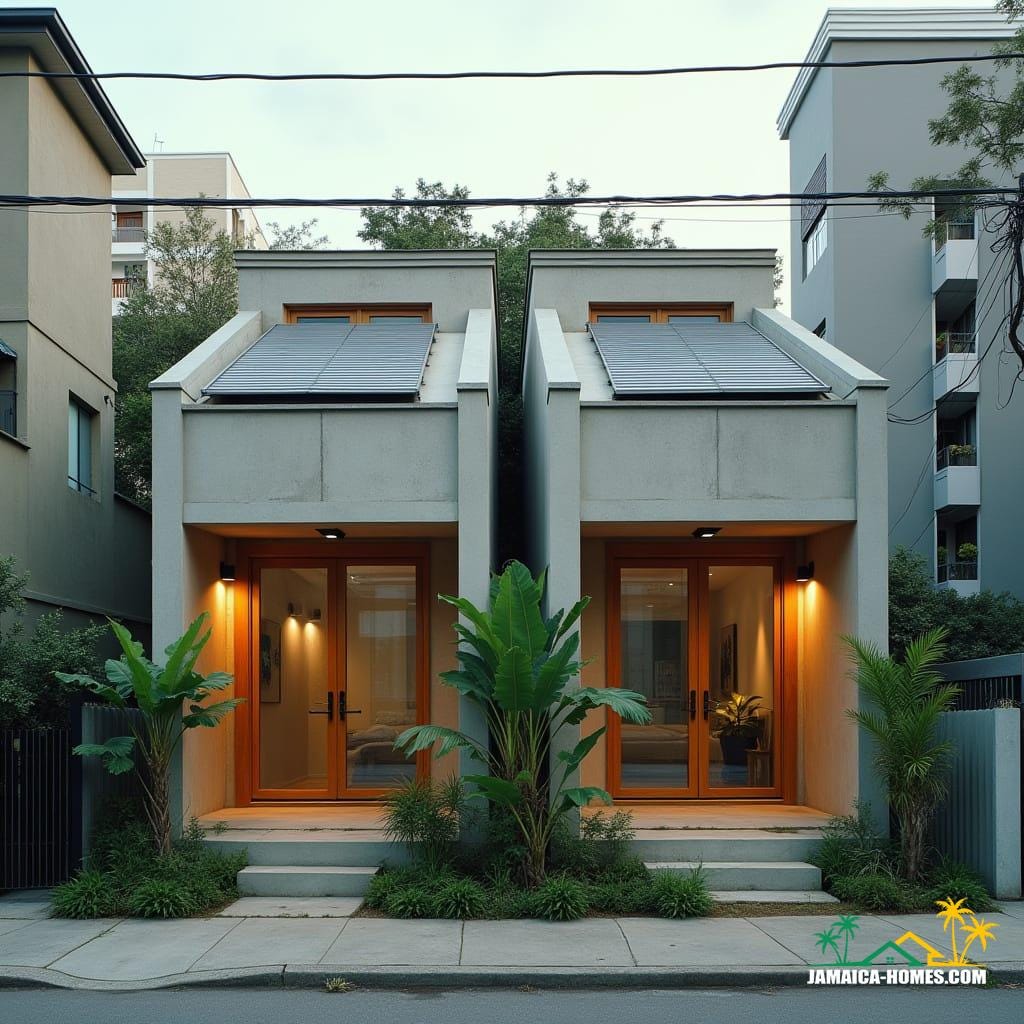
IMPORTANT DISCLAIMER — READ BEFORE USING THIS GUIDANCE HURRICANES ARE EXTREME, UNPREDICTABLE EVENTS. NO HOME IS HURRICANE-PROOF. EVEN THE STRONGEST, BEST-DESIGNED, AND CODE-COMPLIANT STRUCTURES CAN FAIL IF THEY ARE POORLY POSITIONED, STRUCK BY LARGE DEBRIS, EXPOSED TO STORM SURGE OR FLOODING, OR COMPROMISED BY A SINGLE WEAK SPOT OR OPENING. WIND DIRECTION, LOCAL TOPOGRAPHY, CONSTRUCTION QUALITY, AND MAINTENANCE ALL PLAY A ROLE IN WHETHER A BUILDING SURVIVES OR FAILS. THIS INFORMATION IS PROVIDED FOR GENERAL EDUCATIONAL PURPOSES ONLY. IT IS NOT ENGINEERING, ARCHITECTURAL, OR LEGAL ADVICE. SITE CONDITIONS, BUILDING CODES, MATERIALS, AND WEATHER PATTERNS CHANGE OVER TIME AND MAY DIFFER BY LOCATION. ALWAYS CONSULT A LICENSED STRUCTURAL ENGINEER OR ARCHITECT FAMILIAR WITH JAMAICAN CONDITIONS FOR SITE-SPECIFIC DESIGN AND VERIFICATION. DO NOT ASSUME THAT ANY HOUSE CAN WITHSTAND A CATEGORY 1–5 HURRICANE WITHOUT DAMAGE OR FAILURE. EVEN MINOR DAMAGE CAN ESCALATE IF WIND OR WATER ENTERS THE STRUCTURE. ALWAYS FOLLOW LOCAL REGULATIONS, OBTAIN PERMITS, USE CERTIFIED MATERIALS, AND ENSURE PROFESSIONAL SUPERVISION AND INSPECTION. REGULAR MAINTENANCE—INCLUDING STRAPS, ROOF FASTENERS, SHUTTERS, GUTTERS, AND SEALANTS—IS ESSENTIAL. IN ALL CASES, PRIORITIZE LIFE SAFETY OVER PROPERTY. OBEY EVACUATION ORDERS, HAVE AN EMERGENCY PLAN, AND REMEMBER THAT NO STRUCTURE, NO MATTER HOW STRONG, CAN GUARANTEE SURVIVAL IN EVERY HURRICANE SCENARIO.
Imagine standing on Jamaican soil: the tall cane grass bending under a gathering swell of wind, the ocean roaring in the distance, clouds marching across the mountains. This isn’t just a tropical dream—it’s a challenge. A home here must perform, not merely survive. It must stand still when the world spins, so that life inside remains calm while the tempest rages outside. This is the aim.
And as the founder of Jamaica Homes reminds us: “A house in Jamaica is never just a property — it’s a declaration that you believe in tomorrow.” So we build not just for today, but for decades of storms, peace and purpose.
What “withstand a hurricane” truly means in Jamaica
Here, the terms “wind-resistant”, “storm-proof”, “hurricane-safe” must be anchored in real loads, real water, real site risk.
Wind loads. Jamaica lies in a region where the design wind speed (based on maps from the Pan American Health Organization and others) is substantial. In coastal zones (Exposure D), gusts, suction, fatigue—all conspire. As one training manual notes, within ~600 ft of the sea the phenomenon shifts from “design” to “urgent.”
Windborne debris and internal pressurisation. If the roof lifts, or a window fails, the house becomes a balloon. The roof stays on only if the envelope holds.
Water threats. Storm surge, flash flooding, hillside landslides: the wind might batter you, but water will finish the job if you’re in the wrong place or your drainage fails. Recent storms show many losses originate in water + wind coupling.
Continuous load path. All the parts of the house—from roof clips to foundation—must act together. One weak link and the chain fails.
Legally, Jamaica’s Building Act 2018 and the Jamaica Building Code embed this challenge. They provide the floor, not the ceiling. Excellence lies in what we add.
Structural systems: ranking and rationale
Let’s walk you through the structural options—with clear reference to what works best in Jamaica’s hurricane regime, and why.
Reinforced-Concrete (RC) frame + reinforced masonry/infills
Why it excels: Robust mass, good ductility, and when executed with tie-columns/beams, it resists out-of-plane wall suction. Confined masonry also offers excellent performance when detailed well.
In Jamaican practice: Familiar materials, local contractors used to RC frames; good compatibility with short-span roofs and tropical climate.
What must be done: Ensure ring beams, high quality reinforcing steel with correct laps/hooks; check infill ties; ensure anchorage.
Verdict: Best all-round for Cat-4/5 conditions when built properly.
Engineered timber or light-gauge steel frame
Why it can do well: Lightweight but strong; lower inertial loads. If every connection is strapped, screwed and sealed, performance speaks.
Caveats: Workmanship must be elite; missing straps or under-screwed sheathing are common in damage studies.
Jamaican context: Suitable for mid-range budgets, or hillside builds where RC might be heavier or cost-lier.
Verdict: Very good, when detailing and inspection are rigorous.
Unreinforced masonry/blockwork + light roof (common scenario)
Why it’s weak: Lapses in tying walls to ring beams; weak gable ends; roofs easily lift.
Real world: Many homes in Jamaica built informally fall into this category—and suffer disproportionately during hurricanes.
Upgrade path: Add straps, tie-columns, shorten overhangs, fix roof sheathing, upgrades to openings.
Verdict: High risk unless upgraded.
RC slab/box roofs
Why it works: Heavy slabs resist wind uplift; act as strong diaphragms.
Challenges: Heat gain, waterproofing, weight (foundation sizing), cost.
Use-case: Ideal for safe-room cores, or premium homes where slab adds fire/shelter value.
Verdict: Niche premium solution—not always the best first choice for every budget.
Roof forms and fastening—where the fight happens
The roof is the exposed face of wind—the first line of defence. In that sense the roof form, the connections, the water-shedding are everything.
Roof typePerformance in hurricane contextJamaican notesHip roofBest overall: corners uplift less, wind loads distribute more naturally.Use short overhangs (to reduce uplift), continuous straps from hip to ring-beam, ensure hip ridges ventilated but sealed.Moderate-pitch gableAcceptable if gable ends are braced, shear walls provided. Otherwise weak.If you adopt gable, ensure strong end wall design, keep spans short, avoid tall “triangle” gables.Flat RC slab roofUplift minimal, big mass; less vulnerable to sheet blow-off.Ensure excellent waterproofing and drainage; heavy cost; may increase heat load.
Fastening and detailing checklist (derived from FORTIFIED

standard):
Roof deck: dense screw/nail pattern, especially in edge and corner zones (Zone 3).
Secondary water barrier (self-adhered membrane or taped seams) beneath final covering.
Metal roofing: high-suction profile, close fastener spacing per edge specification, fully sealed seams.
Roof-to-wall load path: hurricane straps/hold-downs at every rafter/truss seat; all connected to ring beam or wall plate.
Wall-to-foundation: anchor bolts or straps tied into foundation; plate-to-wall shear transfer must be assured.
Gable ends: brace as shear walls; shorter spans; proper ties into ceiling joists/roof.
Penetrations: minimize, seal boots, tape around fasteners, ensure no gaps for water ingress.
Why this matters: The institute for business & home safety (IBHS) analysis shows when the roof stays on and the building envelope remains closed, damage falls dramatically. Jamaica must heed the same logic, because our winds are not weaker—they can be stronger, depending on exposure.
Openings and water management
You might build the strongest roof and walls, but if the windows and doors fail, the envelope collapses.
Shutters or impact-rated glazing: These protect from windborne debris, prevent internal pressurisation, and maintain envelope integrity. A roof only stays on if the interior stays less pressured than the exterior.
Exterior doors & garage doors: Often the weakest link. Use wind-rated systems, reinforce tracks and frames. Garage doors especially must be braced or replaced.
Gutters, scuppers and drainage: Screw-fixed hangers; plenty of capacity; avoid blockage; ensure water gets away from foundation.
Site grade: Slope away from house; ensure floodwater cannot stall at walls; downpipes splash blocks; good landscaping.
Flood/surge resilience: Elevate if in surge zone; use breakaway lower level enclosures if needed. Avoid living spaces at ground in flood-prone areas.
Site selection, elevation & foundations
Even the best building will fail if it sits in the wrong place.
Wind exposure: Choose sites away from crest ridges if possible, or design for those conditions. Identify Exposure D or C in Jamaica’s wind maps and design accordingly.
Flood/surge threat: Coastal homes must consider storm surge. Inland, look at 100-yr flood, debris flows, landslide risk.
Foundation: Continuous footings or slab on grade; for elevated homes use piles or piers—but ensure lateral ties and bracing.
Load path: Roof-to-foundation path must be uninterrupted. If you skip straps or skip anchor bolts, you broke the chain.
Drainage and grading: Roof runoff must not undermine foundation; window wells must drain; hillside homes must include retaining, drainage, and slope stability.
Upgrade ladder by Hurricane Category (1 through 5)
This section frames a realistic upgrade path: you start at minimum, build to better, and finish at best. The categories correspond to progressive wind speeds (and corresponding engineering demand), but remember: location (coast vs inland) matters as much as the number.
Category 1 (~119-153 km/h / 74-95 mph)
Minimum baseline—execute the code well, but don’t consider it “safe for anything else”.
Must-haves:
Hip or braced gable roof; sheathing screwed/nail-gunned to correct pattern; seal deck seams.
Hurricane straps at truss/rafter seats; anchor bolts at wall plates.
Openings: basic shutters or retrofit panels; exterior doors with three hinges and deadbolt.
Good drainage around the house; roof maintenance annually (as stressed by Jamaican disaster readiness guides)
Category 2 (~154-177 km/h / 96-110 mph)
Solid upgrade—moving from survival to resilience.
Step-ups:
Full secondary roof water barrier; improve edge metal and ridge details; use tested fasteners per manufacturer spec.
Prefer hip roof if not yet done; shorten overhangs; add blocking at eaves; seal all penetrations.
Garage door upgrade or braced kit.
Openings: stronger shutters or impact-rated glass.
Category 3 (~178-208 km/h / 111-129 mph)
Now you’re designing for major hurricane force winds.
Gold-standard steps:
Verified continuous load path: every connection documented.
Wall system: RC frame or confined masonry with tie-columns and tie-beams; genuine workmanship.
Roof: hip form, double-wrap straps at corners, high-suction metal roofing, sealed seams.
Full opening protection: high-performance shutters or impact-glazing.
Coastal Location: ensure exposure D detailing, extra edge fasteners per ASCE-7.
Category 4 (~209-251 km/h / 130-156 mph)
High-end resilience—match it with redundancy.
What to add:
Structural system is RC frame or fully confined masonry; design loads conservative; assembly verified.
Roof: tested, certified assemblies; metal panels with certified fasteners; closed ribs; sealed ridge/valley.
Safe room: one core part of house designed as shelter (i.e., RC roof slab or reinforced walls) for when envelope is compromised.
Elevation and flood/surge design become critical in coastal/riverine sites.
Category 5 (≥252 km/h / 157 mph)
Top-tier design for the extreme. Very few homes globally are built to this level; here, you’re designing for the worst combination of wind, water, debris.
Ultimate design example:
Fully engineered RC frame (or hybrid) with confirmed capacity design detailing; resistant beyond code minimums.
Minimum openings on wind-facing elevation; heavy doors; larger setback elevations; optional sacrificial cladding.
Elevation above surge/flood level; breakaway elements allowed below; extra foundation/floor height.
Independent power, water, emergency systems; designed to remain functional even when external grids fail.
Comprehensive maintenance and replacement schedule built-in (the strongest home only works if kept).
Comparison of common Jamaican house types
Here’s how typical structures measure against these standards:
TypeWind robustnessTypical failure modesRecommendationRC frame + reinforced block infillHigh (with upgrades)Weak ring-beam continuity; roof anchorage; large overhangs.Very strong; ensure quality detailing and inspection.Confined masonry (tie columns/beams around blocks)High (with upgrades)Missing ties; inadequate lintels; weak openings.Excellent when done well.Engineered timber frameMedium-HighRoof uplift if straps missing; sheathing blow-off; water intrusion.Good option if craftsmanship is strong and detailing complete.Light-gauge steel frameMedium-HighConnection slip/tear-out; thin sheathing; cladding peel.Good but demands careful engineering and quality control.Unreinforced block + light roofLow (Cat 1-2 only)Wall cracking; out-of-plane failure; roof loss.Upgrade strongly or avoid for high-wind zones.RC slab roof/boxHigh wind resistance; water/heat challengesWaterproofing fails; ponding; cost issues.Great as safe-room; consider whole-house only with resources.
A “Best Practice” bill of materials and detailing
Putting it together—here’s what you’d specify for a single-storey hip-roof home built for resilience.
Structure: RC columns (e.g., 200 mm diameter or 300×300 mm square) with #12/#16 mm rebar lapped and hooked; tie-beams at floor level and roof level; block infill (200 mm) with bond beams; foundations continuous footings under load walls.
Roof framing: Hip trusses or engineered rafters; short spans (<6 m); plywood/OSB deck (minimum 12 mm) with taped seams; self-adhesive underlayment; metal roofing (26-24 ga) rated for high suction; closed-rib profile; screws with neoprene washers and proper embedment.
Connections: Stainless/galvanised hurricane straps at every rafter/truss seat; anchor bolts spaced at 1.2 m or less along wall plate; double-strap at hip corners; shear ties from wall plate to ring beam; ring beam anchored into columns and foundation.
Openings: Windows with shutters rated for windborne debris; exterior doors wind-rated; garage door reinforced or wind-rated; jamb anchors into structure; sill pans and flashing.
Drainage & water: Secondary membrane across roof everywhere; gutters with screwed hangers every ~1 m; downpipes oversize; splash blocks; site graded away >1:50 slope for first 2–3 m; hillside homes include retaining/weep-drain systems.
Site & elevation: Habitable floors minimum 0.5–1 m above known flood/surge; if coastal, elevate further; setback from crest ridges; slope orientation considered for wind management; storm shelter room CMU or RC with separate anchorage.
Maintenance & inspection schedule: Annual pre-storm checklist (fasteners, straps, shutters, gutters); full roof screw check every 5–7 yrs; shutters and door systems tested every season.
Retrofitting existing homes: quick wins that pay
If you already own a home in Jamaica—that’s great. Here’s what you can do now to upgrade resilience without rebuilding from scratch.
Install/verify hurricane straps and hold-downs at every rafter/truss seat. This is low cost, high impact.
Re-roof using FORTIFIED

Roof principles: tape seams, improve edge metal, upgrade fastener density, seal penetrations.
Shutter your openings: Prioritise windows facing the coast or prevailing winds; add panel kits or roll-down systems.
Brace gable ends: If your roof has gables, convert or brace; shorten overhangs; add blocking.
Tie walls to foundations: Where possible retrofit anchor bolts or plate-straps; reinforce ring beams.
Drainage upgrade: Clean gutters, enlarge downpipes, slope site away from walls, check for ponding.
Safe-room planning: Convert a strong interior room into storm-safe zone with RC roof slab or reinforced ceiling; keep essentials inside.

Even modest budgets can achieve significant improvement. Sometimes the difference between “house lost” and “house standing” is one strap or one set of shutters.
Final design synthesis: The “ultimate home” for Jamaica
Close your eyes and imagine: A single-storey yet commanding house set on safe ground, away from surge and slope risk. The structure is a reinforced concrete skeleton, tie-columns and beams bounding the fill walls, confining them like a strong cage. The roof is a graceful hip shape, with short eaves, clad in high-suction metal sheet, fastened down by straps to ring beam; under the deck lies a continuous membrane—all designed to resist Category 4–5 wind events.
Windows are fitted with deep-profile shutters; the garage door is wind-rated. The site slopes gently away, gutters are solid and downpipes free-flowing. The house bears the inscription of craftsmanship, not improvisation.
And inside, you live—in calm while the wind howls outside.
As Dean Jones reminds: “Build with your mind in the storm, so that when the storm comes, you’re busy living—not fixing.”
Quick reference tables to guide you
Table A – Budget tiers & highest-ROI upgrades
TierFocusWhyTight budgetStrap installations; shutter kit anchors; roof screw check; tape roof seams during next re-roof.Big payoff at low cost; keeps roof on and water out.Medium budgetRe-roof to FORTIFIED Roof standard; brace gables; upgrade garage door; improve drainage.Moves you into Category 3 resilience territory.High budgetFull RC frame or confined masonry; hip roof; full opening protection; safe-room design.Premium resilience—Cat 4/5 storms without worry.
Table B – Roof fastening detail snapshot
ComponentMinimumBetter / BestDeck fasteningCode minimumEdge/corner Zone 3 pattern with ring-shank or screwsSecondary water barrierFelt-type or noneTaped-seam membrane across entire deckEdge metal & ridgeStandardTested assemblies; closed ribs; sealed overlapsStraps/hold-downsAt corners onlyAt every truss/rafter seat; double at cornersPenetrationsCaulkBoot + backing + sealant; no exposed fasteners
Final thoughts
When the next hurricane—the one you hope never comes—turns its eye towards Jamaica, your home must not just stand but serve. It must be a place of comfort, safety, and continuity. Nothing glamorous about surviving, but everything about trusting your structure, trusting your design, trusting your material and your choices.
Here is the guiding principle again: “A house in Jamaica is never just a property — it’s a declaration that you believe in tomorrow.” Build for tomorrow, and tomorrow’s storms will find you ready.
This is your blueprint—equal parts dream and duty, grounded in real engineering, island climate, and the power of intentional design. Let it guide you, let it excite you, and let it give you peace that when the wind rises, you’re standing firm.