


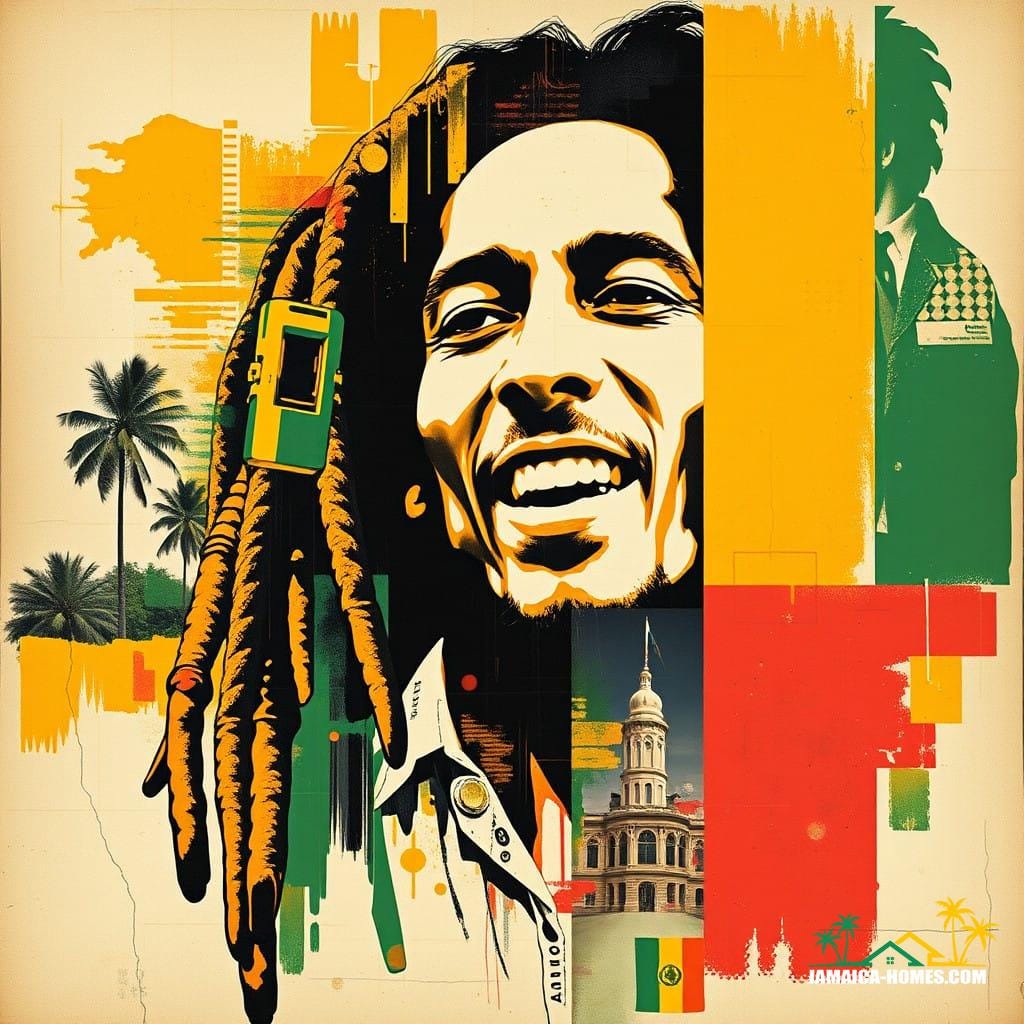
When Bob Marley sat alone with his guitar and recorded “Redemption Song” for the Uprising album in 1980, he stripped everything back. No band. No heavy riddim. Just a voice and a truth that felt older than the island itself. The song was personal, but it was also national. It carried Jamaica’s history in every line. And if you listen carefully, it carries something else too: a lesson about land, ownership, and survival.
Jamaica did not begin as a real estate market. It began as contested ground.
Before Columbus arrived in 1494, the Taíno people lived on this island, farming cassava, fishing the coasts, naming rivers and mountains. Land was not owned in the European sense. It was used, shared, respected. Then came conquest. Spain claimed Jamaica. Later, in 1655, Britain seized it. The island became a plantation economy built on sugar, slavery, and extraction. Land became currency, power, and control. Vast estates were carved out and granted to absentee owners. Africans were trafficked across the Atlantic and forced to work land they could never own.
When Marley sang, “Old pirates, yes, they rob I, sold I to the merchant ships,” he was not speaking metaphorically. He was speaking historically. Jamaica’s economic foundations were built on land that enriched a few and dispossessed many. Ownership was concentrated. Labour was exploited. Generations were born on soil they cultivated but could not claim.
After Emancipation in 1838, something profound began to happen. Freed people did not simply celebrate freedom; they sought land. They pooled resources. They bought small plots. They formed “free villages.” They understood instinctively that freedom without land was fragile. Political liberty without economic footing could easily collapse. So survival became strategic. Ownership became resistance.
But the plantation legacy did not disappear overnight. Large estates still dominated. Access to capital was limited. Infrastructure favoured export crops over local development. The psychological imprint of dispossession lingered. Jamaica entered the twentieth century still wrestling with land inequality and economic vulnerability.
Then came 1962. Independence. A new flag. A new anthem. A new sense of possibility. Yet independence did not automatically redistribute wealth or rewrite the property structure. Jamaica inherited colonial boundaries, legal systems, and economic pressures. Urbanisation accelerated. Rural populations moved into Kingston and other towns seeking opportunity. Informal settlements expanded. Tenure became complicated. Family land passed down without formal documentation. Survival often meant improvisation.
Marley rose in that Jamaica. Born in Nine Mile, raised partly in Trench Town, he understood both rural land hunger and urban struggle. Trench Town was government housing, but it was also a symbol of concentrated poverty and resilience. It was a place where survival was daily and ownership was distant. From that soil came global music. From that struggle came “Redemption Song.”
“Emancipate yourselves from mental slavery, none but ourselves can free our minds.” That line echoes across generations, and it echoes loudly in real estate. Mental slavery is not just about politics. It is about belief. It is about what a people think is possible. For decades, many Jamaicans internalised the idea that property ownership was for the elite, for uptown families, for the well-connected. Renting became normalised as permanent rather than transitional. Informality became accepted as inevitable.
But history shows something different. After emancipation, freed Jamaicans prioritised land even when they had little. They understood that ownership anchors dignity. Today, that lesson remains urgent. In a housing market that is heating up, in a country attracting foreign investors, in communities transforming rapidly, the question is not whether change is coming. It is whether Jamaicans will participate in shaping it.
Survival in Jamaica has always required adaptation. When sugar declined, we pivoted. When bauxite rose, we adjusted. When tourism expanded, we reorganised coastlines and communities. Each economic wave reshaped land use. Hotels replaced fishing beaches. Gated communities replaced cane fields. High-rises began to rise where once there were yards and zinc fences.
But through every shift, one truth remains: land is power.
Property in Jamaica is not just about a house. It is about inheritance, leverage, stability, and voice. A titled lot in Clarendon or St. Elizabeth may not look glamorous, but it represents something profound. It represents the ability to build in phases. To borrow against equity. To pass something concrete to the next generation. To resist displacement. To stand firm when rents rise and markets fluctuate.
Looking back at Jamaica’s past, we see cycles of dispossession and reclamation. We see people denied land, then fighting for it. We see communities formed around shared struggle. We see the law slowly evolving to structure ownership, even as informal practices persist. We see wills unwritten, probate delayed, family land tied up in disputes that stall development for decades. And we see, too often, opportunities lost because documentation was ignored.
Looking forward, the stakes are higher.
Climate change is reshaping coastal realities. Sea levels and storm intensity threaten low-lying communities. Sustainable planning is no longer optional. Infrastructure investment is critical. Urban density must be managed intelligently. Property ownership must be informed, not impulsive. Survival now requires environmental awareness alongside economic foresight.
The Jamaican diaspora plays a growing role in this story. Remittances have long sustained households. Now, diaspora investment is shaping neighbourhoods. Returning residents are building homes, starting developments, and influencing land values. This is a powerful force, but it must be guided with intention. If Jamaicans at home do not secure their stake, they risk being spectators in their own market.
Marley also sang, “Have no fear for atomic energy, ’cause none of them can stop the time.” Time is the one force that humbles every system. Markets rise and fall. Governments change. Global trends shift. But time rewards those who think long term. Property is a long-term play. It is not a quick flip mentality that builds generational security. It is patient acquisition, careful documentation, structured transfer, and strategic development.
In Jamaica, many families possess land informally, known only through memory and verbal agreement. That worked in tight-knit communities decades ago. It struggles under modern economic pressure. Redemption in real estate means formalising what was once informal. It means writing wills. Registering transfers. Understanding titles. Protecting valuation records. Clarifying boundaries. These are not bureaucratic nuisances; they are acts of preservation.
When Marley asked, “How long shall they kill our prophets while we stand aside and look?” it was a cry against passivity. Applied to property, it becomes a question about complacency. How long will we ignore planning advice? How long will we neglect climate warnings? How long will we delay structuring our estates properly? How long will we underestimate the value of land until it is beyond reach?
Survival is not only about enduring hardship. It is about converting hardship into structure. It is about ensuring that struggle is not wasted.
The story of Jamaica is a story of survival. From slavery to emancipation, from colonial rule to independence, from economic shocks to cultural triumphs, this island has endured. Reggae became a global language. Usain Bolt redefined speed. Entrepreneurs built brands that travel worldwide. But beneath every achievement is the quiet foundation of land.
Land is where we build homes. Homes are where we raise children. Children become the next generation of thinkers, creators, leaders. If those homes are unstable, so is the future. If they are secure, so is possibility.
“Won’t you help to sing these songs of freedom?” Marley asked. In today’s Jamaica, one of those songs is ownership done right. Ownership that is documented. Ownership that is sustainable. Ownership that is informed by history and guided by vision.
Jamaica Homes stands in that space between past and future. We operate in a market shaped by colonial history, post-independence evolution, diaspora energy, and global capital flows. We see the tension. We see the opportunity. Our role is not simply to list houses. It is to help Jamaicans navigate complexity with clarity. To treat property not as hype, but as heritage.
If we look back, we see ancestors who fought for land as a symbol of dignity. If we look forward, we see children who will need stability in a changing climate and economy. Between those two horizons stands the present generation. This is our moment to consolidate survival into structure.
Marley’s “Redemption Song” was recorded near the end of his life. There is a sense of urgency in it. A recognition that time is limited. Jamaica, too, stands in a moment of urgency. The market is moving. Development is accelerating. Climate realities are intensifying. Global interest is rising.
Redemption is not automatic. It is intentional.
Survival is not enough. Survival must mature into ownership. Ownership must mature into legacy.
From Taíno villages to plantation estates, from free villages to urban schemes, from zinc fences to gated communities, Jamaica’s land tells a story. The question is whether the next chapter will deepen inequality or broaden participation.
“None but ourselves can free our minds.”
That freedom begins with belief. It continues with knowledge. It solidifies with documentation. And it endures through land.
Songs of freedom are beautiful when sung. They are transformative when built.
In Jamaica, redemption can sound like a guitar in 1980. But it can also look like a title registered, a boundary clarified, a will written, a foundation poured, a key handed to the next generation.
That is survival elevated.
That is life structured.
That is a redemption song in concrete and block, echoing across an island that has always fought to stand on its own ground.