

The Blueprint of Tomorrow: Jamaica’s Children, Its Land, and the New Digital-Physical Real Estate Frontier

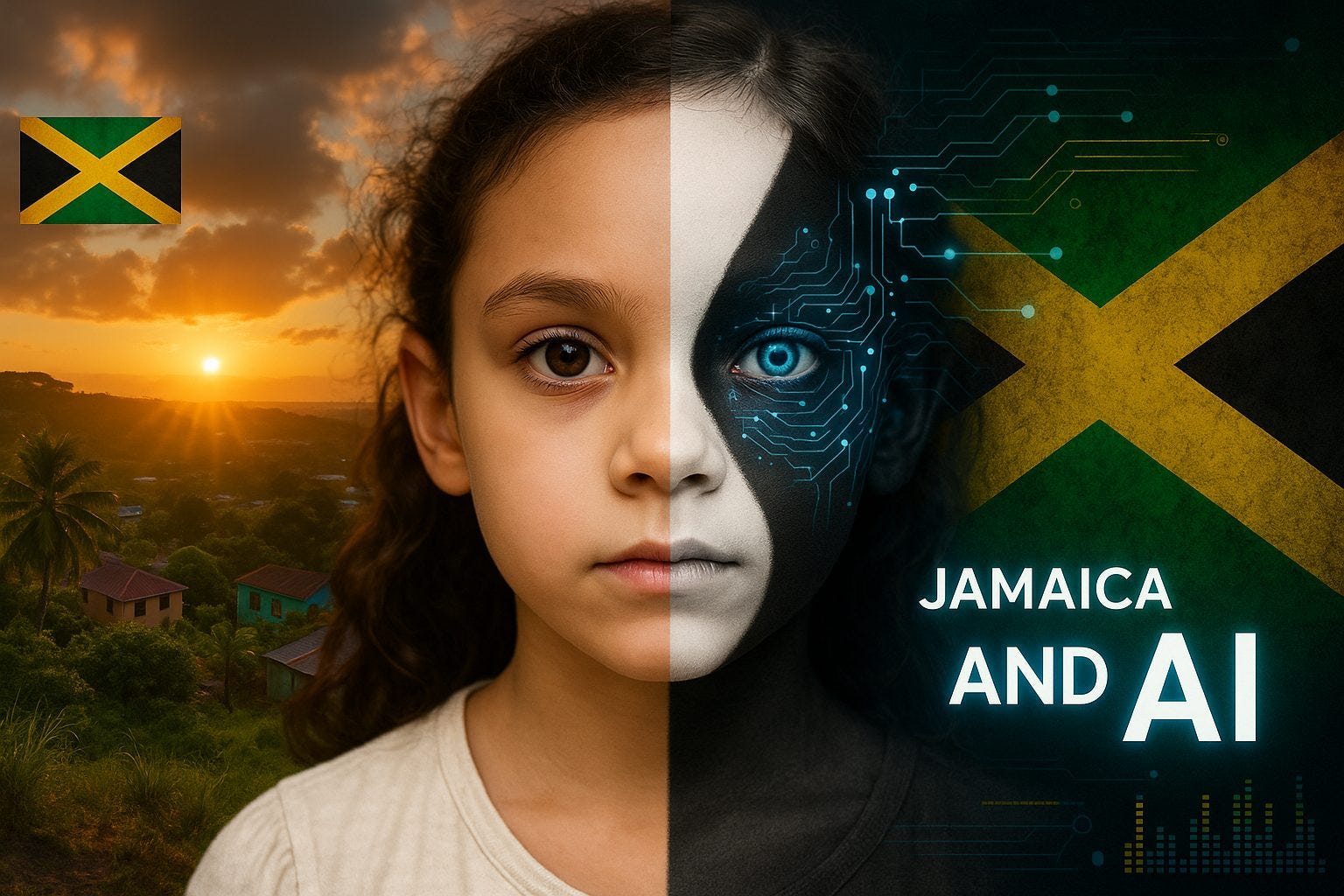
There are times in a nation’s life when the familiar rhythms of yesterday no longer prepare us for the storms—or the opportunities—of tomorrow. Jamaica finds itself in such a moment now. The winds of Hurricane Melissa may have passed, but the scars remain: washed-out roads, shattered roofs, flooded valleys, and families forced once again to rebuild from the soil up. These storms remind us that our physical world is fragile. And yet, even as we hammer nails back into wood and patch the holes left by chaos, a different kind of storm is gathering—one born not of nature, but of innovation.
Artificial intelligence.
For some countries, AI is an upgrade.
For Jamaica, it is an inflection point.
A dividing line between what we have been—and what we could become.
And at the centre of this story lies real estate, both the land beneath our feet and the digital spaces where the next generation will learn, dream, work, and build lives we cannot yet imagine.
Because land is more than land.
And data is more than data.
And the future will be written where the two converge.
Real Estate: The Oldest Story in Jamaica
To understand where Jamaica is going, we must remember where we came from.
Long before the internet, long before electricity, long before political independence, Jamaica’s story was a story of land. Who owned it. Who laboured on it. Who was denied access to it. Who fought to reclaim it. Our villages, our districts, our urban ghettos, our uptown enclaves—all were shaped by physical real estate decisions made long before many of us were born.
Jamaica’s earliest real estate markets were not markets at all. They were systems of control. Plantation ownership wasn’t simply economics; it was identity, power, and life or death. After emancipation, land became the symbol of freedom. The rise of free villages—Sligoville, Sturge Town, Adelphi—formed the first property-owning Black communities in the Caribbean. For the newly freed, owning a piece of ground was proof you had finally stepped into your own destiny.
This connection between land and liberation is part of the Jamaican DNA.
But as the world modernised, real estate expanded beyond the physical. The idea of “place” began to shift. With the arrival of the internet in the mid-1990s, digital space became valuable too. Websites became storefronts. Online presence became reputation. Social media became neighbourhoods of influence. And just as owning land once determined power, owning digital real estate—domains, platforms, content ecosystems—became a new form of capital.
Jamaica, however, adopted this change slower than many nations. While other countries digitalised institutions, modernised land registries, and built online public services, we held onto manila envelopes, long lines, paper deeds, and offices where a single signature could take weeks.
Still, we progressed.
Still, we innovated.
Still, we found our own pace.
And now, a new shift has arrived—faster and more transformational than anything before it.
AI: The Second Great Migration of Real Estate
The first migration was from land to web.
The second is from web to intelligence.
Artificial intelligence is the new frontier of both digital and physical real estate. It will reshape how Jamaicans search for homes, buy land, build communities, design cities, and recover from disasters. But it will also redefine the very meaning of “place,” blending the physical world with intelligent digital layers that follow us everywhere.
For children born in Jamaica today, AI will not feel revolutionary. It will feel normal. It will be the silent participant in their education, entertainment, relationships, and decisions.
A child growing up in 2030 might ask an AI tutor:
“Show me how hurricanes form beyond the Caribbean Sea.”
or
“What neighbourhood in Jamaica fits my family’s lifestyle and income?”
or even
“How can I buy my first piece of land before age 25?”
And the AI will answer—not with random information from the web, but with personalised guidance, data-driven analysis, predictive modelling, and a deep understanding of Jamaican culture, risk patterns, market movements, and geography.
This is the future:
the merging of intelligence with place.
The Children Who Will Inherit the Intelligent Jamaica
Our children will grow up in a world where AI is everywhere—on phones, in classrooms, in government portals, in homes, in the very systems that determine how cities operate. They will not remember dial-up tones or the thrill of the first smartphone. They will grow up talking to AI naturally, the way we talk to friends.
This raises a profound question:
What Jamaica will we give them to inherit?
Will they inherit a country still limping behind global progress?
Or a nation that chooses to leapfrog into leadership?
Will they inherit a Jamaica still struggling with paper titles?
Or a Jamaica with a modern, intelligent land registry?
Will they inherit communities vulnerable to storms?
Or climate-resilient smart districts built with foresight?
These children will be both the architects and the occupants of Jamaica’s next era. Their childhood will not be defined by the physical alone, but by the digital landscapes they inhabit daily.
We owe them an island that keeps up with their potential.
Physical Real Estate in Jamaica: From Yesterday’s Struggle to Tomorrow’s Opportunity
Jamaica’s physical real estate market has always been shaped by extremes—beauty and vulnerability, opportunity and risk, aspiration and inequality. The hurricanes remind us of the fragility of our structures, while urban sprawl reminds us of our planning challenges. Yet the potential remains staggering.
AI is about to rewrite the entire sector.
Imagine a Jamaica where every property includes:
Predictive flood-risk scores.
Hurricane impact simulations.
Dynamic valuation estimates updated daily.
Digital building blueprints stored in a national cloud.
AI-driven mortgage advice tailored to the individual.
Seamless title verification through blockchain-backed registries.
Imagine a Jamaica where a young couple in Portmore uses an AI engine to determine the safest, most cost-effective neighbourhood for raising children—and receives recommendations grounded in scientific data rather than rumour or guesswork.
AI can democratise real estate.
AI can stabilise real estate.
AI can protect real estate.
AI can complicate real estate if we do nothing.
But with intention, AI becomes the greatest tool Jamaica has ever had to modernise its housing sector.
Digital Real Estate: The New Land Boom
Digital real estate is no longer abstract. It is an economic force.
Social media pages, online marketplaces, domain names, AI personas, digital content libraries, virtual learning spaces—these are all properties. They generate revenue, attract investment, influence communities, and shape identity.
A Jamaican teenager running a successful YouTube channel is a digital landowner.
A business with a strong web presence owns digital property.
A platform like Jamaica Homes owns a digital district—an online community where value is constantly exchanged.
As AI grows, these digital properties will evolve into intelligent platforms that curate, advise, predict, negotiate, and personalise everything for users across the globe.
For Jamaica, digital real estate holds a massive opportunity:
It allows us to export talent without losing people.
It lets our children build wealth online before they can even sign a mortgage.
It creates new industries we have barely imagined.
It positions the island as a global hub of digital creativity.
Digital real estate, powered by AI, is the new frontier for national empowerment.
A Country Still Moving Slowly—But with a Chance to Move Smart
Jamaica does not move as fast as the rest of the world.
This is not a criticism—it is a reality.
We are slower in bureaucracy, slower in technology adoption, slower in infrastructure upgrades, slower in public-sector transformation. But Jamaica has always excelled in one area: creative acceleration.
When Jamaicans decide to leap, we leap far.
Reggae changed global music forever.
Usain Bolt redefined athletic possibility.
Jamaican culture dominates significantly more than our population size suggests.
We do not move quickly, but we move powerfully when aligned.
AI gives us the chance to make such a leap again.
If we use it well—use it to modernise real estate, protect children, educate families, fortify communities, and organise development—we can vault ahead of nations with more resources but less agility.
The question is not whether Jamaica can adapt—
the question is whether Jamaica will choose to.
A Vision of Jamaica 2035: Where Digital and Physical Worlds Unite
Picture the Jamaica our children could inherit:
A Jamaica where the National Land Agency is fully digital, transparent, and AI-assisted.
A Jamaica where housing schemes are planned with data-driven precision.
A Jamaica where informal settlements receive structured pathways to safety and legitimacy.
A Jamaica where property markets are fair, fraud-resistant, and future-focused.
A Jamaica where digital learning levels the educational playing field.
A Jamaica where diaspora investment flows confidently through intelligent systems.
A Jamaica where young people build both physical wealth and digital empires.
A Jamaica that uses AI not to replace human ingenuity, but to amplify it.
This Jamaica is not fantasy.
It is possibility—if we are bold enough to pursue it.
Conclusion: Children, Land, and Intelligence Are the Pillars of the New Jamaica
The storms will come again. The old systems will creak. The pace of change will feel overwhelming. But Jamaica has always persevered, always adapted, always rebuilt.
This time, we do not rebuild backward.
We rebuild forward.
For our children.
For our communities.
For the land that has always carried us.
For the digital frontier rising around us.
Real estate—both physical and digital—will be the foundation.
AI will be the engine.
And our people, especially the young, will be the architects.
If we step into this moment with courage, Jamaica will not merely survive the future—
Jamaica will define it.