

The Caribbean Court That Most Caribbean People Never Think About Has a New Leader
Margaret Price-Findlay's appointment as Chief Justice is not just a personal milestone. It is a reminder of one of the region'sremarkable institutions and a glimpse into the future of Caribbean justic


For most Caribbean people, the courts are something that exist in the background.
They appear in newspaper headlines when a major criminal trial concludes, when a constitutional dispute erupts, or when a government loses an important legal challenge. Outside those moments, few people think about the machinery that keeps the rule of law functioning across a region of small islands, multiple governments, different legal systems, and thousands of miles of ocean.
Yet one of the most important institutions in the Caribbean quietly changed leadership this week.
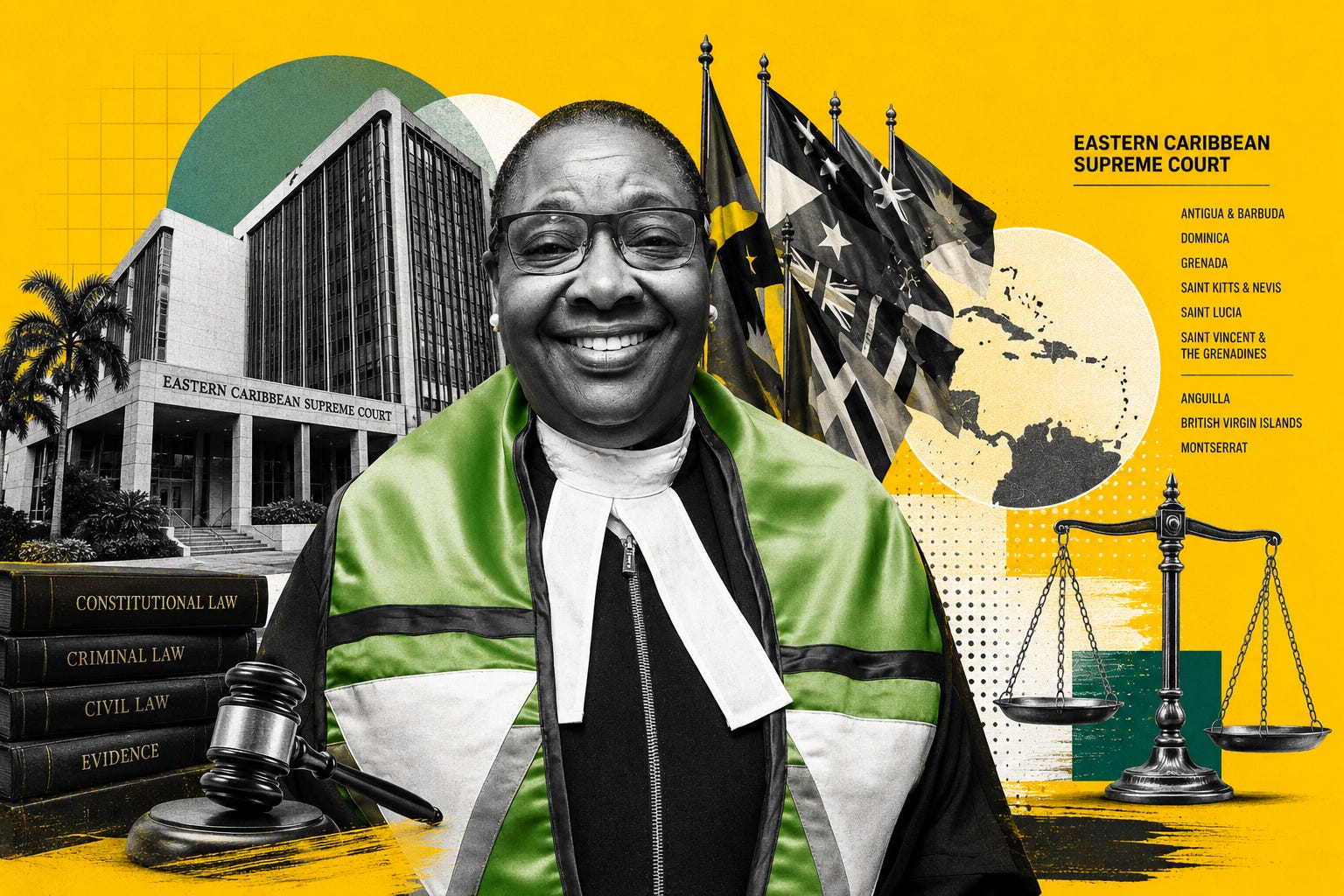
Margaret Price-Findlay, a Trinidad and Tobago-born jurist who has spent much of her professional life serving the wider Eastern Caribbean, was formally confirmed as Chief Justice of the Eastern Caribbean Supreme Court.
The appointment makes her the court’s 14th Chief Justice and only the second woman ever to hold the office. It also marks another milestone in a career that has carried her from Trinidad’s legal profession to the highest judicial office in one of the most unusual court systems anywhere in the world.
The announcement was accompanied by the customary congratulations, ceremonial speeches and expressions of gratitude. Such occasions often focus on personal achievement. What they sometimes overlook is the larger story.
This appointment says something important about how the Caribbean itself is changing.
A Court Without a Country
The Eastern Caribbean Supreme Court is not the supreme court of a single nation.
It serves six independent countries and three British Overseas Territories. Judges hear matters arising in Antigua and Barbuda, Dominica, Grenada, Saint Kitts and Nevis, Saint Lucia, Saint Vincent and the Grenadines, Anguilla, Montserrat and the British Virgin Islands.
Few regions in the world have attempted anything comparable.
The arrangement reflects a longstanding Caribbean reality. Most of the islands are small. Creating separate superior court systems for each territory would be expensive, inefficient and, in some cases, impractical.
Instead, the region developed a shared judicial structure capable of serving multiple jurisdictions while maintaining legal consistency and judicial independence.
The result is a court whose judges routinely travel between islands, whose decisions shape the constitutional and commercial life of numerous countries, and whose influence extends far beyond the public recognition it receives.
Most Caribbean citizens could probably identify their prime minister more easily than their Chief Justice. Yet the decisions made by the Eastern Caribbean Supreme Court affect everything from property rights and criminal justice to elections, business disputes and constitutional freedoms.
A Caribbean Career
Price-Findlay’s professional journey reflects another reality of modern Caribbean life: talent increasingly moves across borders.
Born in Diego Martin, Trinidad, she was educated at Holy Name Convent before studying law at the University of the West Indies and later the Hugh Wooding Law School.
Her early career was spent in private practice in Trinidad and Tobago. In 1991 she relocated to the British Virgin Islands, a move that would shape the remainder of her professional life.
Like many Caribbean professionals, she crossed a stretch of sea without knowing exactly where the journey would lead.
She practised law, established her own firm, served as a magistrate, entered the judiciary, became a High Court judge, later joined the Court of Appeal and eventually rose to lead the institution itself.
The trajectory is impressive not simply because of the position she attained, but because of what it illustrates.
Caribbean integration is often discussed through trade agreements, political declarations and regional summits. In reality, some of the most successful forms of integration have occurred quietly through professional networks, educational institutions and public service.
Lawyers, doctors, engineers, academics and business leaders routinely build careers that span multiple Caribbean territories. Price-Findlay’s career is an example of that regional mobility in practice.
More Than a Symbol
There is understandable attention on the fact that she is only the second woman to lead the court.
Representation matters.
For generations, the highest positions within the legal profession were overwhelmingly occupied by men. The appointment of women to senior judicial offices has altered that landscape throughout the Caribbean.
Yet focusing exclusively on symbolism risks understating the significance of the role itself.
The office of Chief Justice is not merely ceremonial. It requires judicial leadership, administrative management and diplomatic skill.
The holder of the office must oversee judges operating across numerous jurisdictions, maintain confidence in the institution, navigate budgetary pressures and ensure the efficient administration of justice.
That challenge has become increasingly difficult.
Court systems throughout the Caribbean face growing caseloads, technological demands, resource constraints and rising public expectations.
Citizens want justice to be fair. They also want it to be fast.
The tension between those two goals has become one of the defining challenges of modern judicial administration.
The Real Test Ahead
The speeches delivered during judicial ceremonies often emphasize tradition, dignity and continuity.
The harder questions emerge afterward.
Can courts reduce delays?
Can judicial systems modernize without compromising fairness?
Can public confidence be strengthened at a time when trust in institutions is declining around the world?
Can regional courts remain independent in increasingly polarized political environments?
These are the issues that will likely define Price-Findlay’s tenure far more than the ceremony marking its beginning.
During her time as Acting Chief Justice, she repeatedly emphasized judicial independence, institutional trust and collective responsibility.
Those themes suggest an awareness that the legitimacy of courts cannot be taken for granted.
Courts ultimately possess neither armies nor police forces of their own. Their authority rests on something less visible but more powerful: public confidence that their decisions deserve respect.
Maintaining that confidence is among the most important responsibilities of any chief justice.
A Quiet Regional Success Story
The Caribbean often tells itself stories about what is not working.
Economic vulnerability. Political division. Crime. Migration. Brain drain.
Those challenges are real.
But there are also institutions that have endured, adapted and succeeded.
The Eastern Caribbean Supreme Court is one of them.
For nearly six decades it has provided judicial continuity across multiple territories while navigating constitutional change, independence movements, economic crises, natural disasters and shifting political landscapes.
Its existence demonstrates that regional cooperation is not merely an aspiration. In some areas, it is already a reality.
That reality is easy to overlook because functioning institutions rarely generate dramatic headlines.
They are most visible when they fail.
The confirmation of Margaret Price-Findlay offers an opportunity to remember the institution itself, not just the individual who now leads it.
Her appointment is undoubtedly historic.
But perhaps the larger story is that a court serving nine Caribbean jurisdictions continues to function, evolve and command respect in a region that often receives far too little credit for the institutions it has successfully built.
That achievement belongs not only to one chief justice, but to generations of judges, lawyers, administrators and citizens who have sustained the rule of law across the Eastern Caribbean.
The ceremony in Saint Lucia marked the beginning of a new chapter.
The real measure of its success will be written not in speeches, but in the administration of justice throughout the years ahead.