


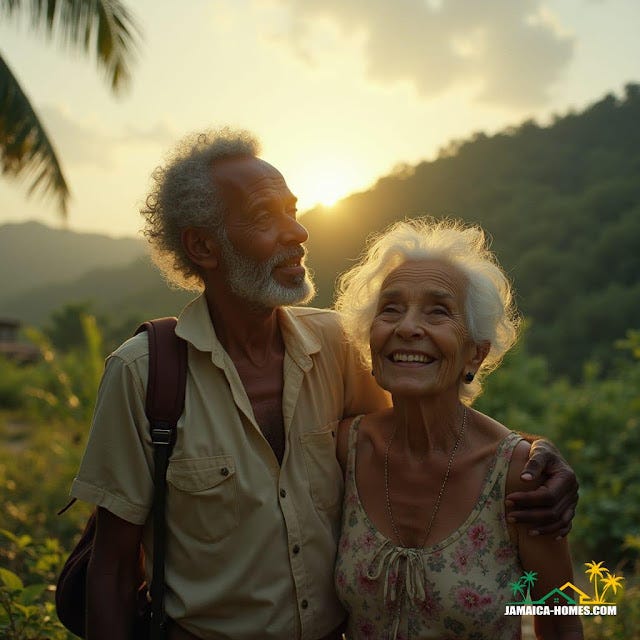
I arrive with a sense of déjà vu. Jamaica is not just an island of turquoise seas and lush hillsides; it is, for many of us who grew up abroad, the great unfinished chapter of our lives. Returning here, you are greeted not only by the heat of the sun and the scent of pimento in the breeze, but also by a quiet and unrelenting question: where do I belong?
On the streets of Kingston, or outside a corner shop in Mandeville, people call me “English.” At first, I bristled. We all speak English, don’t we? But of course, this wasn’t about language — it was about identity. Jamaicans have a refreshing way of naming things exactly as they see them. A man with locks becomes “Rasta.” A bald man is “Baldy.” A painter’s apprentice might simply be called “Brush.” And so, by that same gentle shorthand, I became “English.”
And with that small name, a vast and complicated story unfolded.
The Returnee’s Liminal Space
To be a returnee is to occupy an in-between existence. Your blood is Jamaican. Your values may be Jamaican. You even know the backroads of St. Elizabeth better than some locals. And yet, you are not entirely of the place. You move differently, you sound different, you’ve absorbed rhythms from London, Birmingham, Toronto, or New York.
This liminality is not a failure — it is a fascinating human condition. Like the unfinished house I so often stand before, it is neither ruin nor masterpiece, but something in transition: full of promise, fraught with difficulty, and breathtaking in its complexity.
Reality Bites
And then there are the practicalities — the economics, the bureaucracy, the daily realities that can feel more demanding than the Caribbean sun at noon.
Work is scarce. Networks are essential. Degrees from overseas may draw nods of admiration, but they do not fling open doors. Returnees, even the most qualified, find themselves waiting in the wings while opportunities go to those already woven into Jamaica’s intricate social fabric.
Many arrive with noble ambition, only to encounter resistance. We want to fix, improve, uplift. But change here must be coaxed rather than imposed. Jamaica is a society of proud traditions, of systems that — though at times frustrating — have their own internal logic. To push too hard is to risk rejection.
Real Estate: Rooting the Dream
And yet, amidst all this, there is one enduring anchor: property.
To buy a piece of land, to plant fruit trees that will outlive you, to raise walls that resist both time and tide — this is the dream. For returnees, real estate is never just about financial value. It is legacy, belonging, the physical manifestation of a yearning that no boarding pass can fully capture.
But like any grand design, the reality is seldom smooth. Contractors vanish, permits stall, budgets balloon. A house in Jamaica, like identity itself, is a work in progress. Some succeed — building homes where verandas catch the evening breeze and grandchildren run free. Others falter, leaving half-finished structures or ghost houses peering over valleys, reminders of dreams that slipped away.
A National Crossroads
And here lies the great irony: Jamaica has yet to embrace its returnees as a national asset. Other countries court their diaspora with tax breaks, structured re-entry programmes, and fanfare. Jamaica, for all its brilliance, has been slower to act.
Yet the potential is enormous. Returnees carry with them international expertise, fresh capital, and ideas shaped by global exposure. They are bridges, connectors, catalysts. To not nurture that potential is to waste one of the island’s most renewable resources: its people.
The Poetry of Belonging
So where does that leave me? Still “English.” Still negotiating my place between the familiar and the foreign.
But perhaps that is not a tragedy. Perhaps it is, instead, the poetry of belonging. To exist in that liminal space is to hold two worlds in tension, to understand that identity is not a neat equation but a layered composition.
And like the houses I’ve walked through on this island — some unfinished, some precarious, all magnificent in their intent — we, too, are works in progress. To be a returnee is to build even when the soil resists, to plant even when the sun scorches, to remain even when acceptance feels elusive.
Because in the end, home is not merely where you are recognised.
It is where you choose, with all your heart, to stay and to build anyway.