

The Future Is Moving Faster Than Our Institutions
Artificial intelligence is forcing a global reckoning over education, professionalism and economic survival, while countries like Jamaica risk being trapped inside systems built for a slower world.


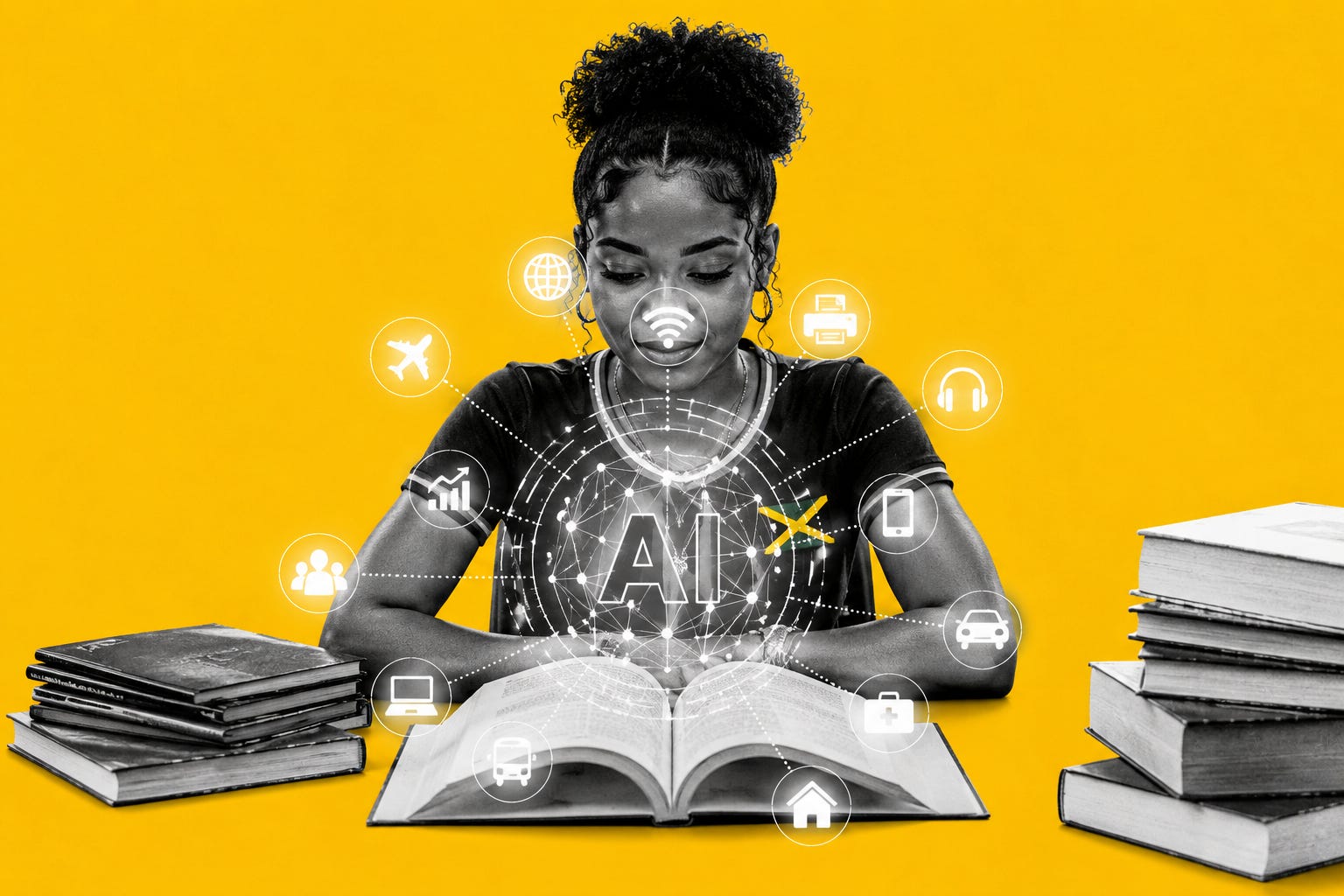
For decades, societies measured progress through expansion. More universities. More courses. More certifications. More committees. More examinations. More regulations. More paperwork. More institutions built around the idea that knowledge itself was scarce and difficult to access.
Artificial intelligence is quietly dismantling that assumption.
The global conversation has shifted rapidly over the past two years. The debate is no longer whether AI will affect education. That argument is effectively over. The real question now being asked inside universities, labour markets and boardrooms around the world is far more uncomfortable: How many institutions are fundamentally unprepared for what is coming next?
That question matters enormously for Jamaica.
Last week, Jamaica formally partnered with the Certified Commercial Investment Member Institute, known globally as CCIM, in a move designed to strengthen real estate professionalism, technical education and international standards across the Caribbean. Government officials described the agreement as transformational, pointing to the importance of investment analysis, data driven decision making and globally benchmarked expertise.
They are not wrong. Strong standards matter. Professionalism matters. Technical competence matters. Investor confidence matters.
But another reality now sits quietly underneath nearly every professional institution on earth, including universities, training bodies and regulators: artificial intelligence is changing the value of traditional education itself.
Not gradually. Not hypothetically. Right now.
Across the world, major headlines are accelerating around the growing mismatch between technological change and educational systems built for a slower era. Fortune recently warned that while the college degree is not dead, the wrong type of degree could carry devastating financial consequences as AI dismantles many of the entry level pathways universities were originally designed around. The New Yorker examined whether artificial intelligence tutoring, rising tuition costs and weakening confidence in degrees are pushing higher education toward structural reinvention. Reuters published commentary warning that AI driven graduate job cuts could eventually undermine the economic logic of expensive university education itself. TIME Magazine argued universities may now require structural reinvention simply to survive the intelligent age.
These are no longer fringe conversations. They are becoming mainstream economic concerns.
For years, universities largely operated as gatekeepers of information. That made sense when information itself was difficult to access. Today, a motivated student with internet access and AI tools can already perform tasks that once required teams of researchers, analysts, assistants or junior professionals.
Artificial intelligence can now summarize reports, assist with coding, generate financial analysis, explain legal concepts, translate languages, create marketing copy, assist with design, simulate business strategies, organize research and generate educational tutoring in real time.
Entire industries are already being reshaped. Writers are feeling it. Designers are feeling it. Coders are feeling it. Junior analysts are feeling it. Administrative professionals are feeling it. Marketing departments are feeling it. Media companies are feeling it.
What is increasingly striking is that AI is not mainly targeting blue collar labour first, as many once assumed.
It is attacking junior intellectual labour.
That changes everything.
Graduate trainees, junior coders, entry level legal staff, basic consultants, research assistants, copywriters, administrative coordinators, paralegals and junior marketers were traditionally the first rung after university. Now that rung itself is beginning to weaken.
Recent research has shown growing numbers of students reconsidering their majors because of fears surrounding artificial intelligence and future employability. Universities worldwide are rushing to embed AI into nearly every discipline, not just computer science, because institutions increasingly understand that graduates entering the next economy without AI fluency may be entering already weakened career pathways.
This is where Jamaica’s situation becomes especially important.
Because Jamaica does not simply face the challenge of educational adaptation. It also faces the challenge of institutional speed.
Anyone who has tried to navigate many Jamaican systems understands the reality immediately. Long queues. Manual processing. Repetitive paperwork. Physical signatures. Fragmented databases. Endless forms. Delayed approvals. Layers of bureaucracy that often consume time faster than they create productivity.
Rules matter. Oversight matters. Professional standards matter.
But there is a difference between structure and stagnation.
Jamaica cannot paperwork its way into the future.
Artificial intelligence now offers countries an opportunity not merely to digitize old inefficiencies but to fundamentally rethink how systems operate altogether. That is where the real global competition may increasingly emerge. Not simply over who has degrees or certifications, but over which countries can become technologically agile enough to survive and compete in the intelligent age.
This is already happening internationally. will.i.am has been publicly investing in new educational models focused on AI literacy, machine collaboration and future focused technical understanding. Around the world, universities are experimenting with shorter learning pathways, stackable certifications, AI integrated programmes and continuous learning models that challenge the traditional idea of a single degree completed once at the beginning of adulthood.
The old monopoly universities held over knowledge is beginning to fracture.
That does not mean universities are becoming irrelevant. Far from it.
Elite institutions may actually become more powerful in the AI era because prestige, networks and trust still carry enormous economic value. But weaker institutions, outdated programmes and rigid systems may struggle badly if they cannot evolve fast enough.
That is one of the biggest truths emerging globally right now.
The prestige economy of education may survive longer than the educational model itself.
And underneath all of this sits an even more uncomfortable reality: there are likely thousands of students beginning courses this year that are already partially outdated as they enroll. Some will graduate into industries radically transformed before their degrees are completed.
That sounds dramatic, but it is increasingly difficult to deny.
Artificial intelligence is improving monthly, not generationally. Many institutions still move as though change occurs slowly enough for curriculum committees, accreditation cycles and regulatory processes to comfortably keep pace.
The world no longer operates at that speed.
That is why the future likely belongs less to static educational models and more to adaptive ecosystems built around continuous reinvention. Microcredentials. AI integrated learning. Project based education. Industry partnerships. Adaptive training. Real world application. Interdisciplinary problem solving. Continuous skill renewal.
Those are no longer futuristic ideas. They are becoming economic necessities.
Ironically, the future may place greater value on deeply human capabilities rather than less. Judgment. Creativity. Leadership. Emotional intelligence. Negotiation. Ethics. Strategic thinking. Relationship management. Psychological understanding. Complex decision making under uncertainty.
Artificial intelligence may automate portions of knowledge work, but trust itself remains profoundly human.
A commercial real estate professional still needs to understand people, negotiation, politics, culture, risk and local market psychology. A journalist still needs judgment, credibility and the ability to interpret society beyond raw information. A leader still needs emotional intelligence and moral clarity in moments where algorithms alone cannot resolve human complexity.
The future is probably not humans versus AI.
It is increasingly humans with AI competing against humans without it.
Countries that understand this early may gain enormous advantages. Countries that move too slowly may become trapped inside outdated systems while the world reorganizes around them.
That is why Jamaica’s development conversation must now become larger than simply increasing certifications or expanding traditional structures.
The island does not merely need more forms, more queues, more disconnected systems or more procedural bottlenecks.
It needs intelligent systems.
It needs technological integration across government. It needs AI literacy at scale. It needs adaptive education. It needs digital infrastructure capable of communicating internally. It needs institutions willing to evolve continuously rather than defend outdated processes indefinitely.
Most importantly, it needs leadership willing to confront uncomfortable truths honestly.
Because artificial intelligence is not just disrupting jobs.
It is disrupting institutional time itself.
And the question Jamaica now faces is not simply whether it can keep up.
The question is whether it is willing to rethink enough, fast enough, to compete in the future already arriving at breakneck speed.
Sources and reporting referenced throughout this commentary include public reporting, analysis and research published by major international media outlets, academic institutions, labour market analysts and industry publications, including Reuters, Fortune, TIME, The New Yorker, Forbes, Gallup and higher education research bodies. Additional reporting and analysis by Jamaica Homes.
This is why…the headlines on Monday looked like this.
https://www.nytimes.com/2026/05/04/technology/trump-ai-models.html
AI and LLMs will inevitably change traditional education forever.