

The Grey House
What Jamaica’s unfinished homes reveal about class, survival and the cost of becoming modern


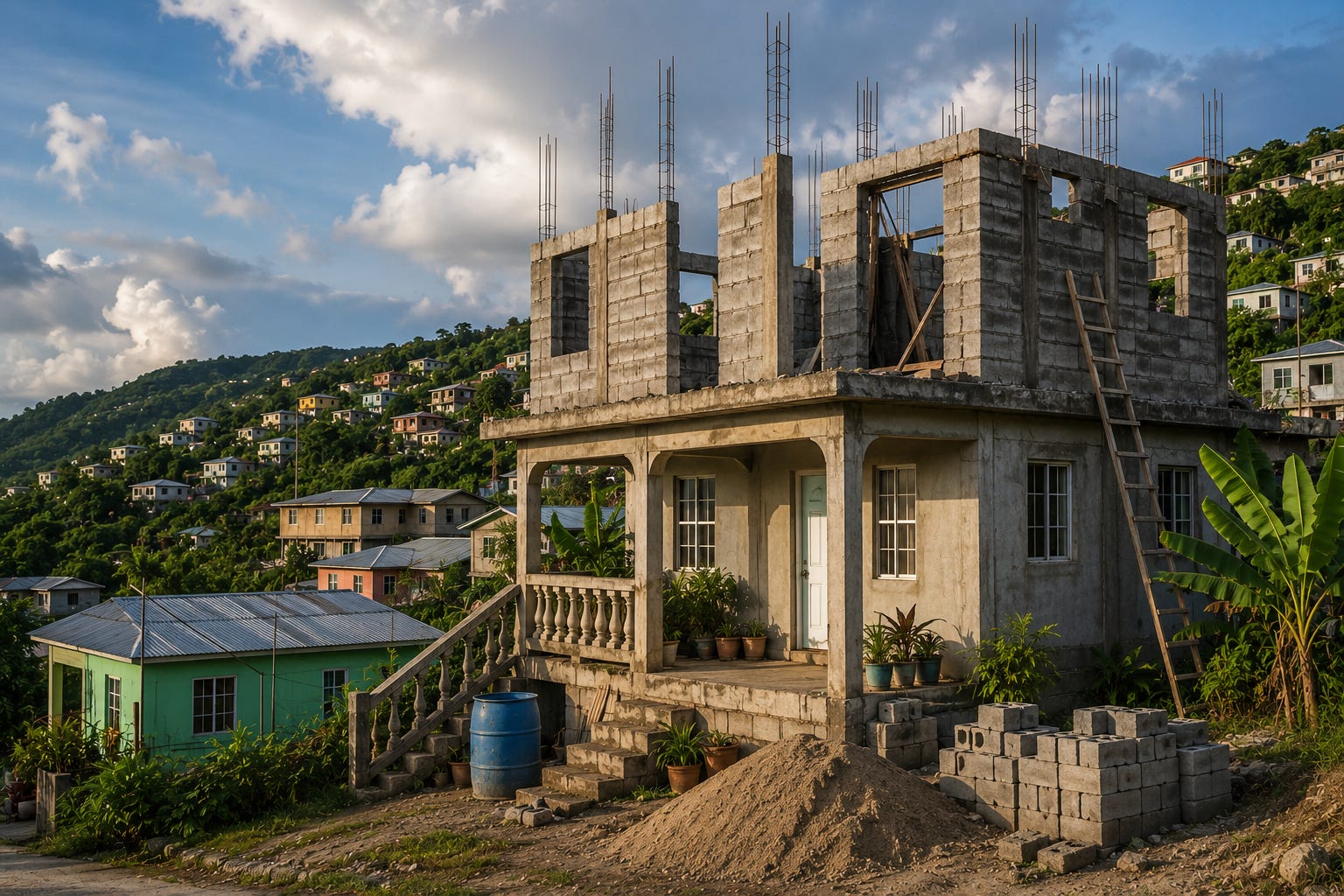
Drive across Jamaica long enough and you begin to notice a particular colour.
Grey.
Not the polished white of resort walls or the painted creams and charcoals of new gated developments. This is the raw grey of curing concrete, exposed block, cast columns and upper floors waiting for another payday.
It is the colour of pause.
Across the island, thousands of houses exist in a state somewhere between beginning and completion. Steel rods rise from rooftops and disappear into the sky. Ground floors are occupied while upper floors remain skeletal. One section carries polished tiles while another waits years for plaster.
To the untrained eye, these homes can look abandoned, chaotic or permanently unfinished.
But that interpretation misses the point entirely.
The Jamaican grey house is not simply a construction site.
It is an economic document.
It records inflation, migration, remittances, fear of debt, distrust of banks, weak insurance penetration, family ambition, and a nation trying to modernise without leaving half its people behind.
“The grey house tells the story of Jamaica more honestly than most policy papers ever could,” said Dean Jones, founder of Jamaica Homes. “You are looking at aspiration colliding with economic reality in real time.”
For decades, Jamaicans have built homes incrementally because many had little alternative. In wealthier countries, homebuilding is often a tightly managed financial event. Plans are approved, mortgages secured, contractors hired, inspections completed and houses delivered.
In Jamaica, for a huge section of the population, housing became something else entirely:
a long term negotiation with uncertainty.
Money does not always arrive consistently.
Jobs do not always last.
Inflation shifts.
Storms come.
Relatives migrate.
The US dollar moves.
Materials rise.
And so the house evolves in stages alongside the family.
A market vendor casts a foundation one year and adds a kitchen three years later. A taxi operator buys blocks after Christmas. A nurse in England sends money for roofing. A son in New York helps finish the bathroom. A small contractor builds downstairs first and leaves the steel for “when time better.”
The house grows in rhythm with survival itself.
Building Before Borrowing
Part of what shaped this culture was Jamaica’s historical relationship with debt.
For generations, borrowing heavily could destroy a family financially. Interest rates were often punishing. Informal work made mortgage qualification difficult. Construction materials remained heavily exposed to imported costs and exchange rate pressure. Even now, many Jamaicans exist somewhere between the formal and informal economy.
So people built with cash when they could.
Not because it was efficient.
Because it felt safer.
This is one reason the unfinished house became culturally accepted. It represented movement without total financial collapse.
In Jamaica, an exposed upper floor does not always signal failure.
Sometimes it signals caution.
“Many Jamaicans do not fully trust stability,” Jones said. “They have lived through too much economic uncertainty for that. So the room by room house became a way to move forward without taking on one catastrophic financial risk.”
The roots of this stretch far back into post emancipation Jamaica, when formerly enslaved people had limited access to wealth and formal systems. Incremental self help building became embedded in rural and working class communities long before modern mortgages became widespread.
But while the culture may be old, the pressures surrounding it are becoming more modern and more severe.
The Dangerous Gap
There is a difficult truth sitting beneath Jamaica’s housing landscape:
many homes operate in a legal and financial grey zone.
A property can be occupied, valuable and sellable while still being:
partially documented,
partially compliant,
underinsured,
or extended over decades without consistent approvals.
That flexibility helped many families achieve ownership.
But it also created vulnerability.
Insurance companies want certainty. Banks want documentation. Engineers want standards. Climate risk demands resilience. Yet much of Jamaica’s housing stock evolved outside rigid systems because rigid systems often excluded ordinary people from participating in the first place.
The result is a country where a house may function socially and economically long before it functions institutionally.
That contradiction becomes more dangerous in a hurricane prone island facing rising insurance pressures and harsher climate realities.
Exposed steel left untreated in salt air weakens. Informal retaining walls fail. Poor drainage floods communities. Improvised electrical systems create fire risk. And when disaster strikes, many families discover too late that the house they spent twenty years building was never truly protected.
“Ownership and protection are not the same thing,” Jones said. “Jamaica solved part of the ownership problem through adaptation and informality, but the protection gap remains enormous.”
That gap is becoming harder to ignore.
The New Jamaica Rising
At the same time, another housing culture is emerging.
Over the last two decades, gated communities have transformed the Jamaican imagination. The gated development is no longer simply about housing. It has become psychological infrastructure.
Order.
Security.
Water tanks.
Electronic gates.
Predictability.
Middle class aspiration.
Distance from disorder.
For younger Jamaicans especially, social media and diaspora influence have reshaped what success looks like. Instagram, overseas travel, YouTube house tours and North American aesthetics now shape housing desires as much as local tradition.
The irony is that even as aspirations globalise, economics remain stubbornly local.
Land prices continue climbing.
Construction costs remain volatile.
Fuel shocks ripple through material prices.
Insurance remains expensive.
Interest rates still hurt.
And so even families dreaming of formal, gated living often find themselves pulled back toward incremental methods anyway.
That is why Jamaica’s future housing landscape may not become fully formalised or fully informal.
It may become hybrid.
Smaller approved homes designed for future expansion.
Semi formal developments.
Starter homes that grow over time.
Incremental construction with phased inspections.
Digital tools helping ordinary Jamaicans design and estimate construction before they build.
The future Jamaican house may still rise in stages. It may simply do so with more structure around it.
The Island Beneath the Concrete
There is also something else hidden inside the grey house:
memory.
A Jamaican home often carries visible evidence of family history. One room may represent years of market vending. Another may reflect a child who migrated overseas. A veranda may have come from “foreign money.” Upstairs may wait until retirement.
Unlike mass produced developments, many older Jamaican homes evolved personally. Imperfectly. Emotionally. Gradually.
That is why they feel different.
Every wall carries biography.
And perhaps that is why the unfinished house still survives despite all predictions that it would disappear.
Because in Jamaica, the house was never just a product.
It was proof.
Proof that a family endured.
Proof that somebody managed to buy land.
Proof that migration meant something.
Proof that hardship did not entirely win.
The danger now is that Jamaica modernises housing in a way that forgets the economic reality that produced these homes in the first place.
If compliance becomes too expensive, if planning becomes too rigid, if formal housing drifts too far from ordinary income, then informality will not vanish.
It will simply deepen.
And so the grey house remains.
Not beautiful in the glossy brochure sense.
Not fully safe.
Not fully complete.
Not fully formal.
But deeply Jamaican.
The steel still points upward.
The next room still waits.
And somewhere inside the unfinished concrete is one of the oldest Jamaican instincts of all:
Find a way.