

The Hidden Emotional Cost of Unfinished Houses
Across Jamaica and the Caribbean, unfinished homes are becoming symbols of climate anxiety, economic pressure, migration, family breakdown, and survival in an increasingly unstable world.


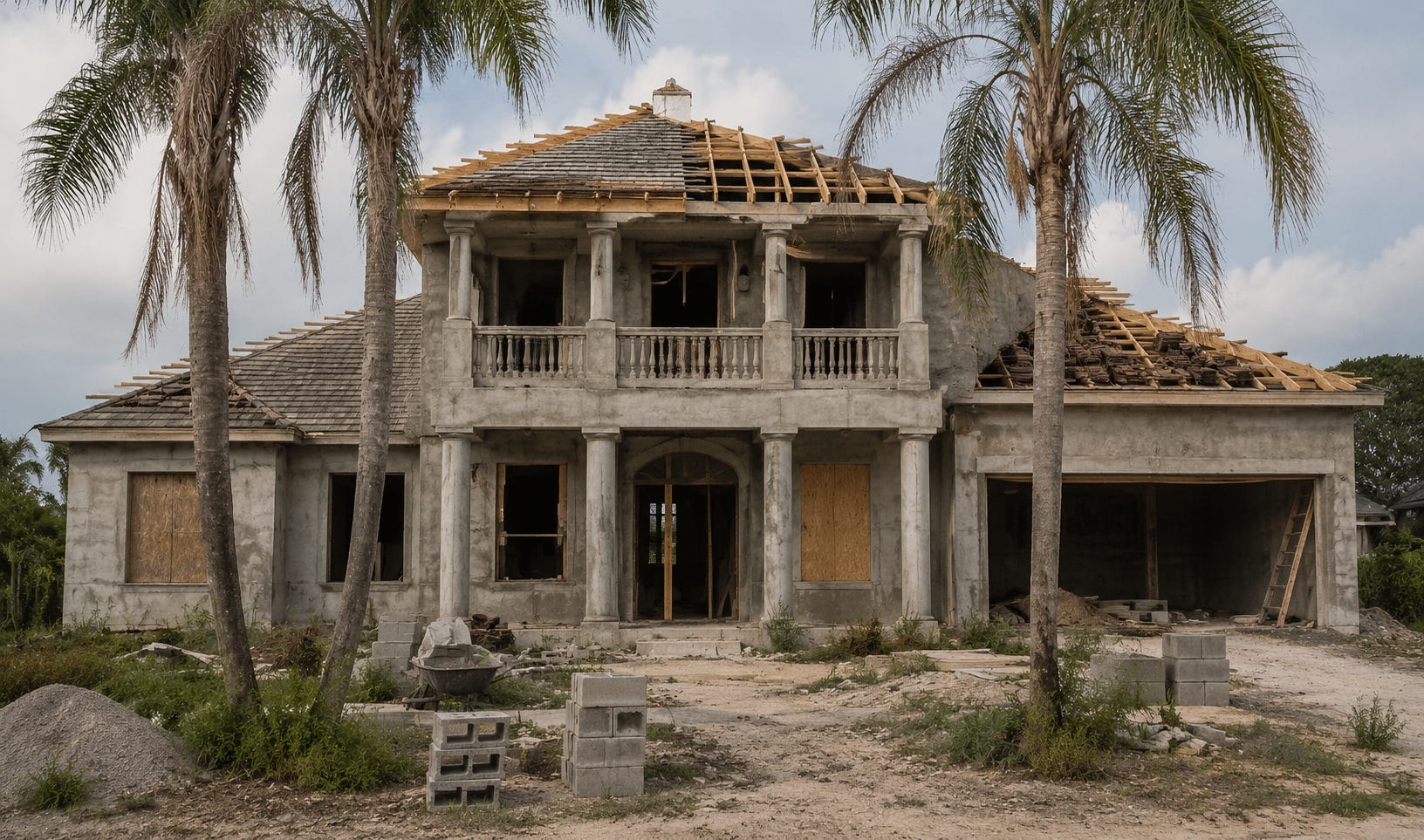
By the roadside in Jamaica, they stand almost unnoticed now.
Concrete walls waiting for rendering. Steel bars pointing into the sky like unanswered questions. Upstairs rooms never completed. Verandas frozen halfway between ambition and abandonment. Houses occupied for decades while somehow still unfinished.
To outsiders, they can appear neglected. To many Caribbean people, they are simply life in progress.
But something is changing.
The unfinished house across the Caribbean is no longer just a symbol of aspiration delayed. Increasingly, it is becoming a record of economic pressure, climate anxiety, family fracture, migration fatigue, and emotional exhaustion in a region that often rebuilds faster than it fully recovers.
In the months following Hurricane Melissa, conversations across parts of Jamaica shifted again toward roofs, insurance, foundations, family land, and the uncomfortable reality that many homes remain dangerously incomplete before the next storm season even arrives.
The wider global backdrop has only intensified those fears. War in the Middle East involving tensions between Iran, Israel, and the United States has contributed to uncertainty around oil prices, shipping costs, inflation, and construction materials. Across the Caribbean, where much of the building sector depends heavily on imported goods, every geopolitical tremor eventually appears in the price of cement, steel, lumber, roofing, fuel, insurance, and freight.
And so the houses wait.
Not abandoned entirely. Just paused.
A Region Built In Stages
In much of the Caribbean, homes are rarely built in one uninterrupted sweep. They evolve over time, often over generations.
A family buys land first. Then a foundation. Then a single room. Children arrive. A relative abroad sends money from London, Toronto, Miami, or Brooklyn. An upstairs floor is planned. The steel is left exposed “for later.”
Later sometimes never comes.
Across Jamaica, Trinidad and Tobago, Guyana, Haiti, and other Caribbean nations, the unfinished home has become part of the architectural language itself.
But behind many of those structures lies something more fragile than economics alone.
A marriage that collapsed halfway through construction.
A father who died before the roof was completed.
A migration dream that changed direction.
An inheritance dispute among siblings.
A family member abroad who stopped sending money.
A couple who separated before the upstairs was finished.
A son who never returned home.
A pension wiped out by inflation.
A mortgage impossible to maintain after illness.
A roof repaired after one hurricane while the rest of the structure quietly deteriorated.
Sometimes a home is not unfinished because people failed. Sometimes it is unfinished because life changed faster than the plans did.
The Emotional Weight Of Concrete
In Jamaica and elsewhere in the Caribbean, houses are rarely just financial assets. They are emotional structures. Cultural structures. Generational structures.
A house may represent migration sacrifice stretching back fifty years.
It may contain the memory of grandparents who sold livestock, worked overseas, or skipped comforts to buy land.
It may represent dignity after colonial poverty.
Or simply proof that somebody survived.
That emotional attachment can make unfinished homes psychologically heavy places to inhabit.
People continue living inside dreams that no longer match their financial reality.
The exposed steel becomes normal. The leaking roof becomes manageable. The unfinished tiles become “temporary” for ten years. Families adapt themselves emotionally to incompletion.
And yet the strain remains.
Mental health specialists across the region have increasingly linked financial instability, housing insecurity, and prolonged economic pressure to anxiety, depression, migration stress, and family conflict. In many households, unfinished housing quietly amplifies all four.
The Insurance Problem Nobody Wants To Face
One of the most dangerous aspects of unfinished or partially completed homes is that many are uninsured or severely underinsured.
Across parts of the Caribbean, insurance penetration remains relatively low, especially among lower and middle income households. Even where insurance exists, rising premiums, climate risks, and valuation gaps have left many homeowners exposed.
In Jamaica, industry discussions have repeatedly suggested that a significant percentage of homes may be underinsured relative to current rebuilding costs.
An unfinished structure creates additional complications:
incomplete electrical systems,
exposed roofing vulnerabilities,
unapproved modifications,
engineering concerns,
and uncertain replacement values.
After hurricanes or seismic activity, families can discover too late that reconstruction costs far exceed coverage.
And seismic risk is becoming part of the conversation again.
The Caribbean sits along multiple fault systems, including areas vulnerable to earthquakes and undersea seismic activity. Haiti’s devastating 2010 earthquake remains a haunting reminder of what poorly reinforced or incomplete structures can mean when disaster strikes.
In practical terms, unfinished homes are often more vulnerable not simply because they are incomplete, but because they may never have been fully engineered to withstand what the region increasingly faces.
Governments, Housing Gaps, And The Quiet Scale Of The Problem
Housing shortages and housing quality issues remain significant across the Caribbean.
Governments continue to announce new housing schemes, resilience programmes, planning reforms, and reconstruction initiatives. In Jamaica, recent years have seen increased discussion around affordable housing, urban redevelopment, disaster resilience, and social housing delivery.
But implementation remains difficult.
Construction inflation continues to outpace wages in many sectors. Land prices have risen sharply in urban areas. Mortgage access remains difficult for many informal or self employed workers. Infrastructure pressures continue. Insurance costs rise. Imported material costs fluctuate with every geopolitical shock.
And meanwhile, the unfinished homes remain visible everywhere.
Some analysts quietly estimate that across the Caribbean, hundreds of thousands of homes may exist in some state of prolonged incompletion, deterioration, informal expansion, or delayed reconstruction.
Not all are abandoned.
Many are fully lived in.
Which is perhaps what makes the phenomenon emotionally unsettling.
The Caribbean has normalised living inside incompletion.
The Numbers Beneath The Concrete
The scale of unfinished and inadequate housing across the Caribbean is difficult to measure precisely because so much of the region’s housing stock exists outside traditional definitions of completion. Yet regional development data increasingly suggests the problem may be far larger than governments openly discuss.
The Caribbean Development Bank and regional housing studies have repeatedly pointed to a widening housing deficit across Latin America and the Caribbean. One Caribbean Development Bank linked estimate suggested the wider region faces a housing deficit of between 42 million and 51 million housing units.
A major housing review found that roughly one in three households across Latin America and the Caribbean experiences some form of inadequate housing. Habitat for Humanity has estimated that approximately 45 percent of the population across the wider region lacks access to decent housing.
The 2024 Housing Yearbook for Latin America and the Caribbean estimated an average qualitative housing deficit of approximately 23.8 percent across surveyed countries, referring to homes that are deteriorated, overcrowded, incomplete, informal, or lacking proper services.
When applied to the Caribbean specifically, the implications become striking.
With a regional population estimated around 44 to 46 million people, the Caribbean may contain roughly 12 to 14 million households. If even 5 to 8 percent of those homes are visibly unfinished, paused, storm damaged, or structurally incomplete, the region could realistically contain between 600,000 and more than 1 million affected structures.
That estimate becomes even more plausible once hurricane damaged housing, informal settlements, and long term self build projects are included.
In Trinidad and Tobago, housing deficit estimates have reportedly affected roughly 26 percent of households. In Guyana, some studies placed the deficit closer to 34 percent, including tens of thousands of homes needing major repairs or improvement. In Suriname, estimates suggested approximately 38 percent of living quarters required significant repairs.
After Hurricane Maria, Dominica reportedly suffered damage to approximately 90 percent of buildings across the island.
The Caribbean’s housing crisis is not simply about homelessness. Increasingly, it is about incompletion.
“People Think It Is Poverty. Sometimes It Is Grief.”
“People see an unfinished house and immediately think failure,” said Dean Jones, founder of Jamaica Homes and Realtor Associate in Jamaica. “But sometimes what they are really looking at is grief. Somebody died halfway through building. Somebody migrated and never came back. Somebody’s marriage collapsed. Somebody lost their pension. Somebody stopped sending money home.”
Jones said the unfinished home has quietly become one of the Caribbean’s most misunderstood structures.
“The Caribbean has normalised living inside incompletion,” he said. “Bare block walls become normal. Steel bars become normal. Leaks become manageable. Families emotionally adapt themselves to unfinished environments because financially they often have no choice.”
He believes worsening climate pressure is now exposing the fragility underneath those compromises.
“One serious hurricane can turn a paused project into a permanent ruin,” Jones said. “And in many cases people are rebuilding uninsured, underinsured, or with money that was already stretched before the storm even arrived.”
A Permanent Reconstruction Economy
Some regional planners privately describe the Caribbean as existing in a permanent reconstruction cycle.
Before one economic shock fully settles, another arrives:
a hurricane,
an earthquake,
inflation,
migration,
a pandemic,
supply chain disruption,
or geopolitical conflict.
The recent instability involving Iran, Israel, and the United States has added renewed concern about global oil prices, shipping costs, and inflation. In import dependent Caribbean economies, global instability quickly affects the local cost of cement, steel, roofing, fuel, freight, insurance, and construction financing.
And the timing could hardly be worse.
In the aftermath of Hurricane Melissa, conversations across parts of Jamaica shifted again toward unfinished roofs, stalled repairs, rising insurance costs, and homes still vulnerable before the next storm season has even begun.
Across the Caribbean, thousands of homes effectively exist in varying stages of repair at almost all times.
The region is rebuilding continuously, but not always fully recovering.
The Caribbean’s Unfinished Inheritance
There is another layer to unfinished homes that statistics rarely capture.
Inheritance.
Across Jamaica and much of the Caribbean, family land arrangements remain deeply complicated. Properties are often passed informally across generations without updated titles, probate completion, or formal subdivision.
The result is a quiet landscape of stalled extensions, disputed ownership, abandoned family homes, and upstairs floors frozen halfway through construction.
“Some unfinished homes are not construction projects anymore,” Jones said. “They are unresolved family conversations sitting in concrete.”
In rural communities especially, it is common to find homes where one sibling migrated abroad, another stayed behind, one wants to sell, another refuses, and nobody can fully move forward.
The building itself becomes a physical archive of changing relationships, changing economies, and changing generations.
When Families Change Direction
Housing experts often discuss affordability. Engineers discuss resilience. Governments discuss supply.
But the emotional side of unfinished housing is discussed far less.
What happens when one spouse dies and the surviving partner no longer wants the dream they built together?
What happens when children inherit a half completed property they cannot afford to finish?
What happens when migration changes identity itself, and the “homecoming house” no longer feels necessary?
Across the region, there are properties quietly taken over by relatives after deaths, disputes, or migration. Some are maintained lovingly. Others become frozen landscapes of unresolved family emotion.
In rural districts especially, there are homes where:
one room remains occupied,
another remains locked,
another unfinished forever.
The building itself becomes a physical archive of changing relationships.
The Caribbean’s Permanent Reconstruction Cycle
The Caribbean increasingly lives in what some planners privately describe as a permanent reconstruction cycle.
Before one recovery finishes, another shock arrives:
a hurricane,
inflation spike,
migration wave,
pandemic,
supply chain crisis,
or geopolitical conflict.
And yet the region continues building.
Not because conditions are easy, but because building remains deeply connected to hope.
Unfinished houses across Jamaica and the Caribbean are not merely evidence of economic weakness. They are evidence of persistence under pressure.
But they are also warnings.
Warnings about climate vulnerability. About insurance fragility. About affordability gaps. About migration dependence. About ageing populations. About family fragmentation. About the emotional exhaustion of living permanently between completion and survival.
Along roadsides across the Caribbean, the concrete shells still rise toward the sky.
Some will one day become beautiful homes.
Some never will.
And somewhere inside many of them lives a story no property valuation could ever fully measure.