


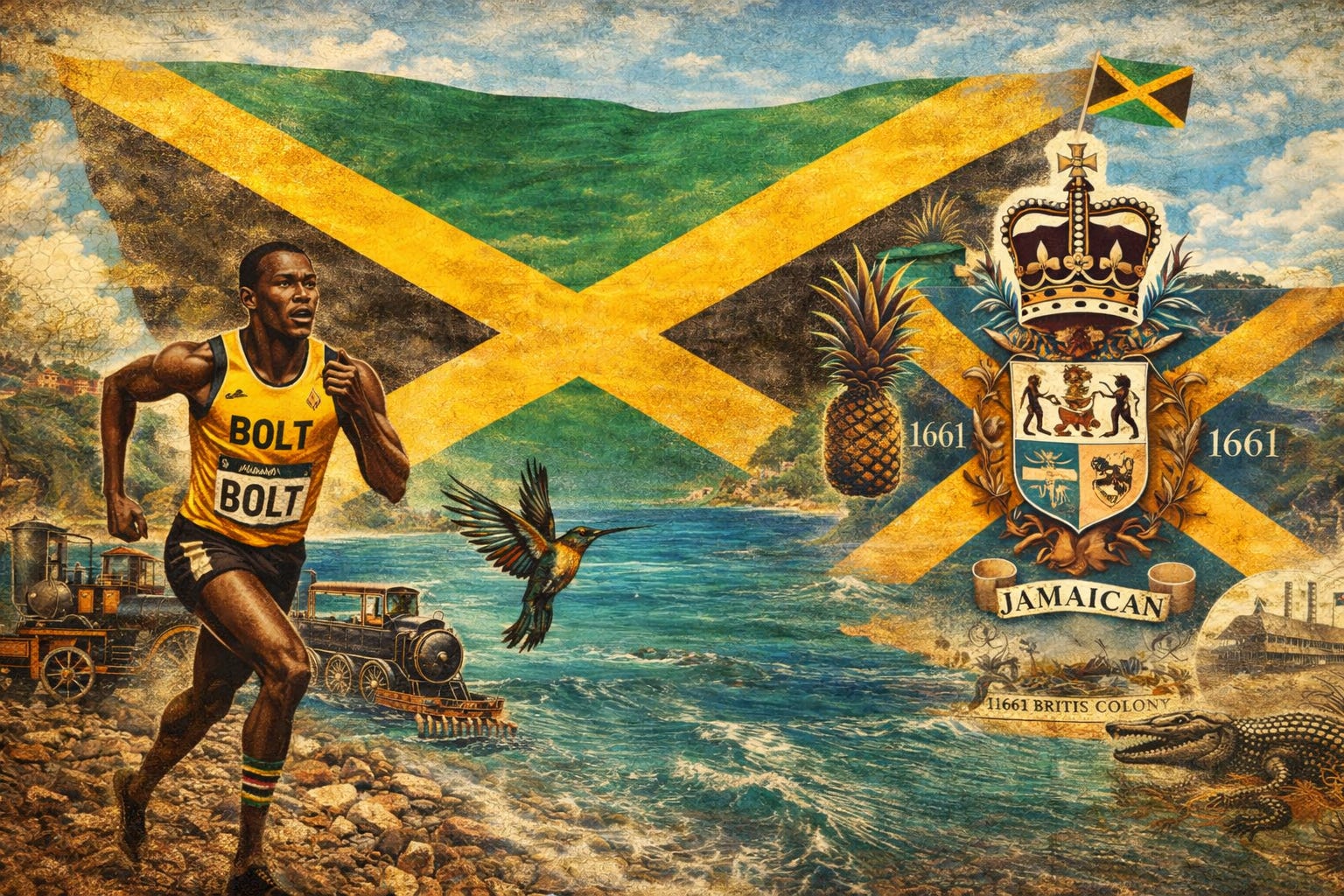
Some places tell their stories quietly. Others wear their history openly, etched into landscapes, towns, and traditions. Jamaica is one of those places where the past seems to linger everywhere—in the mountains that shelter ancient communities, in the ruins of plantation houses, in the rhythms of its music, and in the voices of its people.
To understand Jamaica is to understand that the island is not simply a point on a map in the Caribbean. It is a place layered with centuries of migration, struggle, invention, and cultural brilliance. Each era has left something behind—sometimes tangible, sometimes invisible—but always present in the character of the nation.
The story begins long before colonial powers arrived. It begins with the people who first stepped onto the island and called it home.
The First People of the Island
Long before European ships crossed the Atlantic, Jamaica—then known as Xaymaca, meaning “the land of wood and water”—was inhabited by Indigenous peoples who had travelled across the Caribbean Sea from South America and neighbouring islands.
Archaeological evidence suggests that the earliest settlers arrived in two waves. Around the 7th century, a culture now known as the Redware people settled on the island. Little is known about them today. Their legacy survives mainly through fragments of pottery—simple red clay vessels discovered by archaeologists—which hint at communities that lived quietly along Jamaica’s shores (Black & Britannica Editors, 2026).
Centuries later, another group arrived who would shape the island far more visibly: the Taíno, an Arawakan-speaking people whose society spread throughout much of the Caribbean.
The Taíno built villages across Jamaica, often located near rivers or fertile plains. Their settlements were organised under leaders known as caciques, who governed communities that combined agriculture, fishing, and trade.
Life for the Taíno revolved around the land. They cultivated crops such as cassava, maize, and sweet potatoes, using farming methods that worked with the natural environment rather than against it. Fishing supplied a significant portion of their diet, and their craftsmanship—from pottery to woven goods—reflected a culture deeply connected to its surroundings.
At its peak, the Taíno population on the island may have reached 60,000 people. Their villages were stable and productive, forming a society that had adapted comfortably to Jamaica’s climate and geography (Black & Britannica Editors, 2026).
But this relative balance would not last.
European Arrival and the Spanish Period
In 1494, during his second voyage to the Americas, Christopher Columbus reached Jamaica.
Like many explorers of the era, Columbus viewed the island not as a home already occupied by thriving communities, but as territory waiting to be claimed.
The Spanish crown quickly asserted ownership. Jamaica was granted to Columbus and his family, though the island initially remained something of a colonial backwater—valued mainly as a source of food and supplies for Spanish expeditions elsewhere in the Caribbean (Black & Britannica Editors, 2026).
The first permanent Spanish settlement appeared in 1509, when Juan de Esquivel established the town of Sevilla la Nueva on the north coast.
Later, the colonial capital was moved inland to Villa de la Vega, now known as Spanish Town.
Spanish rule transformed the island dramatically. The Taíno population declined rapidly under the combined pressures of forced labour, violence, and diseases introduced by Europeans.
Within little more than a century, the original inhabitants of Jamaica had been almost entirely wiped out.
At the same time, the Spanish began importing enslaved Africans to work on farms and settlements. Though the number of enslaved people during the Spanish period remained relatively small, their presence marked the beginning of a profound demographic shift that would reshape the island forever.
By the early 17th century, Jamaica’s population had shrunk to roughly 3,000 people, including Europeans, Africans, and a small number of surviving Indigenous inhabitants (Black & Britannica Editors, 2026).
Then, in the middle of the century, the island changed hands once again.
The British Capture of Jamaica
In 1655, an English expedition led by Admiral Sir William Penn and General Robert Venables captured Jamaica from Spain.
The Spanish were eventually expelled, though not before some of their enslaved Africans escaped into the mountains.
These escapees formed communities in the island’s rugged interior, becoming known as the Maroons.
The Maroons developed remarkable survival strategies. They cultivated crops such as plantains and yams, hunted wild animals, and learned to navigate the island’s dense forests and steep hillsides.
Over time, they built fortified settlements in remote areas that proved extremely difficult for colonial authorities to attack.
Their communities also preserved elements of African culture and traditions, blending them with influences from the few remaining Taíno inhabitants.
The Maroons would become a central part of Jamaica’s history, representing one of the earliest and most persistent forms of resistance to colonial rule (Black & Britannica Editors, 2026).
Pirates and the Rise of Port Royal
British Jamaica quickly developed a reputation that was both notorious and legendary.
The island’s new governors encouraged buccaneers—private sailors who attacked Spanish ships and settlements—to base themselves there.
This strategy served a political purpose. Buccaneers disrupted Spanish trade routes and weakened Spain’s control over the Caribbean.
At the centre of this activity stood Port Royal, a port city that soon became famous throughout the Atlantic world.
Port Royal was a place of immense wealth and equally immense lawlessness. Pirates, merchants, soldiers, and adventurers gathered there, turning the city into one of the busiest—and most dangerous—ports in the Caribbean.
Figures such as Henry Morgan, a Welsh privateer who raided Spanish cities, became household names.
But Port Royal’s golden age was short-lived.
In 1692, a devastating earthquake struck the city. Large sections of Port Royal collapsed into the sea, and thousands of people were killed.
The disaster was so dramatic that some contemporaries described it as divine punishment for the city’s excesses.
In the years that followed, many survivors relocated across the harbour to a new settlement: Kingston (Black & Britannica Editors, 2026).
The Plantation Economy
During the 18th century, Jamaica became one of the most profitable colonies in the British Empire.
The engine of this wealth was sugar.
Sugar plantations spread across the island, supported by a vast labour force of enslaved Africans transported through the transatlantic slave trade.
Life on these plantations was brutal. Enslaved workers faced long hours, harsh discipline, and dangerous conditions. Death rates were extremely high due to disease, malnutrition, and physical punishment.
Despite this, the enslaved population continued to grow through constant importation from Africa.
By the late 18th century, Jamaica’s enslaved population had reached approximately 300,000 people, vastly outnumbering the European colonists (Black & Britannica Editors, 2026).
At the same time, resistance to slavery was constant.
Maroons fought guerrilla wars against colonial forces in what became known as the Maroon Wars.
Elsewhere on the island, enslaved people organised rebellions in pursuit of freedom.
One of the most significant uprisings occurred in 1831–1832, when the Baptist preacher Samuel Sharpe led a massive revolt involving tens of thousands of enslaved people.
Although the rebellion was eventually suppressed, it shocked the British public and accelerated calls for the abolition of slavery.
Emancipation and the End of Slavery
In 1807, Britain abolished the transatlantic slave trade.
Three decades later, in 1838, slavery itself was abolished throughout the British Empire.
For Jamaica, emancipation marked a moment of enormous change.
Many formerly enslaved people left plantations and moved to the hills, establishing small farming communities where they could live more independently.
These settlements—often located in difficult terrain—remain part of Jamaica’s rural landscape today.
But freedom did not immediately bring prosperity.
Plantation owners struggled to adapt to a new labour system, and economic conditions across the island deteriorated.
Tensions erupted in 1865 with the Morant Bay Rebellion, led by Paul Bogle.
The uprising reflected widespread frustration among poor Jamaicans who felt excluded from political power and economic opportunity.
The British response was severe. Governor Edward John Eyre declared martial law and brutally suppressed the rebellion.
The aftermath led Britain to reorganise Jamaica as a Crown Colony, placing it under tighter direct control from London (Black & Britannica Editors, 2026).
Economic Change and Migration
By the late 19th century, Jamaica’s economy began to diversify.
Bananas emerged as a major export crop, thanks in part to the work of entrepreneurs such as Captain Lorenzo Dow Baker, who helped establish the banana trade between Jamaica and the United States.
Meanwhile, many Jamaicans sought work abroad.
Thousands migrated to help build the Panama Canal or to work on sugar plantations in Cuba.
Migration became a defining feature of Jamaican life, creating global connections that still shape the island today (Black & Britannica Editors, 2026).
Political Awakening and Labour Movements
During the early 20th century, political awareness grew rapidly among Jamaicans.
One of the most influential figures of this period was Marcus Garvey, who founded the Universal Negro Improvement Association (UNIA) in 1914.
Garvey promoted Black pride, economic independence, and unity among people of African descent across the world.
His ideas resonated deeply in Jamaica and throughout the African diaspora.
At the same time, economic hardship during the Great Depression of the 1930s sparked widespread protests and labour strikes across the island.
These events forced Britain to introduce constitutional reforms that expanded political representation.
Trade unions were formed, and political parties began to emerge.
Jamaica was gradually moving toward self-government (Black & Britannica Editors, 2026).
The Road to Independence
In 1944, a new constitution introduced universal adult suffrage and created an elected House of Representatives.
Two major political parties soon dominated Jamaican politics:
The People’s National Party (PNP), led by Norman Manley
The Jamaica Labour Party (JLP), led by Alexander Bustamante
During the 1950s, Jamaica gained increasing control over its internal affairs.
The island briefly joined the West Indies Federation in 1958, an attempt to unite several Caribbean territories under a single political structure.
However, the federation proved unpopular.
In 1961, Jamaicans voted in a referendum to withdraw.
One year later, Jamaica became an independent nation.
On 6 August 1962, the country celebrated its independence within the Commonwealth, with Alexander Bustamante becoming Jamaica’s first prime minister (Black & Britannica Editors, 2026).
Jamaica in the Modern Era
The decades following independence brought both opportunities and challenges.
Economic development focused on industries such as tourism, bauxite mining, and manufacturing.
Political leadership alternated between the two major parties.
In the 1970s, Michael Manley introduced ambitious social reforms aimed at expanding education, housing, and social equality.
His policies were popular among many Jamaicans but controversial internationally during the Cold War.
Later governments pursued economic restructuring and closer relationships with international financial institutions.
Despite economic challenges, Jamaica continued to strengthen its democratic institutions and cultural identity (Black & Britannica Editors, 2026).
The Global Power of Jamaican Culture
Perhaps Jamaica’s most remarkable global contribution has been cultural.
In the late 1960s, the island gave the world reggae music.
Emerging from earlier styles such as ska and rocksteady, reggae combined heavy bass rhythms with lyrics addressing social injustice and spiritual reflection.
Artists such as Bob Marley, Peter Tosh, and Jimmy Cliff transformed reggae into a worldwide movement.
The music became closely associated with the Rastafari movement, which emphasized African identity, social justice, and spiritual liberation (Cooper & Britannica Editors, 2026).
Today reggae’s influence can be heard in countless musical genres—from hip-hop to reggaeton.
A Nation Still Evolving
Jamaica’s story is still unfolding.
The island continues to navigate economic challenges, political change, and global pressures.
Yet its influence far exceeds its size.
Few places have shaped global culture, music, sport, and identity so profoundly.
From the resilience of the Maroons to the voice of reggae, Jamaica’s history is ultimately a story of people who refused to disappear, refused to be silenced, and instead created something extraordinary.