


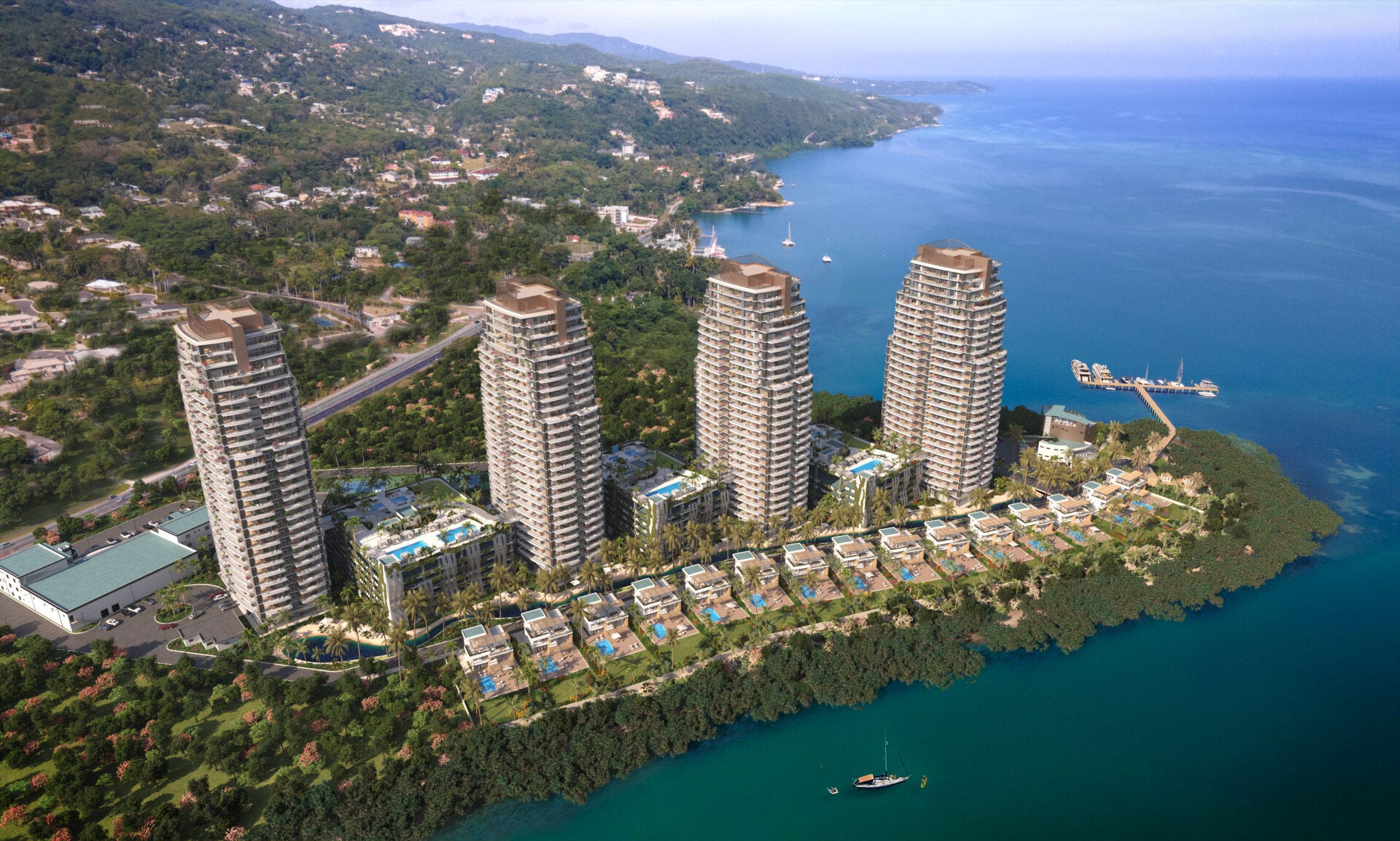
There is something mesmerising about this image. Four towers rise defiantly from the shoreline, their silhouettes a striking interplay of geometry and ambition. The Pinnacle Towers stand not as mere blocks of concrete, but as sculptural statements against the Caribbean sky. Each tower is softened by terraces that ripple upwards like waves frozen mid-motion, echoing the sea below and the mountains beyond. Here, architecture is no longer an afterthought – it is the landscape’s partner.
These are not ordinary buildings. They are declarations. Declarations of where Jamaica is heading, of how bold design can transform coastlines into living works of art. A development like this is not just about building upwards; it is about reimagining how people live with land, sea, and sky. Look closely and you see more than glass and steel – you see intent, vision, and a willingness to push beyond the familiar.
Stand-alone thought: The most daring architecture does not fight its surroundings; it dances with them.
From above, the symmetry is commanding. Four slender towers, aligned yet distinct, like sentinels overlooking the bay. Below, a series of low-slung villas with private pools stretch toward the water, blending intimacy with grandeur. The layering of scale – the soaring towers and the grounded villas – creates a rhythm. It speaks of contrast: vertical aspiration alongside horizontal calm. One for those who want the sky, the other for those who crave the horizon.
This is architecture as theatre. The stage is Jamaica’s coastline, the set a fusion of modern lines and tropical greenery. Each balcony, each pool deck, each shaded terrace – all designed to frame not just a view, but an experience. Here, the ocean is not a backdrop; it is a participant. The salt air, the shimmer of light on water, the sound of yachts drifting offshore – these become extensions of the home itself.
Stand-alone thought: True design is not measured in square footage, but in how it frames the human experience.
What we see is the courage to think differently. For generations, Caribbean architecture has often played safe – low-rise, predictable, restrained. This development dares otherwise. It asks: what if we reached higher? What if luxury wasn’t just imported, but crafted in dialogue with the island itself? This is not imitation; it is invention. Not another tower block, but a vertical village.
Future developers must take note. Boldness is not indulgence – it is necessity. If we are to redefine Caribbean living, it cannot be through timid repetition. It must be through statements like this: uncompromising, ambitious, unapologetically modern. But ambition alone is not enough; it must be tethered to authenticity. The sea breeze must still flow, the sunlight must still dance, the island’s character must still breathe through every concrete joint and pane of glass.
Stand-alone thought: A building without soul is just an object; a building with soul becomes a landmark.
Look again at the setting. The towers do not simply perch on the edge of the sea – they extend toward it, offering decks, pools, and even a pier that draws residents into the water’s embrace. This is not separation; this is connection. The boundary between land and ocean is softened, blurred, celebrated. It is an invitation to live not beside the sea, but with it.
The architectural language here is one of layers – vertical, horizontal, spatial. Balconies cascade like terraces on a hillside, while villas form a carpet at the shoreline. The repetition of form is not monotonous, but melodic. There is rhythm, harmony, and a certain quiet grandeur. It is as if the towers themselves know they are being watched, and they rise with grace, not arrogance.
Stand-alone thought: Great architecture is not about shouting the loudest, but about whispering with confidence.
For Jamaica, this is more than just another development. It is a marker of transformation – a glimpse of a nation willing to engage with global standards of luxury while carving its own identity. This project says: we are not behind, we are not catching up – we are defining. To place towers of this scale on a Caribbean coast is to accept responsibility. Responsibility to residents, to the environment, to the culture. And the success of such a project will not be measured only in sales or profits, but in how it shifts perception. How it makes Jamaicans believe in the possibility of their own landscapes being recast, reimagined, renewed.
Future developers, pay attention. Every building is a legacy. It either uplifts or diminishes. It either expands the horizon of what is possible or contracts it. The question to ask is not simply:
what can we build?
But: what should we build?
What will our children look at and feel proud of?
What will visitors see and know they are somewhere extraordinary?
Stand-alone thought: To build without vision is to waste concrete. To build with vision is to shape history.
This is not just real estate. It is a bold conversation with the future. It is the belief that Jamaica can be both rooted and elevated, both grounded in its culture and soaring in its ambition. And it is proof that when architecture is treated not as commodity but as art, it has the power to transform not just skylines, but mindsets.
Dean Jones
Founder, Jamaica Homes