


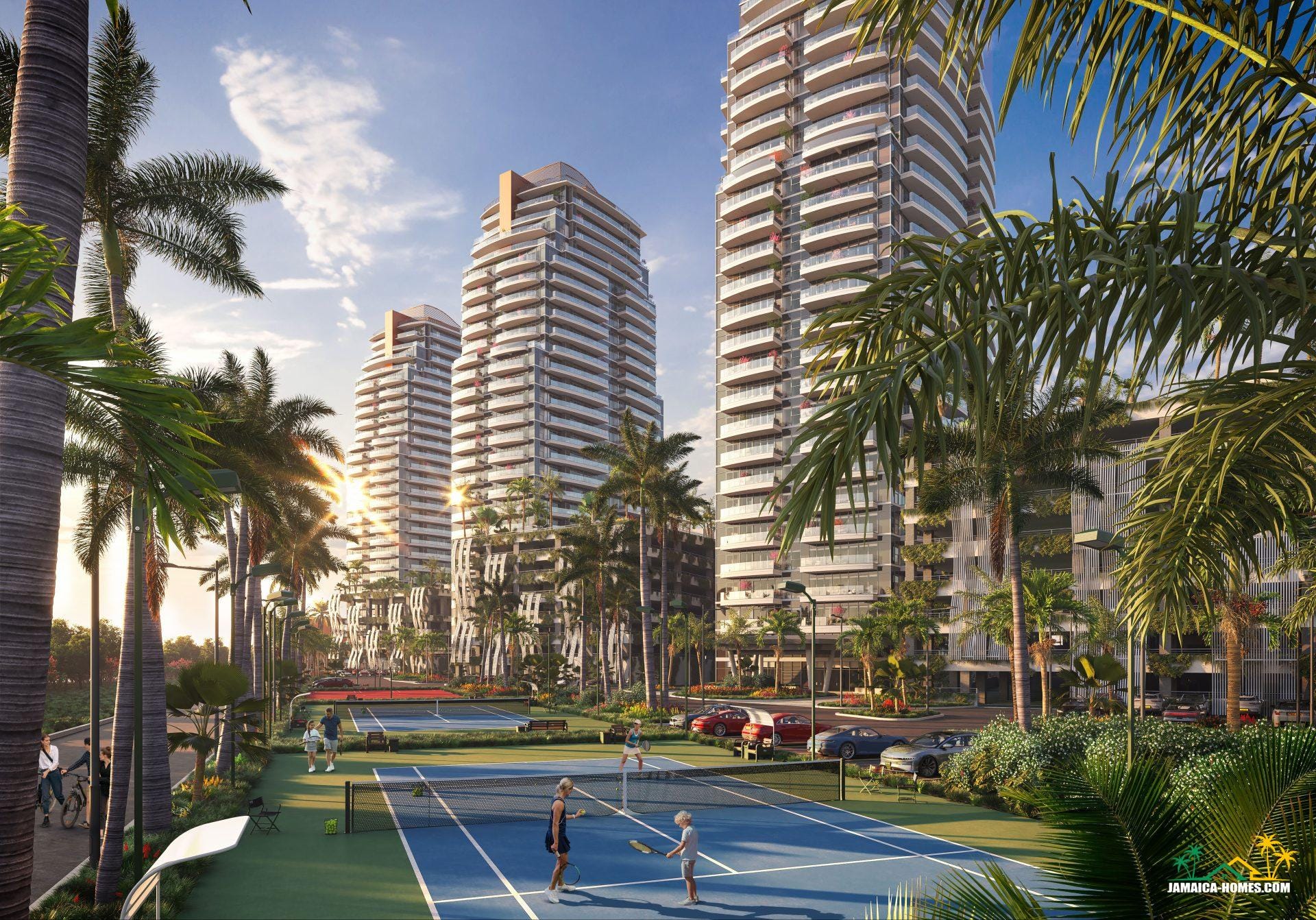
Architecture, at its boldest, is about vision. It’s about taking a piece of land and imagining a future upon it. And what we see here, in this render of The Pinnacle, is not just architecture. It is an urban dream, condensed into the tropics: towers rising like sculptural monoliths, palm-lined boulevards stretching out before them, and at ground level the unmistakable pulse of community life.
This is not the Jamaica of wooden verandas and painted shutters. This is Jamaica looking unapologetically forward, carving out a skyline that could sit confidently in Miami or Dubai, but which has rooted itself firmly in Montego Bay.
The render is a declaration: the Caribbean is ready for vertical luxury living.
Towers that Dance with Light
The first thing that strikes you is the trio of towers. They rise tall, unapologetic, each one clad in glass and steel, each one adorned with curved balconies that ripple upwards like waves frozen in time.
The architects have not gone for flat façades or rigid grids. Instead, they’ve sculpted the elevations so they shimmer in the sun. Notice the way the afternoon light catches the edges of the balconies, throwing shadows and reflections that animate the towers. These are not static blocks; they are kinetic sculptures, changing with the hours of the day.
At the crown of each tower, we see a flourish: subtle architectural caps, a kind of crown gesture. This isn’t cheap decoration. It’s a way of punctuating the skyline, giving each tower its own presence while still belonging to a family.
This is design as theatre. The towers don’t just occupy space; they perform in it.
A Masterplan for Living
One of the criticisms often levelled at tall residential buildings is that they isolate. They pull people up into the air, detaching them from the ground, from community, from the messy vitality of everyday life.
The Pinnacle has responded to this critique head-on.
At ground level, there is no anonymity. Instead, we see activity: tennis courts alive with games, pathways lined with palms, cyclists gliding past, residents strolling. The architecture here isn’t just vertical. It’s horizontal too. The towers are anchored into a landscape of activity, giving residents reasons to linger, to interact, to belong.
It’s not just about housing people. It’s about housing lifestyles.
And that’s crucial. Because luxury in the 21st century is not just about private indulgence. It’s about curated experiences. It’s about being able to step out of your apartment and immediately engage in leisure, wellness, and community.
Sport as Social Glue
The inclusion of tennis courts in the render is not incidental. It’s symbolic.
Tennis courts, pickleball courts, landscaped pathways—these are not just amenities. They are mechanisms for building community. They say: this is not a development where residents retreat into their penthouses. This is a place where people meet, play, talk, and share.
The Pinnacle is setting out to create not just apartments, but a village in the sky. And sport, with its blend of leisure and competition, is the perfect glue.
Notice how the courts are placed in the foreground, front and centre. The message is clear: at The Pinnacle, lifestyle is not an afterthought. It is the foundation.
The Power of Landscape
Look at the planting.
Palms stretch skyward, framing the view, softening the geometry of the towers. Lush greenery weaves between pathways and courts, punctuated with flowering shrubs. The design team clearly understands that in the tropics, landscape is as much architecture as concrete and glass.
Without the palms, these towers could feel alien, imported, disconnected from Jamaica. But with them, the towers are rooted. They belong.
Landscape is what humanises vertical architecture. And here, it is deployed with precision, transforming a high-rise development into a garden city.
International Language, Local Setting
It would be dishonest to pretend otherwise: these towers speak an international architectural language. They could exist in Miami, Panama City, or São Paulo. Their forms are global, not vernacular.
But that’s the point.
The Pinnacle is not trying to mimic traditional Jamaican cottages or colonial verandas. It is trying to position Montego Bay as part of the international stage, a city of ambition, a city of global luxury.
That is a bold move. Some will call it hubris—an imposition of foreign aesthetics on Caribbean soil. Others will call it visionary—a necessary step in placing Jamaica alongside the great lifestyle destinations of the world.
The truth is likely somewhere in between. The Pinnacle is internationalist in style but local in setting. It is not trying to erase Jamaican identity, but to elevate it into a new architectural vocabulary.
Engineering the Dream
Let’s not romanticise. Towers of this scale in the Caribbean come with immense challenges.
Wind and hurricanes: The Pinnacle must withstand storms that can twist steel and shatter glass. Every balcony curve, every panel of glazing must be engineered not just for beauty, but for resilience.
Maintenance: Salt air is a silent destroyer. Glass façades, metal fixings, even landscaping—everything will demand relentless upkeep.
Traffic and infrastructure: A development of this scale will inject hundreds, perhaps thousands, of new residents into Montego Bay. Roads, utilities, and services must rise to the occasion.
And yet, the render whispers confidence. The Pinnacle is not a timid project. It is a project that looks these challenges in the eye and says: we will not compromise on ambition.
Luxury as Vision
Ultimately, what The Pinnacle offers is not just housing, not just real estate. It offers a vision of how people could live in Jamaica.
In this render, luxury is not expressed in marble or chandeliers. It is expressed in:
Space: wide balconies, expansive courts, generous landscapes.
Light: floor-to-ceiling glazing, golden sunsets washing over façades.
Community: shared amenities that encourage life beyond the apartment.
Identity: a skyline that becomes an icon for Montego Bay’s future.
This is not about nostalgia. It is about aspiration.
Dean’s Grand Verdict
If I were to stand here, on the tennis court in this render, and look up at those towers, I would say this:
The Pinnacle is audacious. It risks everything—scale, ambition, aesthetic—to create something that has never before existed in Jamaica. It will divide opinion. Some will see it as visionary, others as alien.
But architecture that provokes is always better than architecture that disappears. And these towers will not disappear. They will define Montego Bay’s skyline for decades to come.
If the execution matches the render—if the towers truly shimmer in the Caribbean sun, if the courts truly hum with life, if the palms truly sway around laughing children and strolling couples—then The Pinnacle will not just be a development. It will be a landmark.
It will mark the moment Jamaica declared: We are part of the future of global luxury living.
For the full project details, see The Pinnacle Montego Bay.