

The Roof Is Still Missing
‘Lots of people still don’t have roofs’: Jamaicans living in hardship after Hurricane Melissa


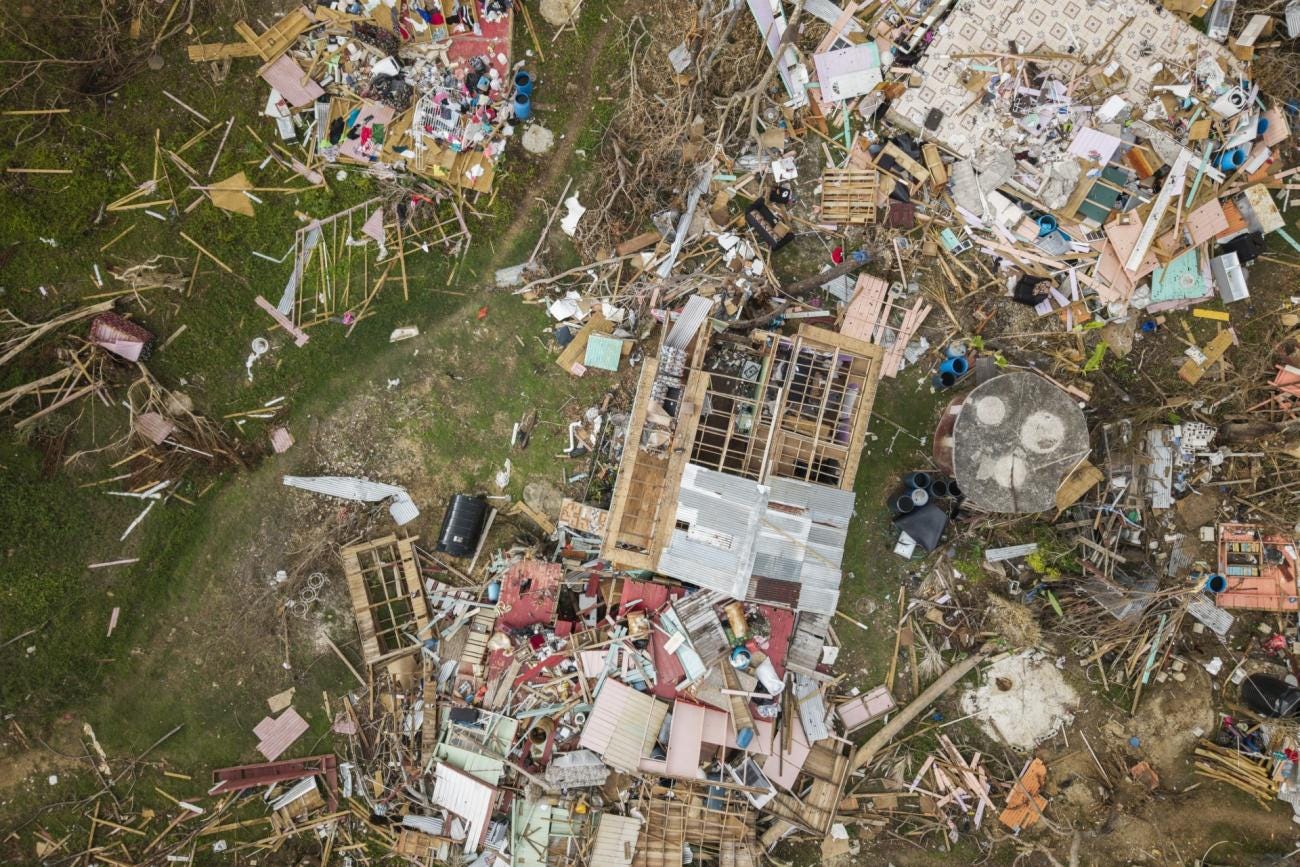
There is a particular kind of silence that follows a storm. Not the drama of landfall, not the urgency of emergency, but the quieter, slower reality of what remains undone. Months after Hurricane Melissa made its violent passage across Jamaica, that silence lingers, and it is not empty. It is filled with absence.
Absence of roofs.
Absence of power.
Absence of certainty.
The numbers, when placed side by side, tell a story that is difficult to ignore.
At its peak, the storm tore through the island with such force that more than 150,000 homes were damaged or destroyed, with approximately 120,000 roofs ripped away entirely . It was not just a weather event; it was a structural unravelling of domestic life across entire parishes.
Electricity, that invisible backbone of modern living, collapsed just as dramatically. At one point, more than 530,000 customers, the majority of the country, were without power . Restoration has been significant, even commendable in scale, yet incomplete. As recently as early 2026, nearly 17,000 customers were still without electricity, concentrated in the hardest-hit western parishes .
And then there is the figure that resists easy measurement.
How many are still without roofs?
There is no definitive number, and that, in itself, is telling. What is known is simpler, more direct, and more unsettling: “lots of people still don’t have roofs” .
Not a statistic. A condition.
To stand in a place like this, months after the storm, is to confront a difficult truth about recovery. It does not unfold evenly. It does not follow neat timelines. It does not distribute itself according to need alone.
It reveals, instead, the structure beneath the structure.
The Jamaican state has not been idle. Billions have been allocated. Programmes have been expanded. The Restoration of Owner-Occupants Family Shelters initiative, known simply as “Roofs”, has been tasked with rebuilding what was lost. Funds are flowing, at least in principle, and thousands of beneficiaries have been identified.
Yet the architecture of recovery is not judged by allocation. It is judged by arrival.
A roof is either there or it is not.
Electricity either flows or it does not.
Between allocation and arrival lies the space where frustration gathers.
Payments, by multiple accounts, have been slow to reach recipients. Assessments, in some areas, appear incomplete. There are calls, increasingly insistent, for reassessment, for verification, for a second look at who has been counted and who has not.
And in that gap, something more fragile begins to erode.
Trust.
It is here that the story turns from engineering to ethics.
Because disaster recovery is not only a logistical challenge; it is a moral one.
There are, inevitably, murmurs. Reports of individuals stepping forward for assistance they may not strictly need. This is not unique to Jamaica. It is, in many ways, a predictable human response in moments of scarcity. But predictability does not make it harmless.
In a system under strain, every misallocation carries weight.
Every dollar diverted delays a repair elsewhere.
Every false claim extends someone else’s exposure to the next rainfall.
The consequence is not abstract. It is lived.
And so the demand that emerges is not simply for more funding, or faster construction. It is for clarity.
Who has been assessed?
Who has been paid?
Who is still waiting?
And why?
There is, too, a broader ambition at play, one that stretches beyond this storm and into the uncertain future that follows.
Jamaica has spoken, with increasing urgency, about building differently. Stronger. More resilient. Better adapted to a climate that is no longer stable. National Reconstruction and Resilience Authority (NaRRA) and related frameworks speak to this intent: not merely to replace what was lost, but to improve upon it.
It is an admirable goal.
But ambition, like recovery, must eventually take physical form.
A hurricane-resistant roof is not an idea. It is timber, steel, labour, and time. It is also, crucially, delivery.
And for those still waiting, the distinction between ambition and reality is not philosophical. It is immediate.
There is a tendency, in the aftermath of large-scale events, to move on too quickly.
The headlines fade. The footage disappears. The world turns to its next crisis.
But recovery does not operate on the timeline of attention.
It operates on the timeline of need.
Nearly six months on, Jamaica finds itself in that second phase — the one that receives less visibility but demands more discipline. The phase where systems are tested not by urgency, but by endurance.
Can funds be tracked transparently?
Can processes be accelerated without being compromised?
Can oversight be strengthened without slowing delivery further?
These are not technical questions alone. They are questions of governance.
There is also, quietly, a lesson in scale.
The storm caused an estimated $8.8 billion in damage, the costliest disaster in the country’s history . Against that figure, even significant national spending begins to look small. International mechanisms, designed to support countries facing climate-driven disasters, have been criticised as insufficient, fragmented, or slow.
Which leaves, once again, the burden closer to home.
On institutions.
On communities.
On the invisible systems that must hold, even under pressure.
And so the image that remains is not one of destruction, but of incompletion.
A house without a roof is not a ruin. It is something paused. Something waiting to be finished.
Multiply that across thousands of homes, across entire districts, and the picture sharpens.
This is not just recovery delayed.
It is normal life deferred.
What, then, is required now?
Not more language about resilience. Jamaica has that in abundance.
Not more announcements of funding. Those, too, are already in motion.
What is required is something simpler, and far more demanding.
Visibility.
Clear, public accounting of progress, where the money has gone, where it is going, and where it has not yet reached.
Speed.
Not reckless acceleration, but the removal of unnecessary friction between decision and delivery.
Integrity.
A system that ensures help reaches those who need it most, and only those.
Because in the end, recovery is not measured in billions spent or programmes launched.
It is measured in something far more ordinary.
A light that turns on.
A roof that holds.
A night spent without fear of the next rainfall.
Until those are restored, fully and for everyone, the work is not finished.
And the silence after the storm will continue to speak.